February 15, 2026

Ice cream barge is the colloquial term for a BRL (Barge, Refrigerated, Large). BRLs were towed vessels employed by the United States Navy in the Pacific theater of World War II to store frozen and refrigerated foodstuffs. They were also able to produce ice cream in large quantities to be provisioned to sailors and US Marines. Three in total were produced: USS Hydrogen, USS Calcium, and USS Antimony.
The ships, concrete barges acquired from the US Army and worth one million dollars, stored 1,500 tons of frozen meat and 500 tons of refrigerated vegetables, eggs, and dairy products indefinitely at 15 °F. To improve the morale of overseas troops, an ice cream freezer facility was included, able to create 10 gallons of ice cream every seven minutes.
read more »
Posted in Food, War |
1 Comment »
December 23, 2025

Since 2018, the health effects of consuming certain processed vegetable oils, or seed oils have been subject to misinformation in popular and social media. The trend grew in 2020 after podcaster and comedian Joe Rogan interviewed fad diet proponent Paul Saladino about the carnivore diet. Saladino made several claims about the health effects of vegetable fats.
The theme of the misinformation is that seed oils are the root cause of most diseases of affluence, including heart disease, cancer, diabetes, and liver spots. These claims are not based on evidence, but have nevertheless become popular on the political right. Critics cite a specific ‘hateful eight’ oils that constitute seed oils: canola, corn, cottonseed, soy, sunflower, safflower, grapeseed, and rice bran.
read more »
Posted in Food, Health, Politics |
1 Comment »
July 15, 2025

Pasta with strawberries (makaron z truskawkami) is a dish from Polish cuisine. It is made by pouring a strawberry and cream sauce over cooked pasta. The dish may be eaten at lunch or as a dessert, and is often served in schools. In Polish culture, pasta with strawberries is often considered to be a nostalgic food associated with childhood. The dish became famous worldwide at Wimbledon 2025, when Polish tennis player, Iga Świątek, said that pasta with strawberries is one of her favorite meals.
The origins of pasta with strawberries are unknown, but strawberries are popularly eaten with similar dishes in Poland. In Polish cuisine, strawberries may be added to rice and soups or stuffed into pierogi. Pasta with strawberries is commonly eaten in summer, as strawberry season lasts from May until July. During this time, strawberries are ripe and inexpensive. Kashubian strawberries are considered to be especially desirable for this dish, since they are reputed to have a high quality taste and aroma.
read more »
Posted in Food, World |
Leave a Comment »
April 13, 2025
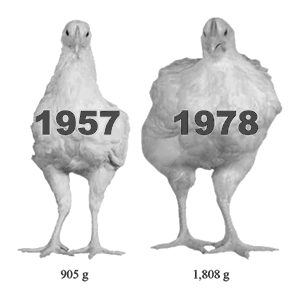
Woody breast is an abnormal muscle condition that impacts the texture and usability of chicken breast meat. The affected meat is described as tough, chewy, and gummy due to stiff or hardened muscle fibers that spread through the filet. The specific cause is not known but may be related to factors associated with rapid growth rates.
Companies often use a three-point scale to grade the woodiness of a particular breast. Although distasteful to many, meat that exhibits woody breast is not known to be harmful to humans who consume it. When detected by suppliers, product shown to have the condition present may be discounted or processed as ground chicken.
read more »
Posted in Food, Money |
Leave a Comment »
June 13, 2024

Dark cuisine (‘hei an liao li’) is a Chinese neologism referring to a culinary style built around foods or food combinations that sound bizarre or even disgusting but which often are tastier than anticipated.
The Chinese term hei an liao li dates from its use in ‘Chuuka Ichiban!’ (‘China’s Number One!’), a 1990s manga series by Etsushi Ogawa, that follow a young chef in 19th-century China as he fights the Dark Cooking Society. In China the term had been used starting in 2012 to discuss stargazy pie, a Cornish baked sardine dish that exemplified ‘all that the Chinese find baffling about Western cooking.’
read more »
Posted in Food, World |
Leave a Comment »
August 6, 2023

The Jewish-American patronage of Chinese restaurants became prominent in the 20th century, especially among Jewish New Yorkers. It has received attention as a paradoxical form of assimilation by embracing an unfamiliar cuisine that eased the consumption of non-kosher foods.
Factors include the relative absence of dairy products compared to European cuisines, concern over German and Italian antisemitic regimes in the 1930s and the proximity of Jewish and Chinese immigrants to each other in New York City.
read more »
Posted in Food, Philosophy, World |
Leave a Comment »
July 20, 2023

A spread is a prison meal made by inmates. Spreads are often made with commissary ingredients, such as instant ramen and corn puffs. Spreads can be simple meals, or elaborate and inventive combinations of ingredients.
Spreads may be used to supplement or replace the government-mandated meals provided to prisoners by the prison, due to the unpalatable and insubstantial nature of many prison meals.
read more »
Posted in Food, Politics |
Leave a Comment »
May 16, 2023

Kudzu [kuhd·zoo] (also called Japanese arrowroot or Chinese arrowroot) is a group of climbing, coiling, and trailing deciduous perennial vines native to much of East Asia, Southeast Asia, and some Pacific islands, but invasive in many parts of the world, primarily North America.
The vine densely climbs over other plants and trees and grows so rapidly that it smothers and kills them by blocking most of the sunlight and taking root space. The plants are in the genus Pueraria, in the pea family Fabaceae, subfamily Faboideae. Kudzu is edible, but often sprayed with herbicides.
read more »
Posted in Food, Science, World |
Leave a Comment »
April 27, 2023

System D is a manner of responding to challenges that require one to have the ability to think quickly, to adapt, and to improvise when getting a job done. The term gained wider popularity after appearing in the 2006 publication of Anthony Bourdain’s ‘The Nasty Bits.’ Bourdain references finding the term in Nicolas Freeling’s memoir, ‘The Kitchen,’ about Freeling’s years as a Grand Hotel cook in France.
The term is a direct translation of French Système D. The letter D refers to any one of the French nouns ‘débrouille,’ ‘débrouillardise,’ or ‘démerde’ (French slang). The verbs se débrouiller and se démerder mean ‘to make do,’ ‘to manage, ‘especially in an adverse situation. Basically, it refers to one’s ability and need to be resourceful.
read more »
Posted in Food, Language, World |
Leave a Comment »
June 21, 2022

A bodega [boh-dey-guh] cat is a type of working cat that inhabits a bodega, which in New York City English refers to a convenience store or deli. Much like farm cats, library cats, and ship cats, a bodega cat is typically a mixed breed cat kept as a form of biological pest control to manage or prevent rodent infestations.
A bodega cat may be a domesticated cat that is kept by the bodega owner, or a semi-feral cat that the bodega owner attracts to the store through regular feeding. Public health departments typically prohibit bodega cats under food codes that ban live animals from establishments where consumable goods are sold.
read more »
Posted in Food, Money |
1 Comment »
May 28, 2022
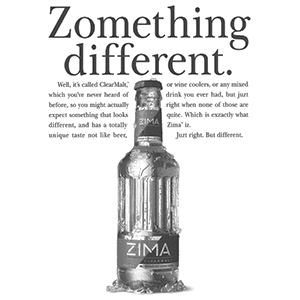
Zima Clearmalt was a clear, lightly carbonated alcoholic beverage made and distributed by the Coors Brewing Company. Introduced in 1993, it was marketed as an alternative to beer, an example of what is now often referred to as a cooler, with 4.7–5.4% alcohol by volume. Its production in the U.S. ceased in 2008, but it was still marketed in Japan until 2021. MillerCoors promoted a limited release of Zima in the summers of 2017 and 2018.
Zima means ‘winter’ in Slavic languages. It was launched nationally in the United States as Zima Clearmalt in 1993 after being test-marketed two years earlier in the cities of Nashville, Sacramento, and Syracuse. The lemon-lime drink was part of the ‘clear craze’ of the 1990s that produced products such as Crystal Pepsi and Tab Clear. Early advertisements for Zima described it as a ‘truly unique alcohol beverage’ and used the tagline ‘Zomething different.’
read more »
Posted in Food, Money |
Leave a Comment »
April 26, 2022

Ramen is a Japanese adaptation of Chinese wheat noodles. One theory says that ramen was introduced to Japan during the 1660s by the Chinese neo-Confucian scholar Zhu Shunsui who served as an advisor to Tokugawa Mitsukuni after he became a refugee in Japan to escape Manchu rule and Mitsukuni became the first Japanese person to eat ramen. Most historians reject this theory as a myth created by the Japanese to embellish the origins of ramen.
According to historians, the more plausible theory is that ramen was introduced to Japan in the late 19th or early 20th century by Chinese immigrants living in the Yokohama Chinatown. According to the record of the Yokohama Ramen Museum, ramen originated in China and made its way to Japan in 1859. Early versions were wheat noodles in broth topped with Chinese-style roast pork. There are many related, Chinese-influenced noodle dishes in Japan.
read more »
Posted in Food, World |
1 Comment »


 The Daily Omnivore