February 19, 2013

Jerky is lean meat that has been trimmed of fat, cut into strips, and then dried to prevent spoilage. Normally, this drying includes the addition of salt, to prevent bacteria from developing on the meat before sufficient moisture has been removed. The word ‘jerky’ is a corruption of the Spanish ‘charqui,’ which is from the Quechua word ‘ch’arki,’ which means to burn (meat). All that is needed to produce basic ‘jerky’ is a low-temperature drying method, and salt to inhibit bacterial growth.
Modern manufactured jerky is normally marinated in a seasoned spice rub or liquid, and dried, dehydrated or smoked with low heat. Some makers still use just salt and sun-dry fresh sliced meat to make jerky. Some product manufacturers finely grind meat, mix in seasonings, and press the meat-paste into flat shapes prior to drying. Jerky is ready-to-eat and needs no additional preparation. It can be stored for months without refrigeration. When the protein to moisture content ratio is correct, the resulting meat is cured, or preserved.
read more »
Posted in Food, World |
Leave a Comment »
February 13, 2013

A breastaurant is a restaurant that has sexual undertones, most commonly in the form of large-breasted, skimpily dressed waitresses and barmaids. The term dates from at least the early 1990s and has since been applied to other restaurants that offer similar services, such as Tilted Kilt (dubbed ‘Hooters goes to Scotland’), Mugs N Jugs, Twin Peaks, Bikinis Sports Bar and Grill, Heart Attack Grill, and the much older Hooters.
The restaurants often offer specific themes, both in decoration and menu, and the operators of the restaurants hope that customers will come just for the food, or that for the customer the sexual nature is secondary to the good food. The restaurants offer numerous perks for customers, including alcohol and flirty servers.
Posted in Food, Money, Sex |
Leave a Comment »
February 13, 2013
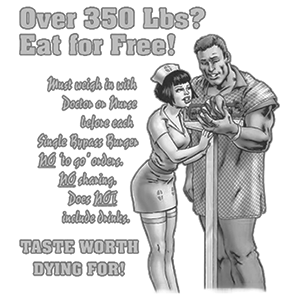
The Heart Attack Grill is an American hamburger restaurant in Las Vegas (formerly located in Chandler, Arizona). It has courted controversy by serving high-calorie menu items with deliberately provocative names coupled with waitresses in sexually provocative clothing. The establishment is a hospital theme restaurant: waitresses (‘nurses’) take orders (‘prescriptions’) from the customers (‘patients’).
A tag is wrapped on the patient’s wrist showing which foods they order and a ‘doctor’ examines the ‘patients’ with a stethoscope. The menu includes ‘Single,’ ‘Double,’ ‘Triple,’ and ‘Quadruple Bypass’ hamburgers, ranging from a half pound to two pounds of beef (up to about 8,000 calories), all-you-can-eat ‘Flatliner Fries’ (cooked in pure lard), beer and tequila (shots are served in four ounce novelty syringes.), ‘butter-fat Shakes,’ and soft drinks such as Jolt and Mexican-bottled Coca-Cola made with real sugar. Customers over 350 lb in weight eat for free if they weigh in with a doctor or nurse before each burger. Beverages and to-go orders are excluded and sharing food is also not allowed for the free food deal.
Posted in Food, Health, Humor |
1 Comment »
February 2, 2013
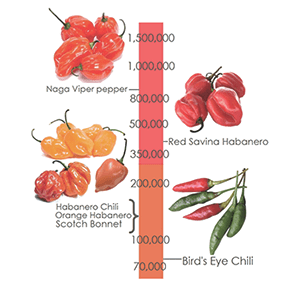
Capsaicin [kap-sey-uh-sin] is a chemical substance. It is responsible for the sense of hotness found in chile peppers. In mammals, it causes a sensation of burning of the tissues it comes in contact with. Capsicain, and other similar substances called capsaicinoids are produced by chile peppers and other plants, probably as deterrents against certain herbivores and fungi. Pure capsaicin is a hydrophobic, colorless, odorless, crystalline to waxy compound.
Capsaicinoids are added to food to make it have a hot taste, but it can also be used as an analgesic (painkiller). Such painkillers are often directly used on the skin. The burning of the capsaicin masks the real pain. Capsicaicin is also the main agent in pepper spray. Capsicain is not soluble in water; it binds to oil and fat. Soap can be used to wash it off. In 2006, it was discovered that the venom of a certain tarantula species activates the same pathway of pain as is activated by capsaicin, the first demonstrated case of such a shared pathway in both plant and animal anti-mammal defense.
read more »
Posted in Drugs, Food |
Leave a Comment »
January 22, 2013
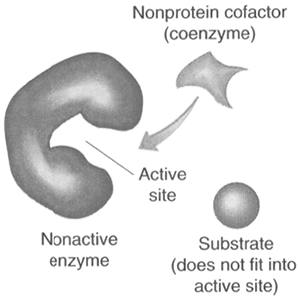
Coenzyme Q10 is an oil-soluble, vitamin-like substance present in most eukaryotic cells, primarily in the mitochondria. Enzymes are protein molecules which work as catalysts (accelerating chemical reactions); coenzymes are are non-protein compounds bound to an enzyme.
They are sometimes referred to as ‘helper molecules.’ CoQ10 aids in cellular respiration (the conversion of sugar into usable energy). It is a component of the electron transport chain and participates in aerobic respiration, generating energy in the form of ATP. Ninety-five percent of the human body’s energy is generated this way. Therefore, those organs with the highest energy requirements—such as the heart, liver and kidney—have the highest CoQ10 concentrations.
read more »
Posted in Drugs, Food, Health |
Leave a Comment »
January 22, 2013

An antioxidant [an-tee-ok-si-duhnt] is a molecule that can slow or stop the oxidation, or loss of electrons, of other molecules. Oxidation reactions are necessary for many bodily functions but can produce free radicals (molecules with an unpaired electron). In turn, these radicals can start chain reactions. When the chain reaction occurs in a cell, it can cause damage or death to the cell. Antioxidants terminate these chain reactions by removing free radical intermediates. They do this by being oxidized themselves (donating an electron to the free radical).
Vitamins and enzymes can have antioxidant properties that neutralize the damaging effects of free radicals. Although oxidation reactions are crucial for life, they can also be damaging; plants and animals maintain complex systems of multiple types of antioxidants. Insufficient levels of antioxidants, or inhibition of the antioxidant enzymes, cause oxidative stress and may damage or kill cells. As oxidative stress appears to be an important part of many human diseases, the use of antioxidants in pharmacology is intensively studied, particularly as treatments for stroke and neurodegenerative diseases. Moreover, oxidative stress is both the cause and the consequence of disease.
read more »
Posted in Food, Health, Science |
Leave a Comment »
January 7, 2013

San Francisco burrito is an Urban Food Log that first became popular during the 1960s in the Mission District of San Francisco. Author Gustavo Arellano classifies the Mission-style burrito as one of three major styles of burritos in the United States, following the earlier, simple burrito consisting of beans, rice, and meat and preceding the California burrito containing cheese and potatoes that was developed in the 1980s.
Originally a Mexican-American food, the San Francisco burrito is distinguished from a regular burrito partly by the amount of rice and other side dishes included in the package, and also by its sheer size. Many taquerias in the Mission and in the greater San Francisco Bay Area specialize in San Francisco burritos. It is typically served in a piece of aluminum foil around a large flour tortilla which is wrapped and folded around a variety of ingredients.
read more »
Posted in Food, World |
Leave a Comment »
January 6, 2013
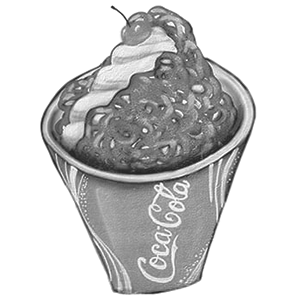
Fried Coke is frozen Coca-Cola-flavored batter that is deep-fried and then topped with Coca-Cola syrup, whipped cream, cinnamon sugar, and a cherry. It was introduced by inventor Abel Gonzales, Jr., a 36-year-old computer analyst from Texas, at the 2006 State Fair of Texas. The concoction won the title of ‘Most Creative’ in the second annual judged competition among food vendors.
It proved very popular in Texas, selling 10,000 cups in the first two weeks. It quickly spread to other states, appearing in at least 47 state fairs in 2007. In 2009, Fried Coke was featured on the Travel Channel’s ‘Bizarre Foods with Andrew Zimmern.’ Fried Coke is estimated to have 830 Calories per cup. Since its introduction in 2006, several variations have appeared, using different types of soda and different toppings.
Posted in Food |
Leave a Comment »
January 3, 2013
Espresso [e-spres-oh] is a type of Italian coffee that is concentrated. It is brewed by forcing a small amount of nearly boiling water under pressure through finely ground coffee beans.
Espresso often has a thicker consistency than coffee brewed by other methods, a higher concentration of suspended and dissolved solids, and crema (meaning cream, but being a reference to the foam with a creamy texture that forms as a result of the pressure). Because espresso is so strong, it is usually mixed with with milk (steamed, wet foamed, or dry foamed) or hot water (e.g. latte, cappuccino, macchiato, mocha, or americano).
read more »
Posted in Food, World |
Leave a Comment »
January 3, 2013
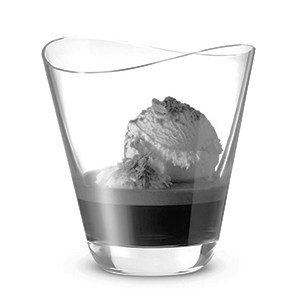
An affogato [ahf-foh-gah-toe] (Italian, ‘drowned’) is a coffee-based beverage.
It usually takes the form of a scoop of vanilla gelato or ice cream topped with a shot of hot espresso. Some variations also include a shot of Amaretto or other liqueur.
Posted in Food |
Leave a Comment »
January 2, 2013
Conjugated [kon-juh-gey-tid] linoleic [li-noh-lee-ik] acids (CLA) are a family acids found mostly in the meat and dairy products derived from ruminants. CLAs can be either cis- or trans-fats.
In 1979, researchers from the University of Wisconsin applied a beef extract to mice skin. The mice were then exposed to a strong carcinogen. When the researchers counted the number of tumors developed by the mice 16 weeks later, they found to their surprise that the mice exposed to the beef extract had 20% fewer tumors. The identity of this anticarcinogen was not discovered until almost a decade later, in 1987.
read more »
Posted in Drugs, Food, Health |
Leave a Comment »
January 1, 2013

A transglutaminase is an enzyme first described in 1959 which creates extensively cross-linked, generally insoluble protein polymers (indispensable for organisms to create barriers and stable structures). Examples are blood clots as well as skin and hair. In commercial food processing, transglutaminase is used to bond proteins together. Examples of foods made using the enzyme include imitation crabmeat, and fish balls. It is produced by bacterial fermentation in commercial quantities or extracted from animal blood, and is used in a variety of processes, including the production of processed meat and fish products.
Transglutaminase can be used as a binding agent to improve the texture of protein-rich foods such as surimi (fish paste) or ham. Transglutaminase is also used in molecular gastronomy to meld new textures with existing tastes. Besides these mainstream uses, transglutaminase has been used to create some unusual foods. British chef Heston Blumenthal is credited with the introduction of transglutaminase into modern cooking. Wylie Dufresne, chef of New York’s avant-garde restaurant wd~50, was introduced to transglutaminase by Blumenthal, and invented a ‘pasta’ made from over 95% shrimp thanks to transglutaminase.
Posted in Food, Science |
Leave a Comment »


 The Daily Omnivore