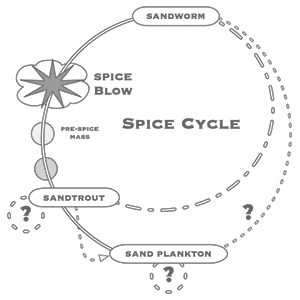
Melange [mey-lahnj] from French ‘mélange’ (‘set of diverse elements’) – also called the ‘spice’ – is the name of the fictional drug central to the ‘Dune’ series of science fiction novels by Frank Herbert, and derivative works.
In the series, the most essential and valuable commodity in the universe is melange, a geriatric drug that gives the user a longer life span, greater vitality, and heightened awareness; it can also unlock prescience (foreknowledge of events) in some humans, depending upon the dosage and the consumer’s physiology. This prescience-enhancing property makes safe and accurate interstellar travel possible. Melange comes with a steep price, however: it is addictive, and withdrawal is fatal.
read more »
October 22, 2012
Melange
October 22, 2012
Spice
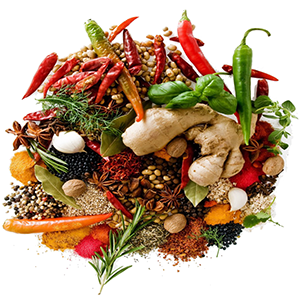
A spice is a dried seed, fruit, root, bark, or vegetative substance primarily used for flavoring coloring or preserving food. Sometimes a spice is used to hide other flavors. Spices are distinguished from herbs, which are parts of leafy green plants also used for flavoring or as garnish.
Many spices have antimicrobial properties. This may explain why spices are more commonly used in warmer climates, which have more infectious disease, and why use of spices is especially prominent in meat, which is particularly susceptible to spoiling. A spice may have an extra use, usually medicinal, religious ritual, cosmetics or perfume production, or as a vegetable. For example, turmeric roots are consumed as a vegetable and garlic as an antibiotic.
read more »
October 20, 2012
Food Microbiology
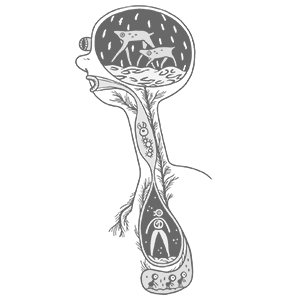
Food microbiology is the study of the microorganisms that inhabit, create, or contaminate food. Including the study of microorganisms causing food spoilage. ‘Good’ bacteria, however, such as probiotics, are becoming increasingly important in food science. In addition, microorganisms are essential for the production of foods such as cheese, yogurt, other fermented foods, bread, beer and wine. Food safety is a major focus of food microbiology. Pathogenic bacteria, viruses, and toxins produced by microorganisms are all possible contaminants of food.
However, microorganisms and their products can also be used to combat these pathogenic microbes. Probiotic bacteria, including those that produce bacteriocins (toxins created by bacteria to kill rival bacteria), can inhibit pathogens. Alternatively, purified bacteriocins such as nisin can be added directly to food products. Finally, bacteriophages, viruses that only infect bacteria, can be used to kill bacterial pathogens. Thorough preparation of food, including proper cooking, eliminates most bacteria and viruses. However, toxins produced by contaminants may not be heat-labile, and some are not eliminated by cooking
read more »
October 19, 2012
Century Egg
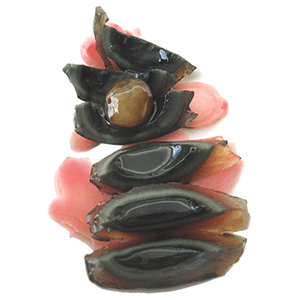
Century egg (‘pidan,’ also known as preserved egg and millennium egg) is a Chinese cuisine ingredient made by preserving fowl eggs in a mixture of clay, ash, salt, quicklime (calcium oxide), and rice hulls for several weeks to several months, depending on the method of processing. Through the process, the yolk becomes a dark green to gray color with a creamy consistency and an odor of sulfur and ammonia, while the white becomes a dark brown, translucent jelly with little flavor.
The transforming agent in the century egg is its alkaline material, which gradually raises the pH of the egg to around 9, 12, or more during the curing process. This chemical process breaks down some of the complex, flavorless proteins and fats, which produces a variety of smaller flavorful compounds. Some eggs have fungal patterns near the surface of the egg white that are likened to pine branches, and that gives rise to one of its Chinese names, the ‘pine-patterned egg.’
read more »
October 19, 2012
Pickling
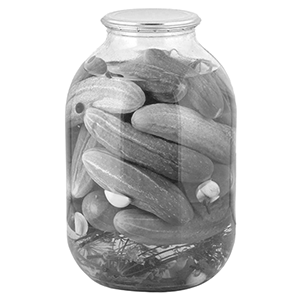
Pickling, also known as ‘brining’ or ‘corning,’ is the process of preserving food with acid. Pickling began 4000 years ago using cucumbers native to India. It is called ‘achar’ in northern India. This was used as a way to preserve food for out-of-season use and for long journeys, especially by sea. Salt pork and salt beef were common staples for sailors before the days of steam engines. Although the process was invented to preserve foods, pickles are also made and eaten because people enjoy the resulting flavors.
Pickling may also improve the nutritional value of food by introducing B vitamins produced by bacteria (when pickled in a process utilizing fermentation). The term ‘pickle’ is derived from the Dutch word ‘pekel,’ meaning ‘brine’ (salt water). In the U.S. Canada, and Australia the word ‘pickle’ alone almost always refers to a pickled cucumber (other types of pickles will be described as ‘pickled onion,’ ‘pickled cauliflower,’ etc.), except when it is used figuratively. In the UK, ‘pickle’ refers to Ploughman’s pickle, a kind of chutney; a pickled cucumber is referred to as a ‘gherkin.’
read more »
October 19, 2012
Fermentation

Fermentation [fur-men-tey-shuhn] is when a living cell uses sugar for energy without requiring oxygen. Yeast is an organism that ferments. When yeast ferments sugar, the yeast eats sugar and makes alcohol. Other organisms (such as bacteria) make vinegar (acetic acid) or lactic acid when they ferment sugar. Fermentation is used to make beer, some types of fuel, and to make bread rise. When yeast ferments, it breaks down the glucose into ethanol and carbon dioxide.
Ethanol fermentation always produces ethanol and carbon dioxide. It is important in bread-making, brewing, and winemaking. Lactic acid fermentation produces lactic acid. It happens in muscles of animals when they need lots of energy fast, and is also used to preserve foods in pickling. The word ‘fermentation’ is derived from the Latin verb ‘fervere,’ which means ‘to boil’ (same root as ‘effervescence’). It is thought to have been first used in the late fourteenth century in alchemy, but only in a broad sense. It was not used in the modern scientific sense until around 1600.
read more »
October 10, 2012
Mustard

Mustard is a condiment made from the seeds of a mustard plant (white or yellow mustard, brown or Indian mustard, or black mustard). The whole, ground, cracked, or bruised mustard seeds are mixed with water, salt, lemon juice, or other liquids, and sometimes other flavorings and spices, to create a paste or sauce ranging in color from bright yellow to dark brown. English mustard is among the strongest, made from only mustard flour, water, salt and, sometimes, lemon juice; but not with vinegar.
French-style Dijon mustard has added vinegar, and is milder. Bavarian sweet mustard is milder still. Homemade mustards are often far hotter and more intensely flavored than commercial preparations. A strong mustard can cause the eyes to water, sting the palate, and inflame the nasal passages and throat. Mustard can also cause allergic reactions. As a cream or a seed, mustard is used in the cuisine of India, the Mediterranean, northern Europe, the Balkan States, Asia, North America, and Africa, making it one of the most popular and widely used spices and condiments in the world.
read more »
October 2, 2012
Old Bay Seasoning
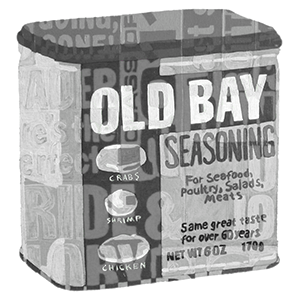
Old Bay Seasoning is a blend of herbs and spices that is currently marketed in the United States by McCormick & Company, and produced in Maryland.
It is produced in the Chesapeake Bay area where it was developed by German immigrant Gustav Brunn in the 1940s, and where the seasoning is very popular to this day. At that time, crabs were so plentiful that bars in Baltimore offered them free and seasonings like Old Bay were created to encourage patrons to purchase more beverages.
read more »
September 16, 2012
Have one’s cake and eat it too

To have one’s cake and eat it too is a popular English idiomatic proverb or figure of speech most often used negatively, to connote the idea of consuming a thing whilst managing to preserve it. This may also indicate having or wanting more than one can handle or deserve, or trying to have two incompatible things. The proverb’s meaning is similar to the phrases, ‘you can’t have it both ways’ and ‘you can’t have the best of both worlds.’
Conversely, in the positive sense, it would refer to ‘having it both ways’ or ‘having the best of both worlds.’ This concept, known as opportunity cost, is one of the most important economic concepts. The phrase’s earliest recording is from 1546 as ‘wolde you bothe eate your cake, and have your cake?’ (John Heywood’s ‘A dialogue Conteinyng the Nomber in Effect of All the Prouerbes in the Englishe Tongue’). This phrase alludes to the impossibility of eating your cake and still having it afterwards.
read more »
September 14, 2012
Mike the Headless Chicken

Mike the Headless Chicken also known as Miracle Mike, was a Wyandotte chicken that lived for 18 months after his head had been mostly cut off. Thought by many to be a hoax, the bird’s owner took him to the University of Utah in Salt Lake City to establish the facts of the story.
In 1945, farmer Lloyd Olsen of Fruita, Colorado had his mother-in-law around for supper and was sent out to the yard by his wife to bring back a chicken. Olsen chose a five-and-a-half-month-old cockerel named Mike. The axe missed the jugular vein, leaving one ear and most of the brain stem intact. Despite Olsen’s botched handiwork, Mike was still able to balance on a perch and walk clumsily; he even attempted to preen and crow, although he could do neither.
read more »
September 11, 2012
Pain in Crustaceans

The question of whether or not crustaceans can experience pain is unresolved. Because of the ambiguous nature of pain, most people who contend that crustaceans do have this capacity approach the issue using ‘argument by analogy’ – that is, they hold that certain similarities between crustacean and human biology or behaviour warrant an assumption that crustaceans can feel pain.
In vertebrates, endogenous opioids are neurochemicals that moderate pain by interacting with opioid receptors. Opioid peptides (chains of amino acids) and opioid receptors occur naturally in crustaceans, and although ‘at present no certain conclusion can be drawn,’ some have interpreted their presence as an indication that crustaceans may be able to experience pain. Lobsters’ opioids may ‘mediate pain in the same way’ as in vertebrates.
read more »
September 10, 2012
Kale Chips
Kale is a form of cabbage, green or purple, in which the central leaves do not form a head. It is considered to be closer to wild cabbage than most domesticated forms. It is in the same family as broccoli, cauliflower, collard greens, and brussels sprouts..When baked or dehydrated, Kale takes on a consistency similar to that of a potato chip, and is a much healthier alternative to regular potato chips. The chips can be seasoned with salt or other spices.
Kale is very high in beta carotene, vitamin K, vitamin C, lutein, zeaxanthin, and reasonably rich in calcium. Kale, as with broccoli and other brassicas, contains sulforaphane (particularly when chopped or minced), a chemical with potent anti-cancer properties. Boiling decreases the level of sulforaphane; however, steaming, microwaving, or stir frying do not result in significant loss.


 The Daily Omnivore