January 11, 2011

Coconut water is the clear liquid inside young coconuts. As the fruit matures, the coconut water gradually is replaced by the coconut meat and air. A very young coconut has very little meat, and the meat is very tender, almost a gel. Coconut water has long been a popular drink in the tropics, especially in Southeast Asia, the Pacific Islands, such as Hawaii, and the Caribbean, where it is available fresh, canned or bottled. It is naturally fat-free and low calorie.
read more »
Posted in Food, Health, World |
Leave a Comment »
January 10, 2011

The peanut butter and jelly sandwich (PB&J) is a sandwich, popular in North America, that includes a layer of peanut butter and either jam or jelly on bread. It has numerous common additions including honey, chocolate or maple syrup, Nutella, bananas, apples, strawberries, butter, marshmallow fluff, potato chips, cheese, raisins and other dried fruit, and last but not least, bacon.
Both peanut butter and jelly were on the U.S. Military ration menus in World War II. It is said that the American soldiers added jelly to their peanut butter to make it more palatable. Peanut butter provided an inexpensive and high protein alternative to meat for soldiers. It was an instant hit and returning servicemen made peanut butter and jelly sales soar in the United States. Food historians haven’t found any ads or other mentions of peanut butter and jelly sandwiches before the 1940s.
Posted in Food |
Leave a Comment »
January 10, 2011

Infrared grills work by igniting propane or natural gas to superheat a ceramic tile, causing it to emit infrared radiation. The thermal radiation is generated when heat from the movement of charged particles within atoms is converted to electromagnetic radiation in the infrared heat frequency range.
IR offers heat that is uniformly distributed across the cooking surface and temperatures reach over 900 °F. This technology was previously patented, but the patents expired in 2000 and more companies have started offering infrared grills at lower prices.
Posted in Food, Technology |
Leave a Comment »
January 3, 2011

A Nice Cup of Tea is an essay by George Orwell, first published in the Evening Standard newspaper in 1946. It is a straight-faced discussion about the craft of making a cup of tea, including his eleven ‘Golden’ rules. Orwell’s rules cover such matters as the best shape for a teacup, the advisability of using water that is still boiling, and his preference for very strong tea.
Posted in Food, Humor, Language |
Leave a Comment »
January 1, 2011

Free Beer, formerly known as ‘Our Beer,’ is the first brand of Danish beer with a ‘free’ recipe – free as in ‘freedom,’ taken after the term ‘free software.’ The name ‘Free Bee’ is a play on Richard Stallman’s common explanation that free software is ‘free as in speech, not free as in beer.’ The recipe is published under a Creative Commons license, specifically the Attribution-ShareAlike license. The beer was created by students at the IT-University in Copenhagen together with Superflex, a Copenhagen-based artist collective, to illustrate how concepts of the free software movement might be applied outside the digital world.
Initially, much of the homebrewing community spoke out against the quality and comprehensiveness of the recipe. Making reference to the technical problems of when software instructions (‘source code’) cannot be made into a functioning program, several people commented that if the recipe were source code, it would not compile (a compiler is a program that takes ‘source code’ from a high-level language and changes it to a target language, mostly machine code, the lowest level language). Since then the recipe went through several iterations and has now reached version 4.0, which corrects most of the early mistakes. The quality of the beer also improved, and the amount of sugar in it decreased by 90%.
Posted in Drugs, Food, Philosophy |
Leave a Comment »
January 1, 2011
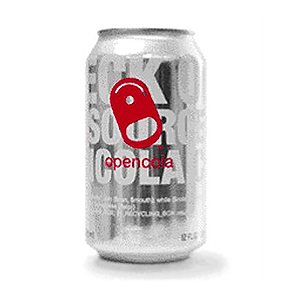
OpenCola is a brand of cola unique in that the instructions for making it are freely available and modifiable. Anybody can make the drink, and anyone can modify and improve on the recipe as long as they, too, license their recipe under the GNU General Public License. Since recipes are, by themselves, not copyrightable, the legal basis for this is untested.
The original version 1.0 was released on 27th January 2001. Current Version is 1.1.3. Although originally intended as a promotional tool to explain free and open source software, the drink took on a life of its own and 150,000 cans were sold. The Toronto-based company Opencola founded by Grad Conn, Cory Doctorow, and John Henson became better known for the drink than the software it was supposed to promote. Laird Brown, the company’s senior strategist, attributes its success to a widespread mistrust of big corporations and the ‘proprietary nature of almost everything.’
Posted in Food, Money, Politics |
Leave a Comment »
December 22, 2010

Freestyle is a touch screen soda fountain introduced by The Coca-Cola Company in 2009. The machine features over 100 different Coca-Cola drink products, and custom flavors. Microdosing blends one or more concentrated ingredients in 46-ounce packets with water and sweetener at the point where the beverage is dispensed, thus avoiding the use of traditional 5-gallon boxes of syrup (also known as a bag-in-a-box). Cartridges store concentrated ingredients in the dispenser cabinet and are RFID enabled. The machine uses RFID chips to detect its supplies and to radio resupplying needs to other units.
These machines include flavors not previously available to the American market including Orange Coke which was previously sold only in Russia and the Baltics, and flavored Dasani waters. The machines transmit supply and demand data to both Coca-Cola and the owner including brands sold, times of the day of sales, troubleshooting information, and service data. They also use Coca-Cola’s loyalty program to let people earn secret flavors.
Posted in Food, Money, Technology |
Leave a Comment »
December 19, 2010

ALDI, short for ‘Albrecht Discount,’ is a discount supermarket chain based in Germany founded by brothers Karl Albrecht and Theo Albrecht in 1913. Karl has since retired and is Germany’s richest man. Theo was Germany’s second richest man until his death in July 2010. The Aldi group operates about 8,210 individual stores worldwide. A new store opens every week in Britain alone.
Originally Aldi stores were ridiculed as being cheap shops selling low-quality goods, and that Aldi’s customers were mostly people who could not afford to shop elsewhere. Gradually many German consumers discovered that the poor reputation of Aldi’s products was either undeserved or economically justifiable. This shift in public perception was boosted by actions like a series of cookbooks that only used Aldi ingredients, which led to the emergence of a kind of Aldi fandom into parts of the German mainstream.
Posted in Food, Money, World |
Leave a Comment »
December 16, 2010

A human milk bank is a service which collects, screens, processes, and dispenses by prescription human milk donated by nursing mothers who are not biologically related to the recipient infant. There are currently eleven milk banks in North America. They are usually housed in hospitals, although sometimes they are free standing.
read more »
Posted in Drugs, Food, Health |
Leave a Comment »
December 15, 2010

Slow Cow is a ‘relaxation beverage’ launched in Quebec in December 2008, dubbed an ‘anti-energy’ drink by its creators.
Slow Cow’s principal ingredient is L-Theanine, an amino acid found in tea plants, which is said to produce a ‘feeling of relaxation and well-being.’ Other ingredients include extracts of chamomile, passiflora, valerian, tilia cordata, and hops.
Posted in Drugs, Food, Health |
Leave a Comment »
December 13, 2010

Spirulina [spahy-ruh-lahy-nuh] is a microscopic blue-green algae in the shape of a spiral coil, living both in sea and freshwater. It is the common name for human and animal food produced primarily from two species: Arthrospira platensis, and Arthrospira maxima. Though referred to as ‘algae’ because they are aquatic organisms capable of photosynthesis, cyanobacteria are not related to any of the various eukaryotic algae. Spirulina is rich in complete proteins, essential fatty acids, b vitamins, minerals, and phytochemicals like beta-carotene. Spirulina contains an unusually high amount of protein, between 55% and 77% by dry weight. It is a complete protein, containing all essential amino acids, though with reduced amounts of methionine, cysteine, and lysine when compared to the proteins of meat, eggs, and milk.
It is, however, superior to typical plant protein, such as that from legumes. Spirulina also contains the amino acid phenylalanine, which should be avoided by people who have the metabolic disorder phenylketonuria. Arthrospira is cultivated around the world, and is used as a human dietary supplement, as well as a whole food, and is available in tablet, flake, and powder form. It is also used as a feed supplement in the aquaculture, aquarium, and poultry industries. Spirulina was a food source for Mesoamericans; the Aztecs called it ‘stone’s excrement.’ Its cultivation dates back to the 9th century in Chad, where dried cakes of spirulina, called dihéare, are used as bullion cubes.
Posted in Food, Health, Science |
Leave a Comment »
December 10, 2010

American fried rice (khao phat Amerikan) is a Thai fried rice dish with ‘American’ side ingredients like fried chicken, ham, hot dogs, raisins, ketchup, and croutons. It was invented during the Vietnam War era to serve to United States Marine Corps and United States Air Force personnel stationed in Thailand. The Malaysian equivalent of American fried rice, called Nasi Goreng USA, is made with many of the same ingredients; however, no pork products are used, and customers are given the choice of ketchup or chili sauce.
Posted in Food, World |
Leave a Comment »


 The Daily Omnivore