April 28, 2016
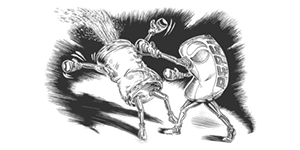

The Pepsi Challenge is an ongoing marketing promotion run by PepsiCo since 1975. It is also the name of a cross country ski race at Giant’s Ridge Ski Area in Biwabik, Minnesota, an event sponsored by Pepsi. The challenge originally took the form of a single blind taste test. At malls, shopping centers, and other public locations, a Pepsi representative set up a table with two white cups: one containing Pepsi and one with Coca-Cola. Shoppers were encouraged to taste both colas, and then select which drink they prefer. The results of the test leaned toward a consensus that Pepsi was preferred by more Americans.
The Pepsi Challenge taste test ad campaign is frequently credited for Coca-Cola’s decision to introduce New Coke in 1985. In his book ‘Blink: The Power of Thinking Without Thinking’ (2005), author Malcolm Gladwell presents evidence that suggests Pepsi’s success over Coca-Cola is a result of the flawed nature of the ‘sip test’ method. His research shows that tasters will generally prefer the sweeter of two beverages based on a single sip, even if they prefer a less sweet beverage over the course of an entire can. Additionally, many participants recalled a difference in temperature between the two drinks. According to these claims, Pepsi was served chilled, while Coca-Cola was served at room temperature, thus making the Pepsi more appealing.
Posted in Food, Money |
1 Comment »
April 15, 2016
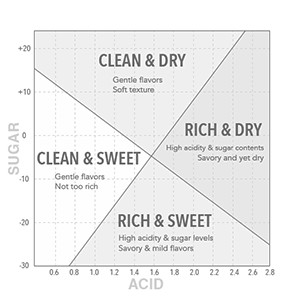
Apéritifs and digestifs are drinks, typically alcoholic, served before (apéritif) or after (digestif) a meal. An apéritif is served to stimulate the appetite, and is therefore usually dry rather than sweet. A digestif is intended to aid digestion. When served after a coffee course, it may be called ‘pousse-café.’ Digestifs are usually taken straight and typically contain carminative herbs, which are thought to aid digestion. ‘Apéritif’ is a French word derived from the Latin verb ‘aperire,’ which means ‘to open.’ The French slang word for ‘apéritif’ is ‘apéro,’ although in France an ‘apéro’ is also light food eaten in the late afternoon/early evening.
Common apéritif choices include dry vermouth, champagne, pastis (an anise-flavored spirit from France), gin, and dry sherry (e.g. fino and amontillado). ‘Apéritif’ may also refer to a snack that precedes a meal. This includes an amuse-bouche (a single, bite-sized hors d’oeuvre), such as crackers, cheese, pâté or olives. Common kinds of digestif include: Brandy, Cream Sherry, Sweet Vermouth, Port, Grand Marnier, Jagermeister, Kahlua, limoncello, ouzo, and tequila. In certain areas, it is not uncommon for a digestif to be taken before a main course. One example is le trou Normand, a glass of Calvados taken before the main course of a meal.
read more »
Posted in Food |
Leave a Comment »
April 8, 2016
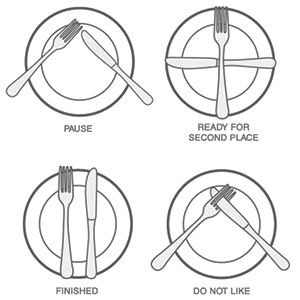
The silent service code is a way for a diner to ‘talk’ to servers during a meal without saying a word, mainly to tell them that the diner is finished. This will prevent any embarrassing situations where the server would take a meal prematurely.
To tell a server you have finished place your napkin to the left of your plate, and place all your utensils together in a ‘4-o’clock’ position on your plate. Utensils crossed on a plate signify that a diner is still eating. If you must leave during the meal, you should place the napkin on your chair to avoid any confusion. The code is almost always taught during business dining etiquette classes.
Posted in Food, Language |
Leave a Comment »
March 24, 2016


Fika [fee-kah] is a concept in Swedish culture with the basic meaning ‘to have coffee,’ often accompanied with pastries or sandwiches. A more contemporary generalized meaning of the word, where the coffee may be replaced by tea or even juice, lemonade or squash for children, has become widespread. In some social circles, even just a sandwich or a small meal may be denoted a fika similar to the English concept of afternoon tea. In Sweden pastries in general (for example cinnamon buns) are often referred to as ‘fikabröd’ (‘fika bread’).
Fika is a common practice at workplaces in Sweden where it constitutes at least one break during a normal workday. Often, two fikas are taken in a day at around 9:00 in the morning and 3:00 in the afternoon. The work fika is an important social event where employees can gather and socialize to discuss private and professional matters. It is not uncommon for management to join employees and to some extent it can even be considered impolite not to join one’s colleagues at fika. The practice is not limited to any specific sector of the labor market and is considered normal practice even in government administration.
read more »
Posted in Food, Money, World |
Leave a Comment »
February 10, 2016

Aquafaba [ah-kwuh-fah-buh], or chickpea brine, is the liquid from canned chickpeas, used as an egg substitute because of its function as an emulsifier, leavening agent, and foaming agent. Vegan baker Goose Wohlt coined the term aquafaba (‘bean liquid’) to describe the substance, which French chef Joël Roessel discovered could be used as substitute for egg whites in recipes. Aquafaba has been used to create meringues, macarons, nougat, and other products that normally require the use of eggs, making them suitable for people with egg allergies, vegans, and lacto-vegetarians.
There is currently no scientific consensus on the chemical properties of aquafaba and why it mimics egg whites so effectively. Seed proteins, including albumins and globulins, as well as soluble fibers, sugars, and glycosides have been proposed as contributing to the similarity. Roessel purports that the most likely agent that causes the liquid to foam are saponins, plant molecules containing a combination of hydrophobic (fat-soluble) and a hydrophilic (water-soluble) components.
Posted in Food, Health |
1 Comment »
December 17, 2015
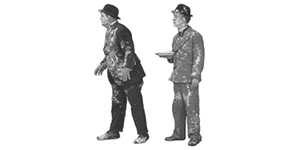
Pieing is the act of throwing a pie at a person or people. This may be a simple practical joke, but can be a political action when the target is an authority figure, politician, or celebrity and can be used as a means of protesting against the target’s political beliefs, or against perceived arrogance or vanity. Perpetrators generally regard the act as a form of ridicule to embarrass and humiliate the victim. In most or all jurisdictions, pieing is punishable as battery, and may constitute assault as well.
In pieing, the goal is usually to humiliate the victim while avoiding actual injury. For this reason the pie is traditionally of the cream variety without a top crust, and is rarely if ever a hot pie. In Britain, a pie in the context of throwing is traditionally referred to as a ‘custard pie.’ An aluminum pie pan or paper plate filled with whipped cream or shaving foam can substitute for a real pie. Pieing and pie fights are a staple of slapstick comedy, and pie ‘tosses’ are also common charity fundraising events, especially in schools.
read more »
Posted in Food, Humor, Politics |
1 Comment »
September 23, 2015

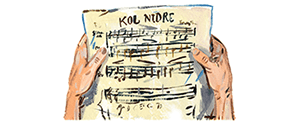
Fasting is primarily an act of willing abstinence or reduction from certain or all food, drink, or both, for a period of time. An absolute fast is normally defined as abstinence from all food and liquid for a defined period, usually 24 hours. Other fasts may be only partially restrictive, limiting particular foods or substances. The fast may also be intermittent in nature.
Fasting practices may preclude sexual intercourse and other activities as well as food. Extended fasting has been recommended as therapy for various conditions by health professionals of many cultures, throughout history, from ancient to modern. Fasting is also a part of many religious observances.
read more »
Posted in Food, Health, Philosophy |
1 Comment »
August 10, 2015
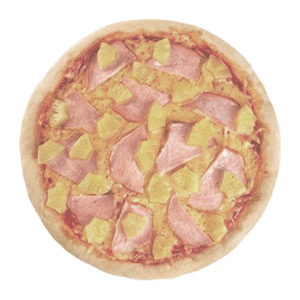
Hawaiian pizza is made up of a dough crust, tomato sauce, Canadian bacon, and pineapple rings or chunks. Often versions will have ham, mixed peppers, mushrooms and bacon.
Pineapple as a pizza topping divides public opinion. Hawaiian was the most popular pizza in Australia in 1999, accounting for 15% of pizza sales, and a 2015 review of independent UK pizzerias found the Hawaiian pizza to be the most commonly available. However, a 2016 survey of US adults had pineapple in the top three least favorite pizza toppings, behind anchovies and mushrooms.
read more »
Posted in Food, World |
Leave a Comment »
June 8, 2015
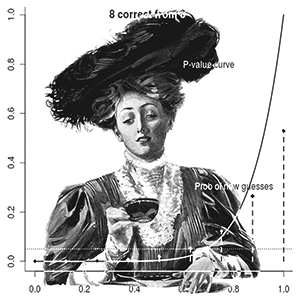
In the design of experiments in statistics, the lady tasting tea is a famous randomized experiment devised by English statisticia Ronald A. Fisher and reported in his book ‘The Design of Experiments’ (1935). The experiment is the original exposition of Fisher’s notion of a ‘null hypothesis’ (what you expect to happen before you run an experiment, i.e. nothing). Fisher’s description is less than ten pages in length and is notable for its simplicity and completeness regarding terminology, calculations, and design of the experiment. The example is loosely based on an event from his life. The lady in question was biologist Muriel Bristol.
Bristol claimed to be able to tell whether the tea or the milk was added first to her daily cup of tea. Fisher proposed to give her eight cups, four of each variety, in random order. One could then ask what the probability was for her getting the number she got correct, but just by chance. She got all eight cups correct. In popular science, David Salsburg published a book entitled ‘The Lady Tasting Tea,’ which describes Fisher’s experiment and ideas on randomization.
Posted in Food, Science |
Leave a Comment »
May 13, 2015

Pappy Van Winkle’s Family Reserve is the flagship brand of bourbon whiskey owned by the ‘Old Rip Van Winkle Distillery’ company (which does not actually own or operate a distillery, but rather has it produced under a contract with another company). It is distilled and bottled by the Sazerac Company at its Buffalo Trace Distillery in Frankfort, Kentucky. It is often regarded as one of the finest bourbons in the world, and is rare to find on the market due to its very low production and high demand. The product has a cult-like following. Famous chefs such as Anthony Bourdain and David Chang have favored the product.
‘Food Republic’ reported that Chef John Currence said: ‘There’s Pappy Van Winkle, then there’s everything else.’ Bourbon aficionados have shown up in droves to get a small chance in a lottery to purchase some. It has been called ‘the bourbon everyone wants but no one can get.’ A writer for ‘The Wall Street Journal’ said ‘You could call it bourbon, or you could call it a $5,000 bottle of liquified, barrel-aged unobtanium.’ Jen Doll wrote in ‘The Wire,’ ‘It’s an age-old dilemma (supply and demand) leading to an age-old marketing dream (a product that can’t be kept on the shelves … money in the pockets … bourbon in the bourbon snifters).’
read more »
Posted in Drugs, Food, Money |
Leave a Comment »
April 20, 2015

In medieval and early modern kitchens, the spit was the preferred way of cooking meat in a large household. A servant known as the ‘spit boy’ or ‘spit jack’ sat near the spit turning the metal rod slowly to cook the food evenly. Mechanical turnspits (‘roasting jacks’) were later invented and were first powered by dogs on treadmills (and then by steam power and mechanical clockwork mechanisms, and presently by electric motors). The Turnspit Dog was a short-legged, long-bodied dog bred to run on a wheel, called a ‘turnspit’ or ‘dog wheel.’
It is mentioned in ‘Of English Dogs’ in 1576 under the name ‘Turnespete.’ English naturalist William Bingley’s ‘Memoirs of British Quadrupeds’ (1809) also talks of a dog employed to help chefs, known as the ‘Kitchen Dog,’ the ‘Cooking Dog,’ the ‘Underdog,’ and the ‘Vernepator.’ In Swedish zoologist Carl Linnaeus’ 18th century classification of dogs it is listed as ‘Canis vertigus’ (‘spinning dog’). The breed was lost since it was considered to be such a lowly and common dog that no record was effectively kept of it. Some sources consider the Turnspit a kind of Glen of Imaal Terrier, others make it a relative of the Welsh Corgi.
read more »
Posted in Food, Technology |
1 Comment »
April 7, 2015
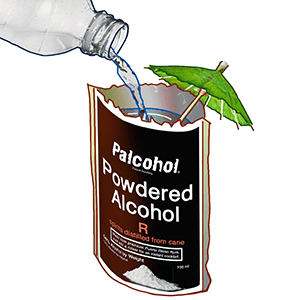
Alcohol powder is molecularly encapsulated ethanol. The powder produces an alcoholic beverage when mixed with water. According to food chemist Udo Pollmer of the European Institute of Food and Nutrition Sciences in Munich, alcohol can be absorbed in cyclodextrins, a synthetic carbohydrate derivative. The cyclodextrins can absorb an estimated 60 percent of their own weight in alcohol while remaining dry to the touch. A US patent was registered for the process as early as 1974.
Alcohol powder can be used to reconstitute alcoholic beverages or inhaled through a nebulizer (mister). In Germany a product called Subyou reportedly was distributed on the Internet. The product was available in four flavors and packed in 65 – 100 gram sachets. When mixed with 0.25 liters of water it gives a drink with 4.8% alcohol. It was assumed a German producer manufactured the product from imported raw alcohol powder from the US.
read more »
Posted in Drugs, Food, Politics |
1 Comment »


 The Daily Omnivore