December 14, 2014

The pizza effect is a term used especially in religious studies and sociology for the phenomenon of elements of a nation or people’s culture being transformed or at least more fully embraced elsewhere, then re-imported back to their culture of origin, or the way in which a community’s self-understanding is influenced by (or imposed by, or imported from) foreign sources.
It is named after the idea that modern pizza was developed among Italian immigrants in the United States (rather than in native Italy where in its simpler form it was originally looked down upon), and was later exported back to Italy to be interpreted as a delicacy in Italian cuisine. Other culinary examples include chicken tikka masala, popularized in the UK before gaining prominence in India, and General Tso’s chicken, a dish unknown in China before it was introduced by chefs returning from the States.
read more »
Posted in Food, Philosophy, World |
Leave a Comment »
December 13, 2014

A fortune cookie is a folded wafer cookie with a piece of paper inside with words of wisdom, an aphorism, or a vague prophecy. The message may also include a Chinese phrase with translation or a list of lucky numbers used by some in lotteries (some of which have become actual winning numbers). Fortune cookies are often served as a dessert in Chinese restaurants in the United States and some other countries, but are absent in China.
The exact origin of fortune cookies is unclear, though various immigrant groups in California claim to have popularized them in the early 20th century, basing their recipe on a traditional Japanese cracker. Fortune cookies have been summarized as being ‘introduced by the Japanese, popularized by the Chinese, but ultimately … consumed by Americans.’ In 1992, Wonton Food of Brooklyn, NY attempted to expand its fortune cookie business into China, but gave up because the product was considered ‘too American.’
read more »
Posted in Food, World |
1 Comment »
December 13, 2014

An oyster pail is a folded, waxed, paper food container commonly used by American Chinese restaurants, traditionally with a handle made of solid wire (microwave-safe plastic handles are also available). In the US oyster pails are now available in standard sizes and can also serve as self-measuring containers, so that many take-out foods are sold in pints and quarts and packed into pails of the appropriate size. They can also be found in some European countries such as Germany and England, but are rarely seen in China. The container has the advantage of being inexpensive, durable, and fairly leakproof, as long as it is kept upright. The top usually includes a locking paperboard tab. The simple origami-like folded construction also allows for some escape of steam from hot food. If the sides are unfolded, the pail can also double as a makeshift plate, but it is more common to eat directly out of the container, a feat that the long reach of chopsticks makes possible.
The paperboard oyster pail was invented in the US around 1894, at a time when fresh oysters were more popular, more plentiful, and less expensive than they are at present. Since shucking oysters (removing the raw meat from the shell) can be difficult and dangerous, it was common to ask the oyster seller open them. The oyster pail provided an inexpensive and sanitary way to bring home shucked oysters. In the early 20th century oyster pails were also used to hold honey. In the mid-20th century, overfishing (and the subsequent rise in price) of oysters left manufacturers with a significant number of unsold oyster pails. However, in the US after World War II, there was a huge increase in sales of prepared foods that could be purchased from restaurants, and heated or finished at home. Chinese food proved to be a popular choice, since it was relatively inexpensive and traveled well. The oyster pail was quickly adopted for ‘Chinese takeout.’
Posted in Food, World |
Leave a Comment »
December 9, 2014


A gypsy brewery is a beer company that does not have its own equipment or premises; it operates on a temporary or itinerant basis out of the facilities of another brewery, generally making ‘one-off’ special occasion beers. The term may refer to the brewmaster, or to the brand of beer. The trend of gypsy brewing spread early in Scandinavia. Their beers, and collaborations later spread to America and Australia.
Gypsy brewers typically use facilities of larger makers with excess capacity. Often, their beers are made with herbs, spices, and fruits, use experimental styles, are high in alcohol, or are aged in old wine or liquor barrels. Prominent examples include Pretty Things, Stillwater Artisanal Ales, Mikkeller and Evil Twin.
Posted in Drugs, Food, Money |
Leave a Comment »
November 30, 2014


Caffeine is a naturally occurring chemical found in various seeds, leaves, nuts, and berries. It serves a dual function in plants: as a toxin against unwanted pests, and as an enticement to pollinators, who are stimulated by it. Common sources of caffeine include coffee seeds (beans), tea leaves, kola nuts, yerba mate leaves, and guarana berries. It is extracted from the plant by steeping in water, a process called infusion. Chemically caffeine is an alkaloid, a non-acidic, nitrogen containing compound. A number of alkaloids are produced by flowering plants (e.g. cocaine from coca, nicotine from tobacco, morphine from poppies) to reduce or avoid being eaten by herbivores.
Specifically, caffeine is a xanthine alkaloid, an organic (carbon-based) compound from which many stimulants are derived. It is the world’s most widely consumed psychoactive drug, but unlike many other psychoactive substances, it is legal and unregulated in nearly all parts of the world. Part of the reason caffeine is classified by the FDA as ‘generally recognized as safe’ is that toxic doses, over 10 grams per day for an adult, are much higher than the typically used doses of under 500 milligrams.
read more »
Posted in Drugs, Food, Health |
Leave a Comment »
November 29, 2014
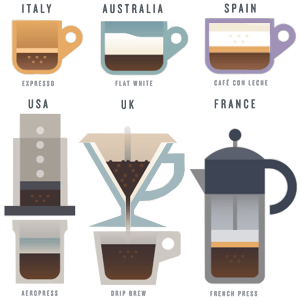
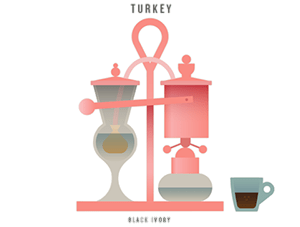
Coffee culture describes a social atmosphere or series of associated social behaviors that depends heavily upon coffee, particularly as a social lubricant. The term also refers to the diffusion and adoption of coffee as a widely consumed stimulant by a culture. In the late 20th century, particularly in the Western world and urbanized centers on the globe, espresso has been an increasingly dominant form. Individuals that participate in cafe culture are sometimes referred to as ‘cafe au laiters’ and ‘espressonites.’
In many urban centers on the world, it is not unusual to see several espresso shops and stands within walking distance of each other or on opposite corners of the same intersection, typically with customers overflowing into parking lots. Thus, the term coffee culture is also used frequently in popular and business media to describe the deep impact of the market penetration of coffee-serving establishments.
read more »
Posted in Food, Politics, World |
1 Comment »
October 30, 2014
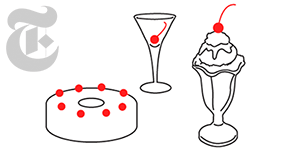

In the US, a maraschino [mar-uh-skee-noh] cherry is a preserved, sweetened cherry, typically made from light-colored sweet cherries such as the Royal Ann, Rainier, or Gold varieties. In their modern form, the cherries are first preserved in a brine solution usually containing sulfur dioxide and calcium chloride to bleach the fruit, then soaked in a suspension of food coloring (usually Red 40), sugar syrup, and other components.
Maraschino cherries are an ingredient in many cocktails, giving them the nickname: ‘Cocktail cherries.’ As a garnish, they often are used to decorate frozen yogurt, baked ham, cakes, pastry, parfaits, milkshakes, ice cream sundaes, and ice cream sodas. They are frequently included in canned fruit cocktail. They are also used as an accompaniment to sweet paan (an Indian preparation of herbs for chewing), and sometimes, along with some of the maraschino “‘juice,’ put into a glass of Coca-Cola to make an old-fashioned or homemade ‘Cherry Coke.’
read more »
Posted in Food, Money, Science |
Leave a Comment »
September 10, 2014


Liebeck v. McDonald’s Restaurants, also known as the McDonald’s coffee case, was a 1994 product liability lawsuit that became a flash point in the tort reform debate in the US. A New Mexico civil jury awarded $2.86 million to plaintiff Stella Liebeck, a 79-year-old woman who suffered third-degree burns in her pelvic region when she accidentally spilled hot coffee in her lap after purchasing it from a McDonald’s restaurant. Liebeck was hospitalized for eight days while she underwent skin grafting, followed by two years of medical treatment.
Liebeck’s attorneys argued that at 180–190 °F coffee was defective, claiming it was too hot and more likely to cause serious injury than coffee served at any other establishment. The jury damages included $160,000 to cover medical expenses and $2.7 million in punitive damages. The trial judge reduced the final verdict to $640,000, and the parties settled for a confidential amount before an appeal was decided. The case was said by some to be an example of frivolous litigation; ABC News called it, ‘the poster child of excessive lawsuits,’ while legal scholar Jonathan Turley said it was ‘a meaningful and worthy lawsuit.’
read more »
Posted in Food, Money, Politics |
Leave a Comment »
September 9, 2014

Postprandial [pohst-pran-dee-uhl] somnolence [som-nuh-luhns] (colloquially known as a food coma) is a normal state of drowsiness or lassitude following a meal. It has two components: a general state of low energy related to activation of the parasympathetic nervous system (can be thought of as ‘rest and digest’ as opposed to the ‘fight-or-flight’ effects of the sympathetic nervous system) in response to mass in the gastrointestinal tract, and a specific state of sleepiness caused by hormonal and neurochemical changes related to the rate at which glucose enters the bloodstream and its downstream effects on amino acid transport in the central nervous system.
In response to the arrival of food in the stomach and small intestine, the activity of the parasympathetic nervous system increases and the activity of the sympathetic nervous system decreases. This shift in the balance of autonomic (involuntary) tone towards the parasympathetic system results in a subjective state of low energy and a desire to be at rest, the opposite of the fight-or-flight state induced by high sympathetic tone. The larger the meal, the greater the shift in autonomic tone towards the parasympathetic system, regardless of the composition of the meal.
read more »
Posted in Food, Health |
1 Comment »
August 11, 2014
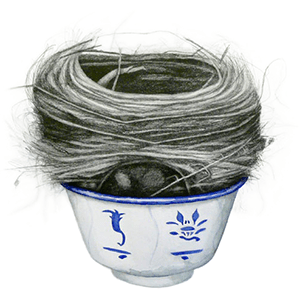
Edible bird’s nests are among the most expensive animal products consumed by humans, with an average nest selling for $2,500 per kilo for end-consumers in Asia. The nests have been used in Chinese cooking for over 400 years, most often as bird’s nest soup. Legend has it that shipwrecked sailors scavenging for food cleaned and cooked the nests and found the resulting stew so invigorating they were able to sail home to inform the emperor of their new discovery.
The Chinese name for edible bird’s nest, ‘yàn wō,’ translates literally as ‘swiftlet nest’ (swiftlets, common to asia, are superficially similar to swallows and known for building nests of solidified saliva). The most famous use for the nests is bird’s nest soup, a delicacy in Chinese cuisine. When dissolved in water, the swiftlet nests have a gelatinous texture used for soup or sweet tong sui (a Cantonese custard).
read more »
Posted in Food, Money, World |
1 Comment »
April 20, 2014


The ketchup as a vegetable controversy refers to proposed United States Department of Agriculture (USDA) Food and Nutrition Service (FNS) regulations, early in the presidency of Ronald Reagan, that intended to provide more flexibility in meal planning to local school lunch administrators coping with National School Lunch Plan subsidy cuts enacted by the Omnibus Regulation Acts of 1980 and 1981.
The regulations allowed administrators the opportunity to credit items not explicitly listed that met nutritional requirements. While ketchup was not mentioned in the original regulations, pickle relish was used as an example of an item that could count as a vegetable. Reagan withdrew the proposal after an almost immediate public outcry.
read more »
Posted in Food, Health |
Leave a Comment »
April 18, 2014

Orthorexia [awr-thuh-rek-see-uh] nervosa [nur-voh-suh] is a proposed eating disorder characterized by an excessive preoccupation with avoiding foods perceived to be unhealthy. The term ‘orthorexia’ derives from the Greek ‘ortho’ (‘right’ or ‘correct’), and ‘orexis’ (‘appetite’), literally meaning ‘correct appetite.’ It was introduced in 1997 by primary care physician Steven Bratman, who claims that in extreme cases, it can lead to severe malnutrition or even death. Even in less severe cases, the attempt to follow a diet that cannot provide adequate nourishment is said to lower self-esteem as the orthorexics blame themselves rather than their diets for their constant hunger and the resulting cravings for forbidden foods.
In 2009, Ursula Philpot, chair of the British Dietetic Association and senior lecturer at Leeds Metropolitan University, described people with orthorexia nervosa to ‘The Guardian’ as being ‘solely concerned with the quality of the food they put in their bodies, refining and restricting their diets according to their personal understanding of which foods are truly ‘pure.” This differs from other eating disorders, such as anorexia nervosa and bulimia nervosa, whereby people focus on the quantity of food eaten.
read more »
Posted in Food, Health |
Leave a Comment »



 The Daily Omnivore