April 17, 2013

The Korova Milk Bar (‘korova’ is Russian for ‘cow’) appears in the novel and film ‘A Clockwork Orange’ by Anthony Burgess. It is a twisted version of a milk bar (general store) that serves milk laced with drugs. The novel begins with the droogs (friends) sitting in their favorite hangout, drinking milk-drug cocktails, called ‘milk-plus,’ to hype themselves for the night’s mayhem.
The protagonist and narrator Alex lists some of the (fictitious) ingredients one can request: vellocet (opiate), synthemesc (synthetic mescalines), drencrom (adrenochrome). For another ingredient he advises to, ‘(drink the milk) ‘with knives in it,’ as it ‘would sharpen you up.” By serving milk (instead of alcohol), the bar is able to serve minors. In the film, the bar has furniture in the shape of naked women and the milk is served from their nipples.
Posted in Drugs, Food |
Leave a Comment »
April 9, 2013

Culinary name is the name of an ingredient when used in the kitchen for preparing food, as opposed to their names in agriculture or in scientific nomenclature. Some are used because they sounds more attractive than the real name, or because a cheaper ingredient can be linked with a more expensive one. The culinary name may also refer to a way of cooking or to a region, or using a particular ingredient.
Additionally, name given on a menu may be different from the culinary name. For example, from the 19th until the mid-20th century, many restaurant menus were written in French and not in the local language. Examples include veal (calf), calamari (squid), scampi (Italian-American name for shrimp), and sweetbreads (pancreas or thymus gland). Culinary names are especially common for fish and seafood, where multiple species are marketed under a single familiar name.
read more »
Posted in Food, Language, Money |
Leave a Comment »
April 9, 2013
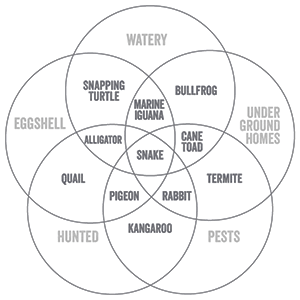
‘Tastes like chicken‘ is a common declaration used when trying to describe the flavor of a food. The expression has been used so often that it has become somewhat of a cliché. As a result, the phrase also sometimes gets used for incongruous humor by being deployed for foods or situations to which it has no real relevance. As an explanation of why unusual meats would taste more like chicken than common alternatives such as beef or pork, different possibilities have been offered.
One idea is that chicken has a bland taste because fat contributes more flavor than muscle (especially in the case of a lean cut such as a skinless chicken breast), making it a generic choice for comparison. Also, chicken reportedly has lower levels of glutamates that contribute to the ‘savory’ aspect of taste known as umami; processing or tenderizing other meats also lowers glutamate levels and makes them taste more like chicken.
read more »
Posted in Food, Humor, Science |
Leave a Comment »
April 2, 2013

Food Not Bombs is a loose-knit group of independent collectives, serving free vegan and vegetarian food to others. Food Not Bombs’ ideology is that myriad corporate and government priorities are skewed to allow hunger to persist in the midst of abundance.
To demonstrate this (and to reduce costs), a large amount of the food served by the group is surplus food from grocery stores, bakeries and markets that would otherwise go to waste. This group exhibits a form of franchise activism. The organization was founded in 1980 in Cambridge, Massachusetts by anti-nuclear activists. One of the co founders was C.T. Lawrence Butler.
Posted in Food, Politics, War |
Leave a Comment »
April 2, 2013

Dumpster diving (called ‘skipping’ in the UK) is the practice of sifting through commercial or residential waste to find items that have been discarded by their owners, but that may prove useful to the dumpster diver. Dumpster diving is also viewed as an effective urban foraging technique.
Dumpster divers will forage dumpsters for items such as clothing, furniture, food, and similar items in good working condition. The dumpster diving term originates from the best-known manufacturer of commercial trash bins, Dempster, who use the trade name ‘Dumpster’ for their bins, and the fanciful image of someone leaping head first into a dumpster as if it were a swimming pool. In practice, the size and design of most dumpsters makes it possible to retrieve many items from the outside of dumpsters without having to ‘dive’ into them.
read more »
Posted in Food, Language, Money |
Leave a Comment »
April 1, 2013

American pop singer Lady Gaga wore a dress made of raw beef, which was commonly referred to by the media as the meat dress, to the 2010 MTV Video Music Awards. Designed by Argentine designer Franc Fernandez and styled by Nicola Formichetti, the dress was condemned by animal rights groups, and named by ‘Time’ as the top fashion statement of 2010. The press speculated on the originality of the meat dress idea, with comparisons made to similar images found in contemporary art and popular culture. Architects Diller Scofidio + Renfro, for example, had designed a meat dress in 2006.
As with her other dresses, it was archived, but went on display in 2011 at the Rock and Roll Hall of Fame after being preserved by taxidermists as a type of jerky. Gaga explained following the awards ceremony that the dress was a statement about one’s need to fight for what one believes in, and highlighted her distaste for the US military’s don’t-ask-don’t-tell policy.
read more »
Posted in Food, Politics |
Leave a Comment »
March 24, 2013

Chifir’ is a type of strong tea brewed in Russia. The etymology is uncertain but is thought to come from the word ‘chikhir” meaning a strong Caucasian wine, or a Siberian word for spoiled wine that has become sour and acidic. Chifir’ is typically prepared with either two or three tablespoons of loose tea per person poured on top of the boiled water. It is brewed for 10–15 minutes without stirring – until the leaves drop to the bottom of the cup. Chifir’ drunk without sugar is highly unpleasant; sweets can be held in the mouth before, during or after drinking to soften its bitter taste.
It is similar to Egyptian Sa’idi tea, a somewhat similar beverage (essentially a 1/9-strength recipe, but consumed in larger quantities).
Posted in Drugs, Food, World |
Leave a Comment »
March 22, 2013
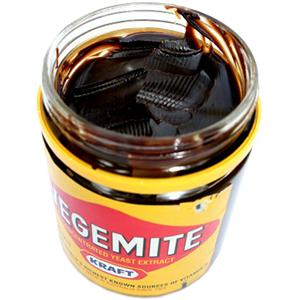
Vegemite [vej-uh-mahyt] is a dark brown Australian food paste made from yeast extract. It is a spread for sandwiches and a filling for pastries. A common method of eating Vegemite is on toasted bread with one layer of butter before spreading a thin layer of Vegemite. It is similar to British, New Zealand and South African Marmite, Australian Promite, Swiss Cenovis and German Hefeextrakt. More recently, other spreads – which are Australian-owned – have come on the market to provide an alternative to the now US-owned product, such as the yeast-based AussieMite.
Vegemite is made from brewers’ yeast extract, a by-product of beer manufacturing, various vegetables, wheat and spice additives. It is salty, slightly bitter and malty, and rich in umami (savory flavor) – similar to beef bouillon. The texture is smooth and the product is a paste. It is not as intensely flavored as British Marmite and it is less sweet than the New Zealand version of Marmite.
read more »
Posted in Food, Health, World |
Leave a Comment »
March 21, 2013

Poutine [poo-teen] (French: ‘a mess’) is a typical Canadian dish (originally from Quebec), made with french fries, topped with brown gravy (meat stock based) and cheese curds (solid parts of soured milk).
Poutine is sold by fast food chains, in small ‘greasy spoon’ type diners (commonly known as ‘cantines’ or ‘casse-croûtes’ in Quebec) and pubs, as well as by roadside chip wagons (commonly known as ‘cabanes à patates,’ literally meaning ‘potato shacks’). International chains like McDonald’s and KFC sell mass-produced poutine in Canada.
read more »
Posted in Food, World |
Leave a Comment »
March 20, 2013
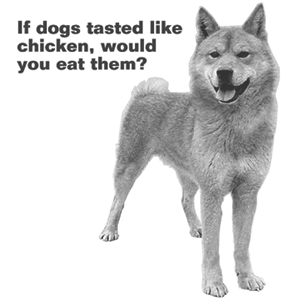
The Nureongi is a yellowish, local dog breed from Korea. It is most often used as a livestock dog, raised for its meat and not commonly kept as a pet. This dog has no formal name in the Korean language. ‘Nureongi’ and ‘hwangu’ are informal Korean words meaning ‘yellow one,’ and might best translate as ‘Brownie’ or ‘Blackie. Another common term is the Korean slang ‘ddong-gae,’ meaning ‘dung dogs’ or ‘shit dogs,’ which refers to the common dogs’ habit of eating feces.
The consumption of dog meat in South Korea, where it is known as ‘Gaegogi,’ has a long history in that country, as well as that of other East Asian cultures. In recent years, it has been controversial both in South Korea and around the world, due to animal rights and sanitary concerns. There is a large and vocal group of Korean people that are against the practice of eating dog meat. There is also a large population of people in South Korea that do not eat or enjoy the meat, but do feel strongly that it is the right of others to do so. There is a smaller but still vocal group of pro-dog cuisine people in South Korea who want to popularize the consumption of dog in Korea and the rest of the world, considering it to be part of the traditional culture of Korea with a long history worth preserving.
Posted in Food, Politics, World |
1 Comment »
March 20, 2013

Maslenitsa (also known as Butter Week) is an Eastern Slavic religious and folk holiday. It is celebrated during the last week before Great Lent—that is, the seventh week before Eastern Orthodox Pascha (Easter). Maslenitsa corresponds to the Western Christian Carnival, except that Orthodox Lent begins on a Monday instead of a Wednesday, and the Orthodox date of Easter can differ greatly from the Western Christian date.
Maslenitsa has its origins in both pagan and Christian traditions. In Slavic mythology, Maslenitsa is a celebration of the imminent end of the winter. As the culmination of the celebration, on Sunday evening, Lady Maslenitsa is stripped of her finery and put to the flames of a bonfire. Any remaining blintzes are also thrown on the fire and Lady Maslenitsa’s ashes are buried in the snow (to ‘fertilize the crops’).
read more »
Posted in Food, Philosophy, World |
Leave a Comment »
March 18, 2013
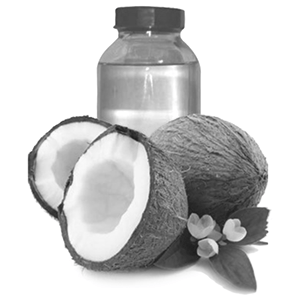
Coconut oil is an edible oil extracted from the kernel or meat of matured coconuts harvested from the coconut palm. Throughout the tropical world, it has provided the primary source of fat in the diets of millions of people for generations.
It has various applications in food, medicine, and industry. Coconut oil is very heat-stable, which makes it suited to methods of cooking at high temperatures like frying. Because of its stability, it is slow to oxidize and, thus, resistant to rancidity, lasting up to two years owing to the high saturated fat content.
read more »
Posted in Food, Health, World |
Leave a Comment »


 The Daily Omnivore