March 9, 2013

Neurowear is a gadget project organization in Japan founded on the concept of the ‘Augumented Human Body.’ The group’s first project, known as necomimi (‘cat ears’) is a headband with a brain wave sensor and motorized cat shaped ears programmed to turn up or down based on the wearer’s thoughts. It runs for 4 hours on 4 AAA batteries and has interchangeable Cat, Dog, and Devil Horn ears. ‘Brain Disco’ is a collaboration between neurowear and Qosmo that measures audience ‘attention.’ The DJ must hold the audience’s ‘attention’ or get ejected. The first Brain Disco experiment was held in July 2012 at Gallery KATA Ebisu.
neurowear demonstrated their new prototype Shippo (‘tail’) at the Tokyo Game Show in September 2012. Shippo was developed with Kiluck Inc. Kiluck failed to fund a similar tail ‘Tailly’ on Kickstarter but is trying again on Indiegogo. The tail wags like a dog based on the user’s mood communicated from the headset wirelessly via Bluetooth. neurowear also showed an iPhone app that uploads the user’s mood to social media complete with geotagging. neurowear presented ‘Neuro Turntable’ in late 2012.
Posted in Games, Humor, Technology |
Leave a Comment »
March 8, 2013
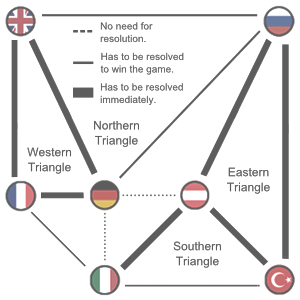
Diplomacy is a strategic board game created by American mail carrier Allan B. Calhamer in 1954 and released commercially in 1959. Its main distinctions from most board wargames are its negotiation phases (players spend much of their time forming and betraying alliances with other players and forming beneficial strategies) and the absence of dice or other game elements that produce random effects.
Set in Europe just before the beginning of World War I, Diplomacy is played by two to seven players, each controlling the armed forces of a major European Power (or, with few players, multiple powers). Each player aims to move his or her few starting units—and defeat those of others—to win possession of a majority of strategic cities and provinces marked as ‘supply centers’ on the map; these supply centers allow players who control them to produce more units.
read more »
Posted in Games, Politics, War |
Leave a Comment »
March 7, 2013

The Style Invitational, or Invite, is a long-running humor contest that ran first in the Style section of the Sunday ‘Washington Post’ before moving to Saturday’s Style and later returning to the Sunday paper. Started in 1993, it has run weekly, except for a hiatus in late 1999. In that time, it has had two anonymous head judges who select winning entries: ‘The Czar’ abdicated in late 2003, leaving the contest in the hands of his former associate, ‘The Empress.’
The humor ranges from an intellectual vein to a less mature style, and frequently touches on sophisticated political or historical allusions. While the contest theme changes every week, some popular contests are periodically repeated. The S.I. has a loyal following of self-proclaimed ‘Losers,’ who refer to having a contest entry published as ‘getting ink.’
read more »
Posted in Games, Humor, Language |
1 Comment »
March 6, 2013

The impact of Native American Gaming varies by tribe and location. In the 1970s, various tribes took unprecedented action to initiate gaming enterprises. In doing so, they created not only a series of legal struggles between the federal, state, and tribal governments but also a groundbreaking way to revitalize the Native American economy.
Native American gaming has grown from bingo parlors to high stakes gaming and is surrounded by controversy on many different levels. There are disputes concerning tribal sovereignty, negative effects of gaming, and a loss of Native American culture. In the US the ‘Indian Gaming Regulatory Act’ (IGRA) was passed in 1988 in order to secure collaboration between the states and tribes and also in order for the federal government to oversee gaming operations.
read more »
Posted in Games, Money, Politics |
Leave a Comment »
February 27, 2013
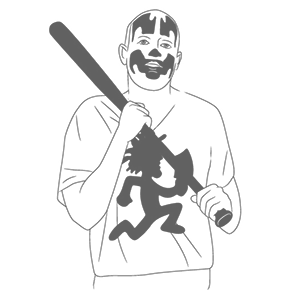
The Gathering of the Juggalos is an annual festival put on by Psychopathic Records, featuring performances by the entire label roster as well as numerous well-known musical groups and underground artists. It was founded by Robert Bruce, Insane Clown Posse (Joseph Bruce and Joseph Utsler), and their label in 2000.
Described by Joseph Bruce as a ‘Juggalo Woodstock’ (‘Juggalo’ being a nickname for fans of the Insane Clown Posse, a Detroit rap group), the Gathering of the Juggalos spans five days and includes concerts, wrestling, games, contests, autograph sessions, karaoke, and seminars with artists. Over its first eleven events, the festival has drawn an attendance of about 107,500 fans.
read more »
Posted in Art, Games, Humor |
1 Comment »
February 19, 2013
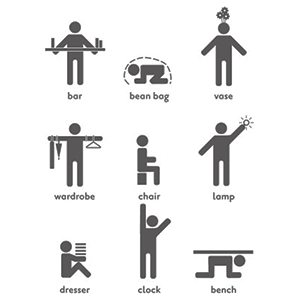
Human furniture (or forniphilia) is a form of bondage and sexual objectification in which a person’s body is incorporated into a chair, table, cabinet or other piece of furniture. The term was originally coined by bondage aficionado Jeff Gord.
Forniphilia is an extreme form of bondage because the subject usually is tightly bound and expected to stay immobile for a prolonged period. They are often gagged and/or placed in position where there is a danger of being smothered. Proper safety requires frequent checks of the submissive’s well-being.
Posted in Games, Sex |
1 Comment »
February 18, 2013

‘Harlem Shake‘ is a song recorded by American DJ and producer Baauer. It was released as a free digital download by Mad Decent imprint label Jeffree’s in 2012. The song incorporates samples of growling-lion sounds and Plastic Little’s 2001 song ‘Miller Time,’ specifically its line ‘then do the Harlem shake.’
In 2013, a user-submitted video set to ‘Harlem Shake’ became a viral hit on YouTube. The song features an undulating synth, harsh snares, and a mechanical bassline. It is categorized by Resident Advisor’s Andrew Ryce as a hip hop and bass song, while David Wagner of ‘The Atlantic’ describes its music as trap, a sub-genre with stylistic origins in EDM and Southern hip hop.
read more »
Posted in Art, Games, Humor |
Leave a Comment »
February 8, 2013
A claw crane or skill crane is a type of arcade game known as a ‘merchandiser,’ commonly found in video arcades, supermarkets, restaurants, movie theaters, shopping malls, and bowling alleys. A claw vending machine consists of prizes, usually plush toys or alternatives such as jewelry, capsuled toys, hats, balls, dolls, shirts, candy and electronics.
Higher end and more expensive prizes are sometimes placed in a plastic bag so the toy is harder to pick up. The player inserts coins into the machine, which then allows the player to manipulate a joystick that controls the claw for a variable time (controlled by the operator) usually 15 to 30 seconds (in some cases, a claw vending machine might offer a minute of time).
read more »
Posted in Games |
Leave a Comment »
February 7, 2013
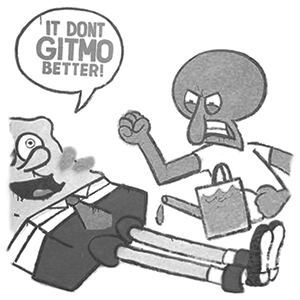
In the summer of 2008 conceptual artist Steve Powers presented a work that came to be known as the Coney Island waterboarding thrill ride. As originally conceived Powers saw the public watching volunteers undergoing actual waterboarding.
‘The Washington Post’ reported that Powers brought in Mike Ritz, a former US official experienced in administering waterboarding, for a one time demonstration of waterboarding on volunteers. This demonstration was not open to the general public, but rather for an invited audience. Powers himself was one of the volunteers.
read more »
Posted in Art, Games, Politics |
Leave a Comment »
February 6, 2013
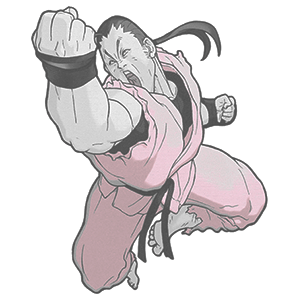
Dan Hibiki is a video game character from Capcom’s ‘Street Fighter’ series of fighting games. Introduced in 1995 as a secret character in ‘Street Fighter Alpha,’ Dan is consistently portrayed as an arrogant, overconfident, yet utterly feeble character. Shortly after the release of ‘Street Fighter II’ in 1991, rival company SNK released their own fighting game, ‘Art of Fighting.’
The principal character of this series, Ryo Sakazaki, bore a resemblance in appearance and name to ‘Street Fighter’ mascots Ryu, as well as other aesthetic similarities to Ken, wearing an orange gi and sporting blonde hair. In humorous retaliation, ‘Street Fighter II’ co-designer Akiman drew an artwork of Sagat holding a defeated opponent by the head during the release of ‘Street Fighter II: Champion Edition.’ The defeated opponent wore an attire similar to Ryo’s: an orange karate gi with a torn black shirt underneath and geta sandals; but had long dark hair tied to a ponytail like Robert Garcia, another character from the ‘Art of Fighting’ series. This character design would become the basis of Dan.
read more »
Posted in Games, Humor |
Leave a Comment »
February 6, 2013

Gold sinks are economic processes by which a video game’s ingame currency (‘gold’), or any item that can be valued against it, is removed. Excess currency leads to inflation of player driven prices. Game designers must balance between scarcity of currency and ease of acquiring currency. This process is comparable to financial repression (measures that governments employ to channel funds to themselves, that, in a deregulated market, would go elsewhere). Most commonly the genres are role-playing game or massively multiplayer online game.
The term is comparable to timesink (an activity that consumes significant time), but usually used in reference to game design and balance, commonly to reduce inflation when commodities and wealth are continually fed to players through sources such as quests, looting monsters, or minigames. Gold sinks are commonly called drains or gold drains. They can also be associated with item drains. The intent of a sink is to remove added value from the overall economy. For example, in ‘Ultima Online,’ items that were placed on the ground would be gathered by the server. This form is referred to as decay or garbage collection.
read more »
Posted in Games, Money, Technology |
Leave a Comment »
January 28, 2013

Buildering (also known as urban climbing, structuring, or stegophily) is the act of climbing on (usually) the outside of buildings and other artificial structures.
The word is a portmanteau, combining the word ‘building’ with the climbing term ‘bouldering’. If done without ropes or protection far off the ground, buildering may be dangerous. It is often practiced outside legal bounds, and is thus mostly undertaken at night-time.
read more »
Posted in Games, Humor |
Leave a Comment »


 The Daily Omnivore