February 2, 2012
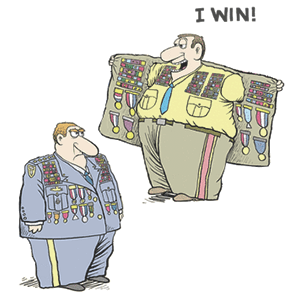
One-upmanship is the art or practice of successively outdoing a competitor. The term originated as the title of a book by Stephen Potter, published in 1952 as a follow-up to ‘The Theory and Practice of Gamesmanship (or the Art of Winning Games without Actually Cheating)’ (1947) and ‘Lifemanship’ titles in his series of tongue-in-cheek self-help books, and film and television derivatives, that teach various ‘ploys’ to achieve this. In that context, the term refers to a satiric course in the gambits required for the systematic and conscious practice of ‘creative intimidation,’ making one’s associates feel inferior and thereby gaining the status of being ‘one-up’ on them.
This satire of self-help style guides manipulates traditional stuffy British conventions for the gamester, all life being a game, who understands that if you’re not one-up, you’re one-down. Potter’s unprincipled principles apply to almost any possession, experience or situation, deriving maximum undeserved rewards and discomforting the opposition. Viewed seriously, it is a phenomenon of group dynamics that can have significant effects in the management field: for instance, manifesting in office politics. The term has been extended to a generic, often punning, extension upmanship used for any assertion of superiority: for instance, Native Upmanship.
Posted in Games, Humor |
1 Comment »
February 2, 2012

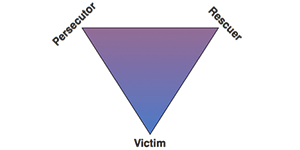
The term mind games refers to three main categories:
First, a largely conscious struggle for psychological one-upmanship, often employing passive–aggressive behavior to specifically demoralize or empower the thinking subject, making the aggressor look superior – ‘mind games or power games.’ Second, ‘The unconscious games played by innocent people engaged in duplex transactions (sending and receiving both explicit and unspoken messages) of which they are not fully aware, and which form the most important aspect of social life all over the world.’ And third, mental exercises designed to improve the functioning of mind and/or personality.
read more »
Posted in Games, Health |
Leave a Comment »
February 2, 2012

‘Games People Play: The Psychology of Human Relationships’ is a 1964 bestselling book by psychiatrist Eric Berne. Since its publication it has sold more than five million copies. The book describes both functional and dysfunctional social interactions.
In the first half of the book, Berne introduces transactional analysis as a way of interpreting social interactions. He describes three roles or ego states, known as the Parent, the Adult, and the Child, and postulates that many negative behaviors can be traced to switching or confusion of these roles. The book uses casual, often humorous phrases such as ‘See What You Made Me Do,’ ‘Why Don’t You — Yes But,’ and ‘Ain’t It Awful’ as a way of briefly describing each game. In reality, the ‘winner’ of a mind game is the person that returns to the Adult ego-state first.
read more »
Posted in Games, Health, Language |
1 Comment »
January 30, 2012
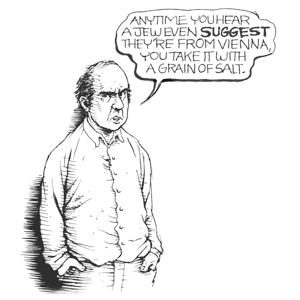
Jewish geography is a popular ‘game’ sometimes played when Jews meet each other for the first time and try to identify people they know in common. An Israeli version of the game, pitsuchim, has been a common pastime among young Israeli backpackers traveling the world, taking its name from a 1980s television quiz show.
As Etan Diamond observes in his book ‘And I Will Dwell in Their Midst: Orthodox Jews in Suburbia’: ‘This ‘game’ of ‘Jewish geography’ follows a simple pattern. One person asks, ‘You’re from [insert name of city here]? Do you know [insert person’s name here]?’ The other one usually responds something like, ‘Sure, he sits behind my uncle in synagogue,’ or ‘I met her once at a youth group convention,’ or ‘She is really good friends with my sister’s college roommate.’ Non-Jews often find it astonishing that such links are made so easily, but given both the relative smallness of the Jewish community – and the even smaller size of the Orthodox Jewish community – and the extensive overlapping social circles within these communities, it should not surprise too much.’
Posted in Games, Philosophy |
Leave a Comment »
January 25, 2012
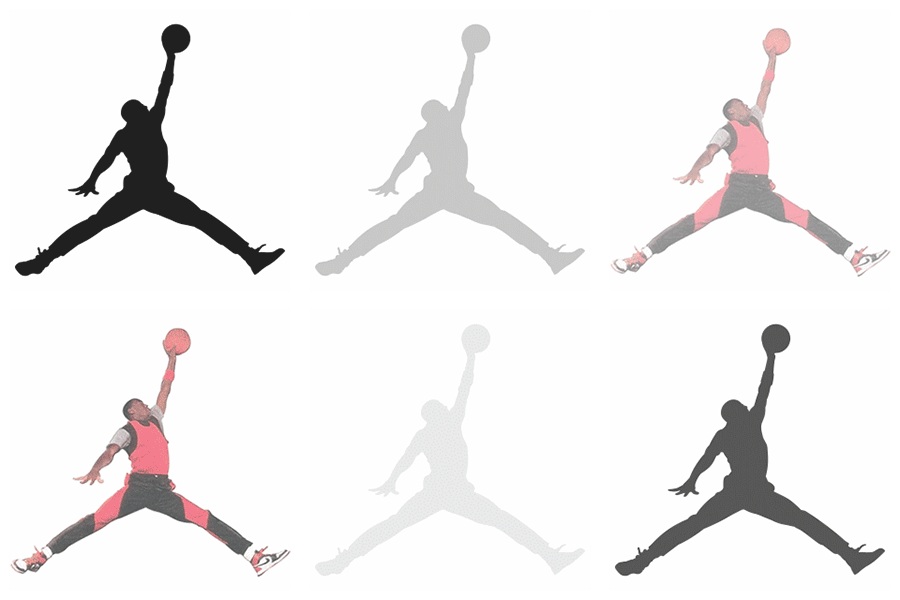
The ‘Jumpman‘ logo is used by Nike to promote its Michael Jordan-related merchandise, including the famous and successful Air Jordan brand of basketball shoes. The logo is a silhouette of a studio photograph of Jordan performing a ballet move, not an actual dunk as many believe. Beginning in 1985, the Jumpman photo or logo always accompanied ‘Jordan’ branded products, even when the only word displayed on the product was ‘Jordan.’
The Air Jordan III, released in 1988, was the first Air Jordan shoe to feature the Jumpman logo, replacing the ‘Wings’ logo, which had been a feature of the Air Jordans I and II. This model was one of the most popular ever. The Jumpman logo would retain a fairly consistent look throughout the Air Jordan line’s history, except on the Air Jordan VIII, on which it was reminiscent of a peace sign. In 1993-94, Nike ran a series of Air Jordan commercials pairing Michael Jordan with Warner Brothers’ own Bugs Bunny. As a tie-in, Nike created a line of merchandise which featured a spoof of the Jumpman using Bugs’ silhouette, combined with a “Hare Jordan” caption. This led to the film ‘Space Jam.’
Posted in Games, Money |
Leave a Comment »
January 19, 2012

Artificial life (alife) is a field of study and an associated art form which examine systems related to life, its processes, and its evolution through simulations using computer models, robotics, and biochemistry. The discipline was named by Christopher Langton, an American computer scientist, in 1986.
There are three main kinds of alife, named for their approaches: soft, from software; hard, from hardware; and wet, from biochemistry. Artificial life imitates traditional biology by trying to recreate biological phenomena, such as sexual reproduction and response to stimuli. The term ‘artificial life’ is often used to specifically refer to soft alife.
read more »
Posted in Games, Science, Technology |
Leave a Comment »
January 15, 2012

Goombas, known in Japan as Kuribo (‘Chestnut People’), are fictional species from Nintendo’s series of ‘Mario’ video games. They first appeared in the NES video game ‘Super Mario Bros.’ as the first enemy players encounter. They are usually brown and are most commonly seen walking around aimlessly, often as an obstacle, in video games. They were included late in the development of Super Mario Bros. in order to create a simple, easy-to-defeat enemy.
Goombas were the last enemy added to the game after play testers stated that the Koopa Troopa was too tricky an enemy. As a result, the designers introduce a basic enemy. When they decided to do this, however, they had very little space left in the game. They used a single image twice to convey the notion that the Goombas are walking, rotating it back and forth, causing it to look lopsided as it walks and giving the motion the appearance of a trot. The Goomba’s resemblance to the Super Mushroom forced designers to change the mechanics and appearance of the Super Mushroom. They used the Goomba’s ability to be jumped on and defeated to teach players how to deal with enemies and to not fear the Super Mushroom. The Goombas are designed after a shiitake mushroom.
Posted in Games |
Leave a Comment »
January 5, 2012

Emergent gameplay refers to complex situations in video games, board games, or role-playing games that emerge from the interaction of relatively simple game mechanics. More recently game designers have attempted to encourage emergent play by providing tools to players such as placing web browsers within the game engine, providing programming languages, and fixing exchange rates.
These cases constitute intentional emergence, where creative uses of the game are intended by the designers. Since the 1970s and 1980s board games and table top role playing games such as ‘Dungeons & Dragons’ have featured intentional emergence as a primary game function by supplying players with relatively simple rules or frameworks for play that intentionally encourage them to explore creative strategies or interactions and exploit them toward victory or goal achievement.
read more »
Posted in Games, Money, Technology |
Leave a Comment »
January 5, 2012
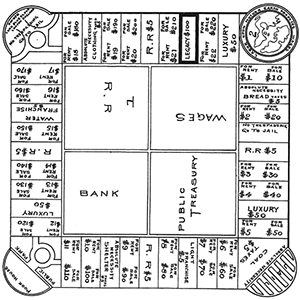
The Landlord’s Game is a board game patented in 1904 by Elizabeth Magie. It is a realty and taxation game, which is considered to be a direct inspiration for the board game ‘Monopoly.’
Though many similar home-made games were played at the beginning of the 20th century, it is the first of its kind to have an attested patent. Magie designed the game to be a ‘practical demonstration of the present system of land grabbing with all its usual outcomes and consequences.’
read more »
Posted in Games, Money, Politics |
Leave a Comment »
December 30, 2011
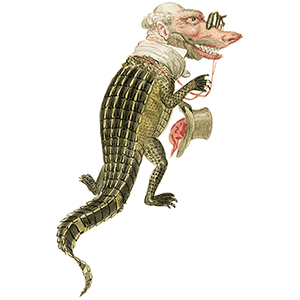
A krewe [kroo] is an organization that puts on a parade and or a ball for the Carnival season. The term is best known for its association with New Orleans Mardi Gras, but is also used in other Carnival celebrations around the Gulf of Mexico, such as the Gasparilla Pirate Festival in Tampa, Florida, and Springtime Tallahassee as well as in La Crosse, Wisconsin and at the Saint Paul Winter Carnival in Minnesota. The word is thought to have been coined in the early 19th century by an organization calling themselves Ye Mistick Krewe of Comus, as an archaic affectation; with time it became the most common term for a New Orleans Carnival organization. The Mystick Krewe of Comus itself was inspired by a Mobile mystic society (a Carnival social organization), with annual parades in Mobile, Alabama, called the Cowbellion de Rakin Society that dated from 1830.
Krewe members are assessed fees in order to pay for the parade and/or ball. Fees can range from thousands of dollars a year per person for the most elaborate parades to as little as $20 a year for smaller marching clubs. Criteria for krewe membership varies similarly, ranging from exclusive organizations largely limited to relatives of previous members to other organizations open to anyone able to pay the membership fee. Krewes with low membership fees may also require members to work to help build and decorate the parade floats and make their own costumes; higher priced krewes hire professionals to do this work. Parading krewe members are usually responsible for buying their own throws, the trinkets thrown to parade spectators according to Mobile and New Orleans tradition.
Posted in Games, Humor |
Leave a Comment »
December 20, 2011
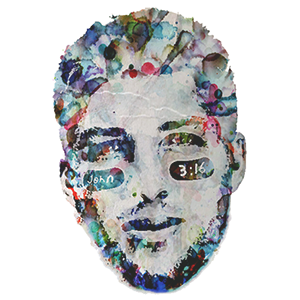
In 2010, a new rule for the next NCAA football season, dubbed ‘The Tebow Rule‘ by media because it would have affected him, banned messages on eye paint. During his college football career, Tebow frequently wore references to biblical verses on his eye black. In the 2009 BCS Championship Game, he wore John 3:16 on his eye paint, and as a result, 92 million people searched ‘John 3:16’ on Google during or shortly after the game. Tebow stated of the searches ‘It just goes to show you the influence and the platform that you have as a student-athlete and as a quarterback at Florida.’
The NFL already has a rule prohibiting players from wearing messages on eye black; so, Tebow is not able to continue the practice in the NFL. Despite the media label, the NCAA denies the rule was influenced by Tebow particularly, since many other notable players (Reggie Bush and Terrelle Pryor for example) wear or have worn messages on eye black. An NCAA spokesman said ‘When this rule was proposed the committee did not focus on any one team or student athlete. That measure reinforces what the intended use of eye black is, which is to shade the eyes from the sun.’
Posted in Games, Philosophy, Politics |
Leave a Comment »
December 19, 2011
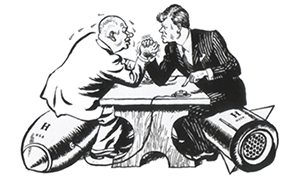

The game of chicken, also known as the hawk-dove or snowdrift game, is an influential model of conflict for two players in game theory. The principle of the game is that while each player prefers not to yield to the other, the worst possible outcome occurs when both players do not yield.
The name ‘chicken’ has its origins in a game in which two drivers drive towards each other on a collision course: one must swerve, or both may die in the crash, but if one driver swerves and the other does not, the one who swerved will be called a ‘chicken,’ meaning a coward; this terminology is most prevalent in political science and economics.
read more »
Posted in Games, Politics, Science |
Leave a Comment »


 The Daily Omnivore