December 13, 2011

‘Carts of Darkness‘ is a 2008 National Film Board of Canada documentary film by Murray Siple about a group of homeless men in North Vancouver, who use shopping carts to collect bottles and cans to return for money and also race down the city’s steep slope for thrills. The subjects in the film control the carts using only their weight and one foot, during descents that cross intersections, with top speeds claimed to be as high as 70 km/h.
Siple, a former director of extreme sports videos and avid skateboarder and snowboarder, became a quadriplegic after a car accident in 1996. His first film after his accident, ‘Carts of Darkness’ allowed the filmmaker to regain the excitement he had experienced with extreme sports as well as relate to a fellow group of outsiders.
Posted in Art, Games, Money |
1 Comment »
December 13, 2011
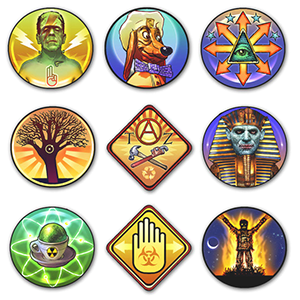
The Cacophony Society is ‘a randomly gathered network of free spirits united in the pursuit of experiences beyond the pale of mainstream society.’ It was started in 1986 by surviving members of the now defunct Suicide Club of San Francisco, a secret society devoted to urban exploration and anarchic pranks. Cacophony has been described as an indirect culture jamming outgrowth of the Dada movement, and the Situationists. One of its central concepts is the ‘Trip to the Zone,’ inspired by the 1979 Film ‘Stalker’ by Andrey Tarkovskiy.
According to self-designated members of the Society, ‘you may already be a member.’ The anarchic nature of the Society means that membership is left open-ended and anyone may sponsor an event, though not every idea pitched garners attendance by members. Cacophony events often involve costumes and pranks in public places and sometimes going into places that are off limits to the public. Cacophonists have been known to regale Christmas shoppers with improved Christmas carols while dressed as Santa Claus, and later invite strippers to sit on Santa’s lap at their annual SantaCon event.
read more »
Posted in Games, Humor |
1 Comment »
December 13, 2011


The Suicide Club was a secret society in San Francisco credited as the first modern extreme urban exploration (urbex) society, and also known for anarchic group pranks. The club was founded by Gary Warne in 1977 as a course he taught at the ‘Communiversity’ in San Francisco, part of the Free School Movement, and it lasted until shortly before Warne’s death in 1983.
Events generally started and ended in Warne’s used paperback bookstore, Circus of the Soul. The name of the Suicide Club was inspired by three stories written by Robert Louis Stevenson, where men who want to die belong to a club, where each evening one of them is randomly selected for death. The name belied the gentle albeit zany nature of its members, who had a predilection towards light-hearted practical jokes.
read more »
Posted in Games, Humor |
Leave a Comment »
December 13, 2011

SantaCon is a mass gathering of people dressed in Santa Claus costumes parading publicly on streets and in bars in cities around the world. The focus is on spontaneity and creativity, while having a good time and spreading cheer and goodwill. Sometimes known as Naughty Santas, Cheapsuit Santas, Santarchy, Santapalooza, and Santa Rampage, SantaCon incorporates elements of a flash mob in the context of cheerful bawdy and harmless behavior, the singing of naughty Christmas carols, and the giving of small gifts to strangers. In 2005, a more violent version of the event occurred when participants in New Zealand rioted, looting stores, throwing bottles at passing cars, and assaulting security guards.
In 1994, the Suicide Club (a secret society in San Francisco credited as the first modern extreme urban exploration society, and also known for anarchic group pranks) staged the first ‘Santarchy,’ which was later adopted as Santacon by offshoot the Cacophony Society (a randomly gathered network of free spirits united in the pursuit of experiences beyond the pale of mainstream society). Influenced by the surrealist movement, Discordianism, and other subversive art currents, the Cacophonists celebrated the Yule season in a distinctly anti-commercial manner, by mixing guerrilla street theater and pranksterism.
Posted in Games, Humor, Philosophy |
Leave a Comment »
December 8, 2011

Aquascaping is the craft of arranging aquatic plants, as well as rocks, stones, cavework, or driftwood, in an aesthetically pleasing manner within an aquarium—in effect, gardening under water. Aquascape designs include a number of distinct styles, including the garden-like Dutch style and the Japanese-inspired nature style. Although the primary aim of aquascaping is to create an artful underwater landscape, the technical aspects of aquarium maintenance must also be taken into consideration.
Many factors must be balanced in the closed system to ensure the success of an aquascape, including filtration, maintaining carbon dioxide at levels sufficient to support photosynthesis underwater, substrate and fertilization, lighting, and algae control. Aquascape hobbyists trade plants, conduct contests, and share photographs and information via the internet.
read more »
Posted in Art, Games, Science |
2 Comments »
December 8, 2011

Pteridomania [tuh-rid-uh-mey-nee-uh] or Fern-Fever was a craze for ferns. Victorian decorative arts presented the fern motif in pottery, glass, metal, textiles, wood, printed paper, and sculpture, with ferns ‘appearing on everything from christening presents to gravestones and memorials.’
The term, a compound of ‘Pteridophytes’ and ‘mania,’ was coined in 1855 by Charles Kingsley in his book ‘Glaucus, or the Wonders of the Shore’: ‘Your daughters, perhaps, have been seized with the prevailing ‘Pteridomania’…and wrangling over unpronounceable names of species (which seem different in each new Fern-book that they buy)…and yet you cannot deny that they find enjoyment in it, and are more active, more cheerful, more self-forgetful over it, than they would have been over novels and gossip, crochet and Berlin-wool.’
read more »
Posted in Games, Money, Science |
Leave a Comment »
December 1, 2011

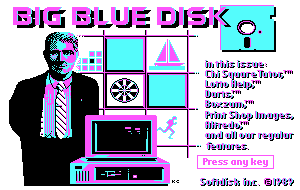
A disk magazine, colloquially known as a diskmag, is a magazine that is distributed in electronic form to be read using computers. These had some popularity in the 1980s and 1990s as periodicals distributed on floppy disk, hence their name. The rise of the Internet in the late 1990s caused them to be superseded almost entirely by online publications, which are sometimes still called ‘diskmags’ despite the lack of physical disks.
A unique and defining characteristic about a diskmag in contrast to a typical ASCII ‘zine’ is that a diskmag usually comes housed as an executable program file that will only run on a specific hardware platform. A diskmag tends to have an aesthetically appealing and custom graphical user interface (or even interfaces), background music and other features that take advantage of the hardware platform the diskmag was coded for. Diskmags have been written for many platforms, ranging from the C64 on up to the IBM PC and have even been created for video game consoles, like ‘scenedicate’ for the Dreamcast.
read more »
Posted in Games, Language, Technology |
Leave a Comment »
November 30, 2011
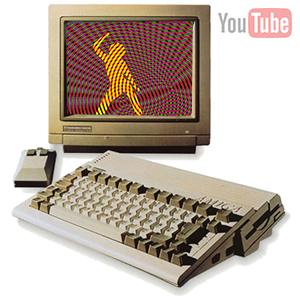
The demoscene is a computer art subculture that specializes in producing demos, which are non-interactive audio-visual presentations that run in real-time on a computer. The main goal of a demo is to show off programming, artistic, and musical skills. The demoscene first appeared during the 8-bit era on computers such as the Commodore 64, ZX Spectrum and Amstrad CPC, and came to prominence during the rise of the 16/32-bit home computers (the Amiga and the Atari ST). In the early years, demos had a strong connection with software cracking. When a cracked program was started, the cracker or his team would take credit with a graphical introduction called a ‘crack intro’ (shortened cracktro). Later, the making of intros and standalone demos evolved into a new subculture independent of the software (piracy) scene.
Prior to the popularity of IBM PC compatibles, most home computers of a given line had relatively little variance in their basic hardware, which made their capabilities practically identical. Therefore, the variations among demos created for one computer line were attributed to programming alone, rather than one computer having better hardware. This created a competitive environment in which demoscene groups would try to outperform each other in creating amazing effects, and often to demonstrate why they felt one machine was better than another.
read more »
Posted in Art, Games, Technology |
Leave a Comment »
November 30, 2011

A display hack is a computer program with similar purpose to a kaleidoscope: to make pretty pictures (symmetrical or otherwise). Famous display hacks include ‘munching squares’ and ‘smoking clover.’ Some display hacks can be also implemented by creating text files which contain numerous escape sequences for a text terminal to interpret. A famous example on the VT100 terminal displayed a Christmas tree, with twinkling lights and a toy train circling its base. The XScreenSaver software contains a large collection of X Window System and OpenGL display hacks.
Display hacks have a history of several decades. Arguably the first display hack was a program called Bouncing Ball on the Whirlwind computer in the early 1950s. The famous munching squares hack, on the other hand, originates in the PDP-1 computer in ca. 1962. Crack intros, display hacks programmed by software crackers for the home computers of the 1980s, evolved into what was to be known as demos and demo effects. The creation of demos later became a subculture of its own, now known as the demoscene.
Posted in Games, Technology |
Leave a Comment »
November 30, 2011
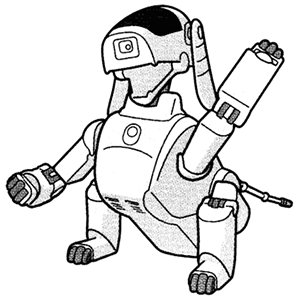
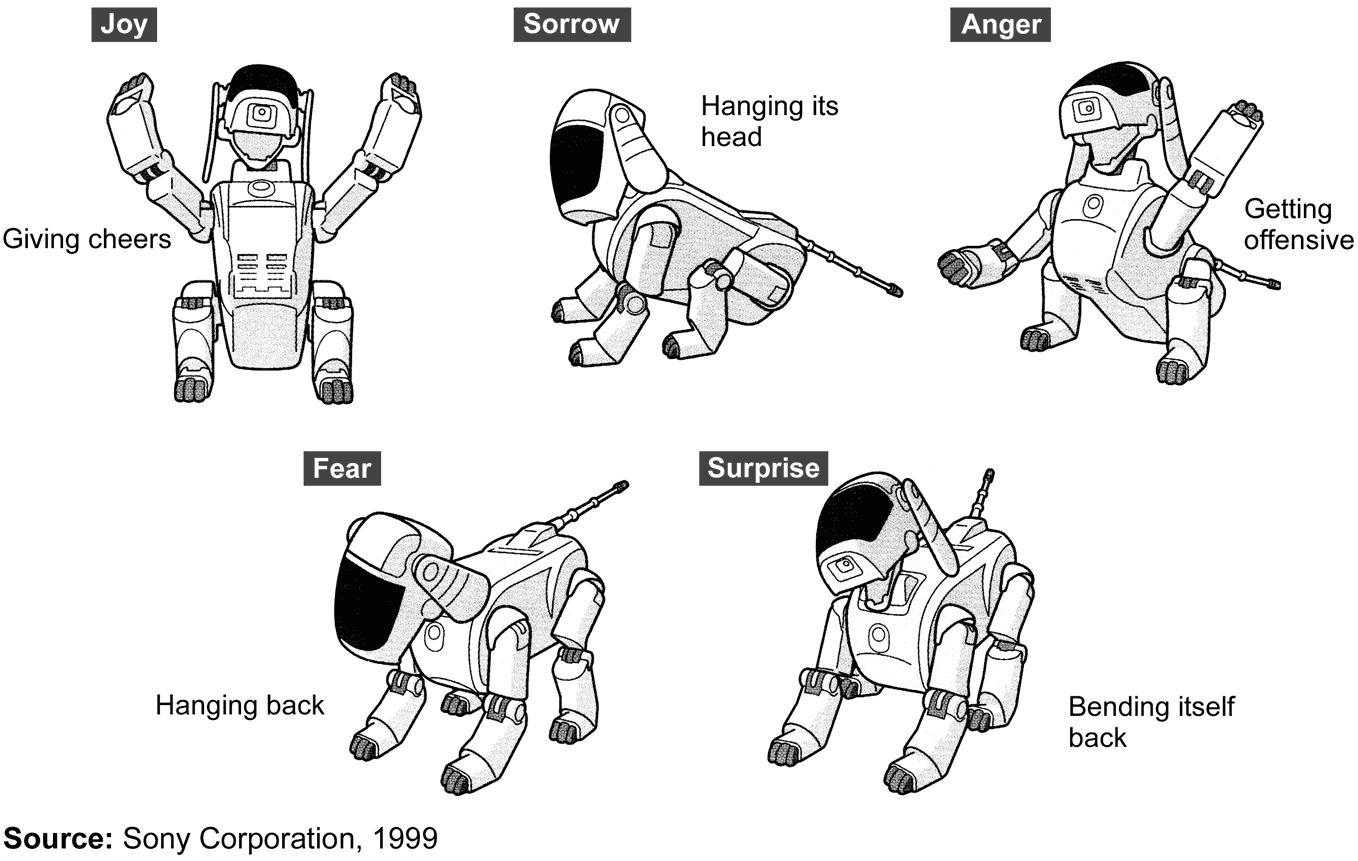
AIBO was one of several types of robotic pets designed and manufactured by Sony from 1999 to 2006. AIBO is able to walk, ‘see’ its environment via camera and recognize spoken commands in Spanish and English. AIBO are autonomous robots since they are able to learn and mature based on external stimuli from their owner, their environment, and from other AIBOs. Artist Hajime Sorayama created the initial designs for the AIBO. AIBO’s sounds were programmed by Japanese DJ/avant-garde composer Nobukazu Takemura. The International AIBO Convention takes place every year at Sony Robotics Tower in the Shinjuku prefecture.
AIBO runs AIBOware on a pink Memory Stick, which allows the robot to be raised from pup to fully grown adult while going through various stages of development as its owner interacts with it. AIBOware allows the owner to interact with a fully mature robot able to understand (though not necessarily willing to obey) 100 voice commands. Without the AIBOware, the AIBO will run in what is called ‘clinic mode’ and can only perform basic actions. Many AIBO owners enjoy teaching their pets new behaviors by reprogramming them in Sony’s special ‘R-CODE’ language. AIBO’s complete vision system uses the SIFT algorithm, to recognize its charging station. The newest versions are equipped with a Wi-Fi connection, allowing them to send the pictures they take via email which led to the Roblog.
Posted in Games, Money, Technology |
Leave a Comment »
November 30, 2011


Société Bic (pronounced ‘Bick’ in English) is a company based in Clichy, France, founded in 1945, by Baron Marcel Bich known for making disposable products including lighters, ballpoint pens, and shaving razors; they also manufacture magnets and watersports products including surfboards, kayaks, and dinghies.
The Bic pen, more correctly the Bic Cristal, was the company’s first product and 50 years later is still synonymous with the name Bic. The company’s US subsidiary accounts for more than half of the worldwide company’s sales.
Posted in Games, Money |
Leave a Comment »
November 29, 2011
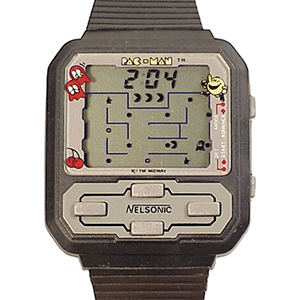
Nelsonic Industries is the name of an electronics manufacturing and development company that operated from Queens, NY in the early 1980s and throughout the 1990s when it was acquired by the watch-manufacturer, M.Z. Berger. Nelsonic produced numerous toy-themed wrist-watches during their existence, often targeting younger audiences with likenesses of characters from popular franchises such as Barbie, the Ghostbusters, and Mario. Nelsonic became notable during the early mid-1980s for being the first electronics company in the United States to produce game-watches (multi-purpose electronic devices capable of functioning as both a time-piece and as a typically electronic game). Today the original Nelsonic Game Watch line has entered the secondary market and individual Game Watches have become highly sought-after collectibles that often fetch high prices on online auction websites.
Throughout its existence, Nelsonic produced pop-culture-themed wrist-watches for children and young adults. The chronograph digital watches, typically made of molded plastic, invariably featured an alarm and utilized LCD display-screens to display the time for their wearers. In time the company began manufacturing multi-purpose units that used the LCD screen to combine time display functions with simple video game functions. These simple video games were variations on the theme of the Calculator watch.
Posted in Games, Money, Technology |
Leave a Comment »



 The Daily Omnivore