September 27, 2011

Hypermiling is the act of driving using techniques that maximize fuel economy. Those who practice these techniques are referred to as ‘hypermilers.’ Hypermiling can be practiced in any vehicle regardless of its fuel economy. It gained popularity as a result of the rise in gasoline prices during the 2000s. Some hypermiling techniques are illegal in some jurisdictions because they are dangerous. Hypermiling has come under fire from several quarters due to claims of dangerous or unlawful behavior by some hypermilers, such as tailgating larger vehicles on freeways to save fuel by drafting. As a result, the Hypermiling Safety Foundation was formed in August 2008 to promote a safety and public awareness program, advocating legal fuel-saving techniques.
Hypermiling contests have been held on selected courses. The Maximum Fuel Economy contest was held in Indiana, where ‘world records’ for the Honda Insight (213 miles per gallon), Toyota Prius (136 miles per gallon) and the Ford Escape Hybrid (76 miles per gallon) were set. Contestants used techniques which included rolling through all stop signs and having the vehicle tires inflated well beyond recommended specifications. Another contest is the Tour to the Shore, held in New Jersey, which evaluates drivers of cars and trucks.
Posted in Games, Money, Technology |
Leave a Comment »
September 26, 2011


A simulation video game describes a diverse super-category of video games, generally designed to closely simulate aspects of a real or fictional reality. Construction and management simulation (CMS) is a subtype in which players build, expand or manage fictional communities or projects with limited resources.
Strategy games sometimes incorporate CMS aspects into their game economy, as players must manage resources while expanding their project. But pure CMS games differ from strategy games in that ‘the player’s goal is not to defeat an enemy, but to build something within the context of an ongoing process.’ Games in this category are sometimes also called ‘management games.’
read more »
Posted in Games, Technology |
Leave a Comment »
September 26, 2011

Dating sims (or dating simulations) are a video game subgenre, usually Japanese, with romantic elements. They are also sometimes put under the category of ‘neoromance.’ The most common objective of dating sims is to date, usually choosing from among several characters, and to achieve a romantic relationship. They can involve several technical elements such as a time limit, several statistics such as looks and charm which can be boosted through exercise, or an ‘attraction meter’ which can increase or decrease depending on one’s decisions.
The term dating sim is also often used incorrectly as a synonym for the visual novel genre. While the two genres often share a common visual presentation, dating sims are sometimes considered to be more statistically based than the ‘choose your own adventure’ style of visual novels.
read more »
Posted in Games, Love, Sex |
Leave a Comment »
September 26, 2011

A ‘shoot ’em up’ is a subgenre of video games in which the player controls a lone character, often in a spacecraft or aircraft, facing large numbers of enemies while dodging their attacks. A variation arose in the early 1990s called ‘maniac shooters’ and ‘bullet hell,’ which required the player to dodge overwhelming numbers of enemy projectiles and called for still faster reactions. Bullet hell games arose from the need for 2D shoot ’em up developers to compete with the emerging popularity of 3D games: huge numbers of missiles on screen were intended to impress players. Toaplan’s ‘Batsugun’ (1993) provided the prototypical template for this new breed, with ‘Cave’ (formed by former employees of Toaplan, including ‘Batsugun’ creator Tsuneki Ikeda, after the latter company collapsed) inventing the type proper with 1995’s ‘DonPachi.’
Manic shooter games marked another point where the shoot ’em up genre began to cater to more dedicated players. Games such as ‘Gradius’ had been more difficult than ‘Space Invaders’ or ‘Xevious,’ but bullet hell games were yet more inward-looking and aimed at fans of the genre looking for greater challenges. Treasure’s shoot ’em up, ‘Radiant Silvergun’ (1998), introduced an element of narrative to the genre. It was lavished with critical acclaim for its refined design, though it was never released outside of Japan and remains a much sought after collectors’ item. Its successor ‘Ikaruga’ (2001) featured improved graphics and was again acclaimed as one of the best games in the genre. The genre has undergone something of a resurgence with the release of the Xbox 360 and Wii online services, and games like ‘Geometry Wars: Retro Evolved,’ while in Japan arcade shoot ’em ups retain a deep-rooted niche popularity.
Posted in Games, Money, Technology |
Leave a Comment »
September 11, 2011

Figure 8 racing is a form of automobile racing that combines elements of oval racing, demolition derby, and road racing. Racing is done on a track shaped like an 8. The cars cross paths at the center of the 8, which is known as the ‘crossover.’ Because of this layout, crashes are inevitable. Figure 8 racing is a unique sport that requires strict attention to detail and timing to successfully navigate the crossover. The oldest operating figure 8 track in the United States is Indianapolis Speedrome in Indianapolis, Indiana. The track has been in operation since the 1940s. It hosts the annual World Figure 8 race, which is considered the world championship event. The first 3 hour long endurance race was held in 1977.
Figure 8 track racing began right after World War II in the late 1940s. The track may have had an overpass so that the cars did not cross each other’s paths. Most historians believe that the first track where drivers crossed each other’s paths was the 1/5 mile long Indianapolis Speedrome. The sport received nationwide publicity when it was frequently televised on ABC’s ‘Wide World of Sports’ in the 1960s, usually from the Islip Speedway in New York. The cars used are often standard cars, but are usually modified for lightness and safety. A wing much like a sprint car may be placed on the roof to increase downforce. The cars’ bodies are typically made out of sheet metal.
Posted in Games, Humor |
Leave a Comment »
September 10, 2011

Tsundere [tsoon-dey-ray] is a Japanese character development process that describes a person who is cold and even hostile before gradually showing their warm side. The word is derived from the terms ‘Tsun Tsun,’ meaning to turn away in disgust, and ‘Dere Dere’ meaning to become ‘lovey dovey.’
Originally found in Japanese bishōjo games (or ‘gal games,’ a type of Japanese video game centered on interactions with attractive anime-style girls; a subset of dating simulators), the word is now part of the otaku moe phenomenon (a rarefied pseudo-love for fictional characters).
read more »
Posted in Games, Love, Sex |
Leave a Comment »
September 7, 2011
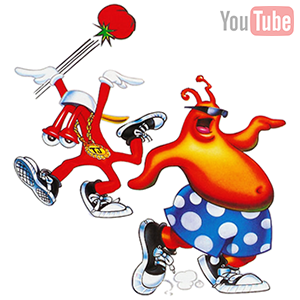
ToeJam & Earl is an action video game for the Sega Genesis (Mega Drive elsewhere). Released in 1991, it centers on the titular ToeJam and Earl—alien rappers who have crash-landed on Earth. As they attempt to escape the planet, players assume the role of either character and collect pieces of their wrecked spacecraft. ToeJam & Earl’s design was heavily influenced by the computer role-playing game Rogue, and took from it such features as the random generation of levels and items. It references and parodies 1990s urban culture and is set to a funk soundtrack. The game was positively received by critics, who praised its originality, soundtrack, humor and two-player cooperative mode. It attained sleeper hit status despite low initial sales, and its protagonists were used as mascots by Sega. Several sequels were produced for other consoles, but their commercial and critical success was mixed.
The game has been called a surreal, comic satire, and a ‘daringly misanthropic commentary on Earthly life.’ ToeJam, a red, three-legged alien, wears a large gold medallion and a backwards baseball cap, while the rotund and orange Earl is marked by high-tops and oversized sunglasses; both outfits are ‘over-the-top appropriations’ of 1990s urban culture. Their speech features California slang. The game is set to a jazz-funk and hiphop soundtrack inspired by Herbie Hancock.
read more »
Posted in Art, Games, Humor |
Leave a Comment »
September 7, 2011

Mountainboarding is a well established, if little-known extreme sport, derived from snowboarding. A mountainboard is made up of components including a deck, bindings to secure the rider to the deck, four wheels with pneumatic tires, and two steering mechanisms known as trucks.
Mountainboarders ride specifically designed boardercross tracks, slopestyle parks, grass hills, woodlands, gravel tracks, streets, skateparks, ski resorts, BMX courses and mountain bike trails. It is this ability to ride such a variety of terrain that separates mountainboarding from other board sports.
read more »
Posted in Games, Technology |
Leave a Comment »
August 25, 2011

Persistence hunting is a hunting technique in which hunters use a combination of running and tracking to pursue prey to the point of exhaustion. While humans can sweat to reduce body heat their quadruped prey would need to slow from a gallop to pant. Today, it is very rare and seen only in a few groups such as Kalahari bushmen and the Tarahumara or Raramuri people of Northern Mexico. Persistence hunting requires endurance running – running many miles for extended periods of time. Among primates, endurance running is only seen in humans, and persistence hunting is thought to have been one of the earliest forms of human hunting, having evolved 2 million years ago.
The persistence hunt may well have been the first form of hunting practiced by hominids. It is likely that this method of hunting evolved before humans invented projectile weapons, such as darts, spears, or slings. Since they could not kill their prey from a distance and were not fast enough to catch the animal, one reliable way to kill it would have been to run it down over a long distance.
read more »
Posted in Food, Games, Science |
1 Comment »
August 25, 2011
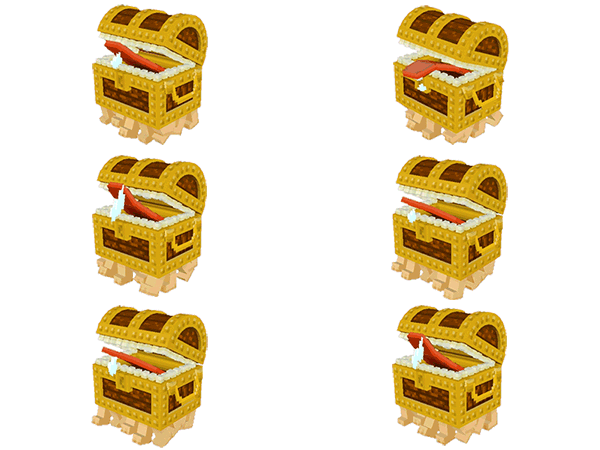
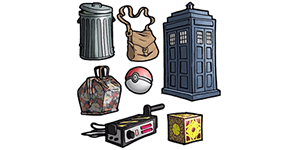
Magic satchel is a term often used in reference to role-playing video games. It refers to the use of a character’s inventory in the game, which can often contain more items (or items of too large a size) than is physically possible for the character to carry without any visible means to hold or transport them. The concept is so common in fantasy fiction that it is parodied by the character The Luggage in Terry Pratchett’s ‘Discworld’ series, a semi-sentient, bottomless treasure chest that follows its owner around.
The term ‘hammerspace’ describes the seemingly invisible place from which fictional characters, such as cartoon characters, pull out very large objects, such as mallets. Technically the term hammerspace is not used to refer to a magic satchel itself, but rather the area or pocket of space that a magic satchel occupies; a magic satchel is like a door to hammerspace. The ‘bag of holding’ is a similar concept in the role-playing game ‘Dungeons & Dragons.’ A real-world example is the clown car which often is used in the circus, in which numerous clowns clamber out of a tiny automobile.
read more »
Posted in Games, Humor |
1 Comment »
August 25, 2011


Hammerspace (also known as malletspace) is a fan-envisioned extradimensional, instantly accessible storage area in fiction, which is used to explain how animated, comic and game characters can produce objects out of thin air. Inexplicable production of items dates back to the very beginning of animated shorts and was a fairly common occurrence during the golden age of animation. Warner Bros. cartoon characters are particularly well-known for often pulling all sorts of things — guns, disguises, bombs, anvils, mallets— from behind their backs or just offscreen. However, the explanation for this phenomenon was mostly just left to suspension of disbelief.
The term ‘Hammerspace’ itself originates from a gag common in certain anime and manga. A typical example would be when a male character would anger or otherwise offend a female character, who would proceed to produce, out of thin air, an oversized wooden rice mallet (saizuchi) and hit him on the head with it in an exaggerated manner. The strike would be purely for comic effect, and would not have any long-lasting effects. The term was largely popularized first by fans of ‘Urusei Yatsura’ (a comedic manga, popular in the 1980s).
read more »
Posted in Games, Humor, Language |
1 Comment »
August 18, 2011

The Adidas Samba is an indoor soccer training shoe. It has been among Adidas’ most popular, best selling shoes in recent times, the second best sold Adidas shoe ever with over 35 million sold pairs worldwide, behind the legendary Adidas Stan Smith. It is produced in a variety of color schemes, yet the classic black with three white stripes is the most popular. The shoe features a tan gumsole that distinguishes it from other Adidas shoes.
The shoe was first produced in 1950 to enable association football players to train on icy hard ground (hence the suction cups on the gumsole). Its original design featured the classic three stripes, as well as the gold trefoil on the foldable tongue. As years progressed, the Samba evolved into the Samba Millennium (which was made without the extended tongue) and the Samba ’85. Classic models of the shoe are still in production, under the name Classic M. the original model is sometimes used for training, street play, and futsal (a variant of indoor soccer).
Posted in Games, Money |
Leave a Comment »




 The Daily Omnivore