April 19, 2011
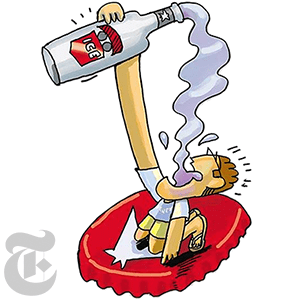
Icing is a drinking game in which players are required to bend down on one knee and chug a bottle of Smirnoff Ice. Participants are encouraged to come up with elaborate ways to present the Ice to their targets by hiding bottles in inconspicuous locations, or in situations where drinking it would be dangerous or embarrassing (e.g. before they drive somewhere, attend a meeting, etc.). Failure to drink, no matter the circumstance, results in the humiliation of the victim, and players are encouraged to mistreat those who refuse to play.
The target of an Icing can perform an ‘ice block’ by grabbing a Smirnoff Ice within arms reach (e.g. on his person). An ice block can be in the form of any size Smirnoff Ice, thus upping the stakes for the challenger. Once the player presents this ice block to the original player, the original player must drink both ices. You can ice block an ice block, even though this would lead to back and forth infinite ice blocks. Refusal to consume an Ice results in excommunication, meaning that that player can no longer ice anyone or get iced. Furthermore, you cannot pour it into any other drinking container to mimic another liquid. This is punishable by drinking that said ice.
Posted in Food, Games, Humor |
Leave a Comment »
April 14, 2011
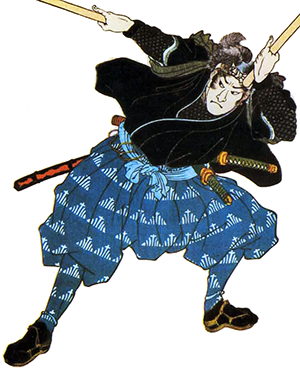
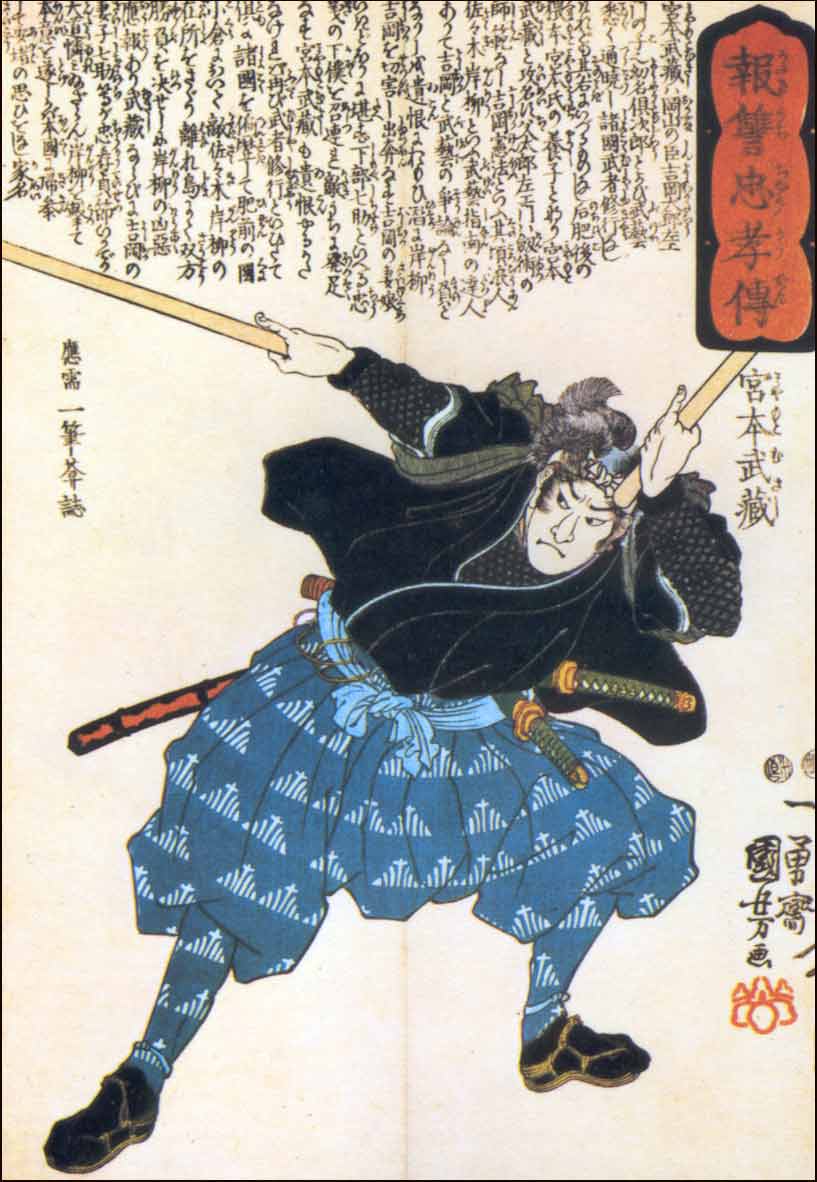
Miyamoto Musashi (c. 1584– 1645) was a Japanese swordsman and samurai famed for his duels and distinctive style. He became renowned through stories of his excellent swordsmanship in numerous duels, even from a very young age.
He was the founder of the Niten-ryū style of swordsmanship and the author of ‘The Book of Five Rings,’ a book on strategy, tactics, and philosophy that is still studied today.
read more »
Posted in Games, Philosophy, War |
Leave a Comment »
April 14, 2011

Downhill biking (DH) is a gravity-assisted time trial mountain biking event. Riders race against the clock, usually starting at intervals of 30 seconds (seeded from slowest to fastest), on courses which typically take two to five minutes to complete. Riders are timed with equipment similar to that used in Downhill skiing. The placing is determined by the fastest times to complete the course; races are often won by margins of under a second.
As the name of this discipline implies, downhill races are held on steep, downhill terrain with no extended climbing sections, resulting in high speed descents with extended air time off jumps and other obstacles. Portugal is the host country of a Unique variety of down hill races, the Urban Down Hill, known as the ‘Lisbon Down Town,’ held annually in May. The ‘Cerro Abajo’ race in Valparaiso, Chile is another annual urban downhill event.
Posted in Games, World |
Leave a Comment »
April 14, 2011

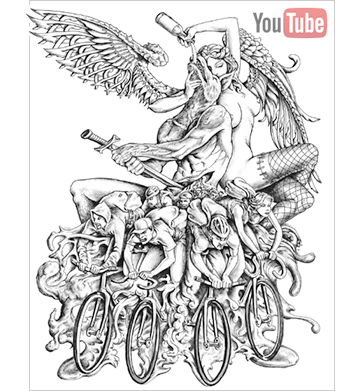
An Alleycat race is an informal bicycle race. Alleycats almost always take place in cities, and are often organized by bicycle messengers. The informality of the organization is matched by the emphasis on taking part, rather than simple competition. Many Alleycats present prizes for the last competitor to finish (sometimes known as Dead Friggin’ Last or DFL).
The first race to be called ‘Alleycat’ was held in Toronto in 1989. Regularly organized Alleycats can be found in cities across North America, Europe and Asia. Many smaller cities with no cycle messenger population are also home to alleycats run by the burgeoning urban cyclist subculture.
read more »
Posted in Games, Humor |
Leave a Comment »
April 13, 2011


Designer toys are collectibles that are produced in limited editions (as few as 10 or as many as 2000 pieces) and created by artists and designers. Designer toys are made of variety of materials; ABS plastic and vinyl are most common, although wood, metal, and resin are occasionally used. The term also encompasses plush, cloth and latex dolls.
read more »
Posted in Art, Games, Money |
Leave a Comment »
April 13, 2011

Club 57 was a nightclub located at 57 St. Mark’s Place in the East Village, New York City during the late 1970s and early 1980s. It was a hangout and venue for performance- and visual-artists and musicians, including Keith Haring, Klaus Nomi, and to a lesser extent, Jean-Michel Basquiat.
read more »
Posted in Art, Games, Money |
Leave a Comment »
April 11, 2011

A jinx [jingks], in popular superstition and folklore, is: a type of curse placed on a person that makes them prey to many minor misfortunes and other forms of bad luck; a person afflicted with a similar curse, who, while not directly subject to a series of misfortunes, seems to attract them to anyone in his vicinity; and an object/ person that brings bad luck.
Jinx is also a children’s game (although not necessarily played only by children) with myriad rules and penalties that occurs when two people unintentionally or intentionally speak (or type) the same word or phrase simultaneously.
read more »
Posted in Games, Humor, Language |
Leave a Comment »
April 11, 2011

The Candle Problem is a cognitive performance test, measuring the influence of functional fixedness on a participant’s problem solving capabilities. The test was created by Gestalt psychologist Karl Duncker and published posthumously in 1945. The test presents the participant with the following task: how to fix a lit candle on a wall (a cork board) in a way so the candle wax won’t drip onto the table below. To do so, one may only use the following along with the candle: a book of matches and a box of thumbtacks.
The solution is to empty the box of thumbtacks, put the candle into the box, use the thumbtacks to nail the box (with the candle in it) to the wall, and light the candle with the match. The concept of functional fixedness predicts that the participant will only see the box as a device to hold the thumbtacks and not immediately perceive it as a separate and functional component available to be used in solving the task. However, if the task is presented with the tacks piled next to the box (rather than inside it), virtually all of the participants were shown to achieve the optimal solution.
Posted in Games, Science |
Leave a Comment »
April 11, 2011

Beginner’s luck refers to the supposed phenomenon of novices experiencing disproportionate frequency of success or succeeding against an expert in a given activity. One would expect experts to outperform novices – when the opposite happens it is counter-intuitive, hence the need for a term to describe this phenomenon.
The term is most often used in reference to a first attempt in sport or gambling, but is also used in many other diverse contexts. The term is also used when no skill whatsoever is involved, such as a first-time slot machine player winning the jackpot.
read more »
Posted in Games, Language, Philosophy |
Leave a Comment »
April 11, 2011
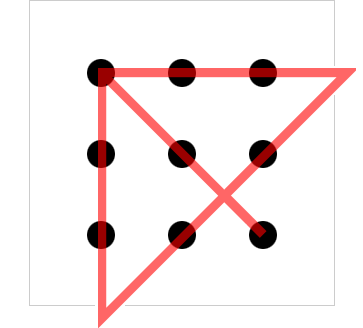
‘Thinking outside the box‘ is to think differently, unconventionally or from a new perspective. This is sometimes called a process of lateral thought. As catchphrase, or cliché, it has become widely used in business environments, especially by management consultants and executive coaches, and has spawned a number of advertising slogans. To think outside the box is to look further and to try not thinking of the obvious things, but to try thinking beyond them.
The origins of the phrase are obscure; but it was popularized in part because of a nine-dot puzzle, which British author, John Adair claims to have introduced in 1969. The puzzle proposed an intellectual challenge—to connect the dots by drawing four straight, continuous lines that pass through each of the nine dots, and never lifting the pencil from the paper. The conundrum is easily resolved, but only if you draw the lines outside the confines of the square area defined by the nine dots themselves.
Posted in Games, Language, Money |
Leave a Comment »
April 11, 2011

Amigurumi [ah-mee-goo-roo-mee] is the Japanese art of knitting or crocheting small stuffed animals and anthropomorphic creatures. The word is derived from a combination of the Japanese words ‘ami,’ meaning crocheted or knitted, and ‘nuigurumi,’ meaning stuffed doll. The pervading aesthetic of amigurumi is cuteness. To this end, typical amigurumi animals have an over-sized spherical head on a cylindrical body with undersized extremities.
Amigurumi are usually crocheted out of yarn using the single crochet stitch. They can also be knit. Typically, crochet hooks or knitting needles that are slightly smaller than normal are used, in order to achieve a tight gauge that retains stuffing. Stuffing is usually standard polyester or cotton craft stuffing, but may be improvised from other materials. Plastic pellets may be inserted beneath stuffing in order to distribute weight at the bottom of the figure. They are usually worked in sections and then joined, except for some amigurumi which have no limbs, only a head and torso which are worked as one piece.
Posted in Art, Games, World |
2 Comments »
April 7, 2011
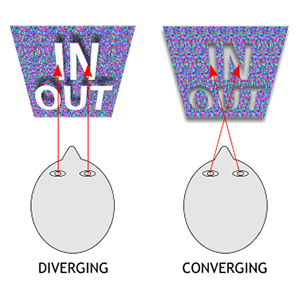
An autostereogram [aw-toh-ster-ee-uh-gram] is a stereogram (an optical illusion of depth created from flat images), designed to create the visual illusion of a three-dimensional scene from a two-dimensional image in the human brain.
In order to perceive 3D shapes in these autostereograms, the brain must overcome the normally automatic coordination between focusing and vergence (the simultaneous movement of both eyes in opposite directions to obtain or maintain single binocular vision).
read more »
Posted in Art, Games, Technology |
Leave a Comment »





 The Daily Omnivore