October 27, 2012

Lunchables is a line of lunch combinations manufactured by Kraft Foods, Inc, beginning in 1988. They are marketed under the Oscar Mayer brand in the United States and Dairylea in the United Kingdom. Many Lunchables products are produced at Kraft Foods, Inc.’s Fullerton factory in Fullerton, California, and are then distributed across the nation.
A typical Lunchables meal combination includes crackers, small slices of meat, and an equal number of slices of cheese. Other varieties include pizza, small hot dogs, small burgers, nachos, subs, and wraps. Overall there are 25 different kinds of Lunchables meals. ‘Deluxe’ versions, which were originally developed for adults, included two types of meats and two types of cheeses. Deluxe versions usually also contained a sauce and a mint.
read more »
Posted in Food, Health, Money |
Leave a Comment »
October 27, 2012
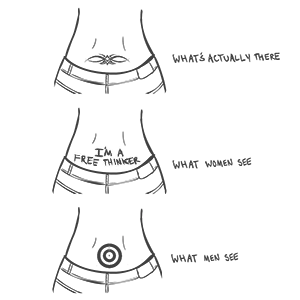
Lower-back tattoos (often referred to as tramp stamps) are a form of body art that became popular among women in the 2000s and gained a reputation as a feminine type of tattoo. Although historically men comprised the majority of tattoo recipients, in the early 1990s, the practice gained popularity among women. In the early to mid-20th century, women with tattoos were heavily stigmatized, and were rarely found in middle-class society. Lower-back tattoos were popularized in the early 2000s, in part owing to the influence of celebrities, including Britney Spears, Christina Ricci, and Pamela Anderson. The popularity of low-rise jeans and crop tops may have also spurred the increase in lower-back tattoos.
Another appeal of tattooing the lower back is that there is little fat there, lessening the chance that images will become misshapen over time. Also, the lower back is often concealed, providing women the choice of when to reveal their tattoo. Medical practitioners who administer anesthesia have questioned whether epidural analgesia should be provided to women with lower-back tattoos. Concerns have emerged that epidural catheters may cause tattoo pigment to enter interspinous ligaments and other areas, potentially leading to health problems. There is general consensus that epidural catheters should not be placed through irritated or infected tattoos. However, harm has not been clearly documented when placing epidural catheters through healthy tattooed skin.
Posted in Art, Health, Sex |
Leave a Comment »
October 27, 2012

The cocktail party effect is the phenomenon of being able to focus one’s auditory attention on a particular stimulus while filtering out a range of other stimuli, much the same way that a party-goer can focus on a single conversation in a noisy room. This effect is what allows most people to ‘tune in’ to a single voice and ‘tune out’ all others. It may also describe a similar phenomenon that occurs when one may immediately detect words of importance originating from unattended stimuli, for instance hearing one’s name in another conversation.
The cocktail party effect works best as a binaural effect, which requires hearing with both ears. People with only one functional ear seems much more disturbed by interfering noise. However, even without binaural location information, individuals can selectively attend to one particular speaker if the pitch of their voice or the topic of their speech is sufficiently distinctive (albeit with greater difficulty). This phenomenon is still very much a subject of research, in humans as well as in computer implementations (where it is typically referred to as source separation or blind source separation).
read more »
Posted in Health, Science, Technology |
Leave a Comment »
October 24, 2012


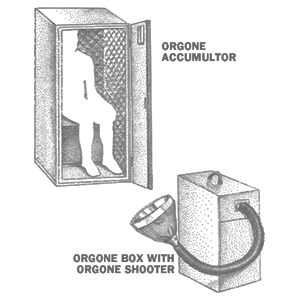
Orgone [awr-gohn] energy was a hypothetical universal life force originally proposed in the 1930s by Austrian psychiatrist Wilhelm Reich. In its final conception, developed by Reich’s student Charles Kelly after Reich’s death, Orgone was conceived as the anti-entropic principle of the universe, a creative substratum in all of nature comparable to Mesmer’s animal magnetism, the Odic force of Carl Reichenbach and Henri Bergson’s élan vital.
Orgone was seen as a massless, omnipresent substance, similar to luminiferous aether, but more closely associated with living energy than inert matter. It could coalesce to create organization on all scales, from the smallest microscopic units—called bions in orgone theory—to macroscopic structures like organisms, clouds, or even galaxies. Reich’s theories held that deficits or constrictions in bodily orgone were at the root of many diseases—including cancer—much as deficits or constrictions in the libido could produce neuroses in Freudian theory.
read more »
Posted in Health, Science, Sex |
Leave a Comment »
October 24, 2012
Within the work of the Austrian psychoanalyst Wilhelm Reich (1897–1957), the term orgastic potency referred to the ability to experience an orgasm with specific psychosomatic characteristics. Reich described it as ‘the real emotional experience of the loss of your ego, of your whole spiritual self,’ and believed it was essential for the capacity to love.
For Reich, ‘orgastic impotence,’ or failure to attain orgastic potency (not to be confused with anorgasmia, the inability to reach orgasm), meant that the undischarged libido, which he saw as a physical energy, might cause illness. This he defined as neurosis, arguing that ‘not a single neurotic individual possesses orgastic potency.’ According to one of his followers, Elsworth Baker, someone who can attain orgastic potency ‘cannot maintain a neurosis.’
read more »
Posted in Health, Science, Sex |
Leave a Comment »
October 24, 2012

The quarterlife crisis is a period of life following the major changes of adolescence, usually ranging from the late teens to the early thirties, in which a person begins to feel doubtful about their own lives, brought on by the stress of becoming an adult. The term was coined by analogy with mid-life crisis. It occurs shortly after a young person enters the ‘real world.’ Austrian psychologist Erik H. Erikson, who described eight crises that humans face during their development, proposed the existence of a life crisis occurring at this age.
The conflict he associated with young adulthood is the ‘Intimacy vs. Isolation’ crisis. According to him, after establishing a personal identity in adolescence, young adults seek to form intense, usually romantic relationships with other people. The notion of the quarter-life crisis is explored by the 1967 film ‘The Graduate,’ one of the first film depictions of this issue. Other notable films that also do so are ‘Garden State,’ ‘High Fidelity,’ and ‘Lost in Translation.’ The 2008 web series ‘Quarterlife’ was so named for the phenomenon.
Posted in Education, Health |
Leave a Comment »
October 24, 2012
Identity crisis, according to psychologist Erik Erikson, is the failure to achieve ego identity during adolescence. Erikson coined the term. The stage of psychosocial development in which identity crisis may occur is called the ‘Identity Cohesion versus Role Confusion’ stage. During this stage (adolescence), we are faced with physical growth, sexual maturation, and integrating our ideas of ourselves and about what others think of us. We therefore form our self-image and endure the task of resolving the crisis of our basic ego identity.
Successful resolution of the crisis depends on one’s progress through previous developmental stages, centering on issues such as trust, autonomy, and initiative. Those who emerge from the adolescent stage of personality development with a strong sense of identity are well equipped to face adulthood with confidence and certainty. This sort of unresolved crisis leaves individuals struggling to ‘find themselves.’ They may go on to seek a negative identity, which may involve crime or drugs or the inability to make defining choices about the future. ‘The basic strength that should develop during adolescence is fidelity, which emerges from a cohesive ego identity.’
read more »
Posted in Health |
Leave a Comment »
October 24, 2012
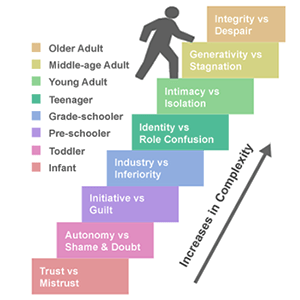
Erikson’s stages of psychosocial development are eight stages through which a healthily developing human should pass from infancy to late adulthood, according to neo-Freudian psychologist Erik Erikson. In each stage the person confronts, and hopefully masters, new challenges. Each stage builds on the successful completion of earlier stages. The challenges of stages not successfully completed may be expected to reappear as problems in the future. However, mastery of a stage is not required to advance to the next stage.
Erikson’s stage theory characterizes an individual advancing through the eight life stages as a function of negotiating his or her biological forces and sociocultural forces. Each stage is characterized by a psycho social crisis of these two conflicting forces. If an individual does indeed successfully reconcile these forces (favoring the first mentioned attribute in the crisis), he or she emerges from the stage with the corresponding virtue. For example, if an infant enters into the toddler stage (autonomy vs. shame & doubt) with more trust than mistrust, he or she carries the virtue of hope into the remaining life stages.
read more »
Posted in Health, Philosophy, Science |
Leave a Comment »
October 24, 2012
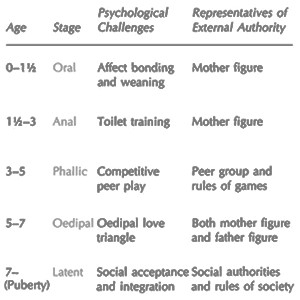
In Freudian psychology, psychosexual development is a central element of the psychoanalytic sexual drive theory, that human beings, from birth, possess an instinctual libido (sexual appetite) that develops in five stages.
Each stage — the oral, the anal, the phallic, the latent, and the genital — is characterized by the erogenous zone that is the source of the libidinal drive. Sigmund Freud proposed that if the child experienced sexual frustration in relation to any psychosexual developmental stage, s/he would experience anxiety that would persist into adulthood as a neurosis, a functional mental disorder.
read more »
Posted in Health, Sex |
Leave a Comment »
October 23, 2012

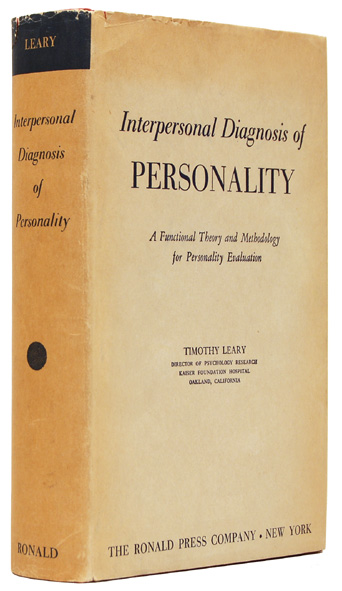
Interpersonal reflex is a term created by Timothy Leary and explained in the book, ‘Interpersonal Diagnosis of Personality: A functional theory and methodology for personality evaluation’ (1957). While examining recorded protocols of communications in adults, Leary discovered that typical patterns of interaction existed. Individual units of these behaviors were called interpersonal mechanisms or interpersonal reflexes: ‘They are defined as the observable, expressive units of face-to-face social behavior.’ These reflexes are automatic and involuntary responses to interpersonal situations. They are independent of the content of the communication. They are the individual’s spontaneous methods of reacting to others.
Leary states, ‘The reflex manner in which human beings react to others and train others to respond to them in selective ways is, I believe, the most important single aspect of personality. The systematic estimates of a patient’s repertoire of interpersonal reflexes is a key factor in functional diagnosis.’ Examining interpersonal reflexes helps to explain communication and behavioral patterns in healthy and unhealthy relationships. For example, tender, supportive operations tend to train others to agree, conciliate, and depend. Rigid autocratic individuals seek out docile admiring followers. Competitive, self-enhancing behavior pulls envy, distrust, inferiority feelings, and at times respectful admiration from others.
Posted in Health, Philosophy, Science |
Leave a Comment »
October 23, 2012

The interpersonal circumplex is a model for conceptualizing, organizing, and assessing interpersonal behavior, traits, and motives. It is defined by two orthogonal axes: a vertical axis (of status, dominance, power, or control) and a horizontal axis (of solidarity, friendliness, warmth, or love).
In recent years, it has become conventional to identify the vertical and horizontal axes with the broad constructs of agency and communion. Thus, each point in the interpersonal circumplex space can be specified as a weighted combination of agency and communion.
read more »
Posted in Health, Philosophy, Science |
Leave a Comment »
October 23, 2012

The eight-circuit model of consciousness is a transhuman (an intermediary form between the human and a hypothetical posthuman) theory proposed by Timothy Leary and expanded on by Robert Anton Wilson and Antero Alli. The model describes eight circuits of information (eight ‘brains’) that operate within the human nervous system.
Each circuit is concerned with a different sphere of activity. The lower four, the ‘larval circuits,’ deal with normal psychology, while the upper four, the ‘stellar circuits,’ deal with psychic, mystical, enlightened and psychedelic states of mind.
read more »
Posted in Drugs, Health, Philosophy |
Leave a Comment »


 The Daily Omnivore