October 9, 2012

A powered exoskeleton, also known as powered armor, or exoframe, is a powered mobile machine consisting primarily of an exoskeleton-like framework worn by a person and a power supply that supplies at least part of the activation-energy for limb movement. Powered exoskeletons are designed to assist and protect the wearer. They may be designed, for example, to assist and protect soldiers and construction workers, or to aid the survival of people in other dangerous environments. A wide medical market exists in the future of prosthetics to provide mobility assistance for aged and infirm people.
Other possibilities include rescue work, such as in collapsed buildings, in which the device might allow a rescue worker to lift heavy debris, while simultaneously protecting the worker from falling rubble. A fictional ‘mech’ is different from a powered exoskeleton in that the mecha is typically much larger than a normal human body, and does not directly enhance the motion or strength of the physical limbs. Instead the human operator occupies a cabin or pilot’s control seat inside a small portion of the larger system. Within this cabin the human may wear a small lightweight exoskeleton that serves as a haptic control interface for the much larger exterior appendages.
read more »
Posted in Health, Technology, War |
Leave a Comment »
October 9, 2012

‘Conversion therapy‘ (also known as ‘Reparative therapy’) is a pseudo-scientific therapy that aims to change sexual orientation. Mainstream American medical and scientific organizations have expressed concern over conversion therapy and consider it potentially harmful. The advancement of conversion therapy may cause social harm by disseminating inaccurate views about sexual orientation. As a result, conversion therapy on minors is illegal in California.
The American Psychiatric Association has condemned psychiatric ‘treatment’ which is ‘based upon the assumption that homosexuality per se is a mental disorder or based upon the a priori assumption that a patient should change his/her sexual homosexual orientation.’ It states that, ‘Ethical practitioners refrain from attempts to change individuals’ sexual orientation.’ And that political and moral debates over the integration of gays and lesbians into the mainstream of American society have obscured scientific data about changing sexual orientation ‘by calling into question the motives and even the character of individuals on both sides of the issue.’
read more »
Posted in Health, Philosophy, Sex |
1 Comment »
October 3, 2012
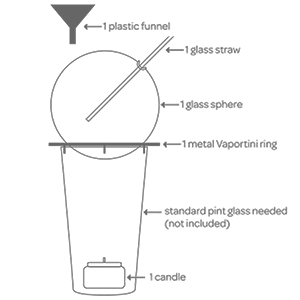
Alcohol Without Liquid is a process introduced first in Asia and Europe that allows people to take in liquor (distilled spirits) without actually consuming liquid. The machine vaporizes alcohol and mixes it with oxygen, allowing the consumer to breathe in the mixture.
The machine has been dubbed AWOL, a play on the military term AWOL (Absent Without Leave). The AWOL machine produces a very fine alcoholic mist. The continual intake of this mist over a twenty-minute period is the equivalent of taking one shot of distilled spirits. The machine was introduced to the United States in 2004.
read more »
Posted in Drugs, Health, Technology |
1 Comment »
October 2, 2012


Whole brain emulation or mind uploading (sometimes called mind transfer) is the hypothetical process of transferring or copying a conscious mind from a brain to a non-biological substrate by scanning and mapping a biological brain in detail and copying its state into a computer system or another computational device.
The computer would have to run a simulation model so faithful to the original that it would behave in essentially the same way as the original brain, or for all practical purposes, indistinguishably. The simulated mind is assumed to be part of a virtual reality simulated world, supported by an anatomic 3D body simulation model. Alternatively, the simulated mind could be assumed to reside in a computer inside (or connected to) a humanoid robot or a biological body, replacing its brain.
read more »
Posted in Health, Philosophy, Technology |
6 Comments »
October 2, 2012

A posthuman is a concept originating notably in the fields of science fiction, futurology, contemporary art, and philosophy.
These multiple and interactive origins have contributed to profound confusion over the similarities and differences between the posthuman of ‘posthumanism’ (a line of philosophical reasoning) and the posthuman of ‘transhumanism’ (an intermediary form between the human and the hypothetical posthuman).
read more »
Posted in Health, Philosophy, Technology |
1 Comment »
October 1, 2012
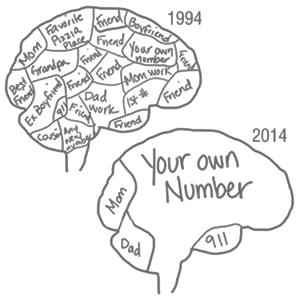
‘Is Google Making Us Stupid? What the Internet is doing to our brains’ is a magazine article by technology writer Nicholas G. Carr highly critical of the Internet’s effect on cognition. It was published in ‘The Atlantic’ magazine as a six-page cover story in 2008.
Carr’s main argument is that the Internet might have detrimental effects on cognition that diminish the capacity for concentration and contemplation. Despite the title, the article is not specifically targeted at Google, but more at the cognitive impact of the Internet and World Wide Web.
read more »
Posted in Education, Health, Technology |
Leave a Comment »
October 1, 2012

‘The Extended Mind‘ is a book in the field of philosophy of mind edited by MIT philosopher Richard Menary. It contains several papers by different philosophers. The ‘extended mind thesis’ (EMT) refers to an emerging concept that addresses the question as to the division point between the mind and the environment by promoting the view of active externalism.
The EMT proposes that some objects in the external environment are utilized by the mind in such a way that the objects can be seen as extensions of the mind itself. Specifically, the mind is seen to encompass every level of the cognitive process, which will often include the use of environmental aids.
read more »
Posted in Health, Philosophy, Technology |
Leave a Comment »
September 30, 2012
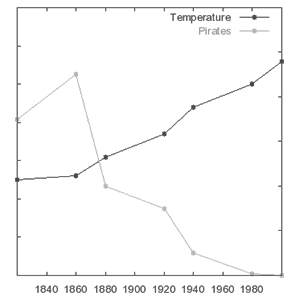
‘Correlation does not imply causation‘ is a phrase used in science and statistics to emphasize that a relationship between two variables does not automatically imply that one causes the other. The opposite belief, ‘correlation proves causation,’ is one of several questionable cause logical fallacies by which two events that occur together are claimed to have a cause-and-effect relationship.
The fallacy is also known as ‘cum hoc ergo propter hoc’ (Latin for ‘with this, therefore because of this’) and ‘false cause.’ It is a common fallacy in which it is assumed that, because two things or events occur together, one must be the cause of the other. By contrast, the fallacy, ‘post hoc ergo propter hoc,’ requires that one event occur after the other, and so may be considered a related fallacy.
read more »
Posted in Health, Language, Science |
Leave a Comment »
September 30, 2012
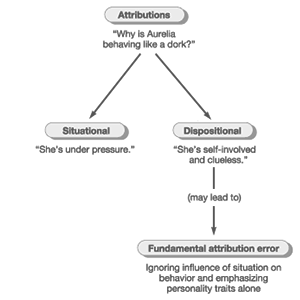
Actor-observer asymmetry (also actor-observer bias) explains the errors that one makes when forming attributions about behavior. When a person judges their own behavior, and they are the actor, they are more likely to attribute their actions to the particular situation than to a generalization about their personality. Yet when a person is attributing the behavior of another person, thus acting as the observer; they are more likely to attribute this behavior to the person’s overall disposition than as a result of situational factors.
People are more likely to see their own behavior as affected by the situation they are in, or the sequence of occurrences that have happened to them throughout their day. But, they see other people’s actions as solely a product of their overall personality, and they do not afford them the chance to explain their behavior as exclusively a result of a situational effect.
read more »
Posted in Health, Science |
Leave a Comment »
September 29, 2012
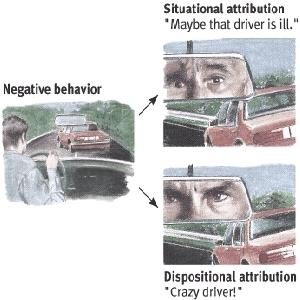
In social psychology, the fundamental attribution error describes the tendency to over-value dispositional or personality-based explanations for the observed behaviors of others while under-valuing situational explanations for those behaviors.
The fundamental attribution error is most visible when people explain the behavior of others. It does not explain interpretations of one’s own behavior—where situational factors are often taken into consideration. This discrepancy is called the actor–observer bias. As a simple example, if Alice saw Bob trip over a rock and fall, Alice might consider Bob to be clumsy or careless (dispositional). If Alice tripped over the same rock herself, she would be more likely to blame the placement of the rock (situational).
read more »
Posted in Health, Science |
Leave a Comment »
September 29, 2012
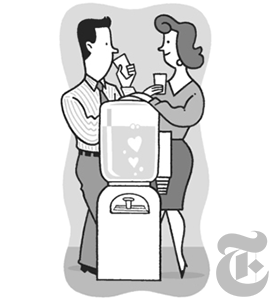
The mere-exposure effect is a psychological phenomenon by which people tend to develop a preference for things merely because they are familiar with them. In social psychology, this effect is sometimes called the familiarity principle. The effect has been demonstrated with many kinds of things, including words, Chinese characters, paintings, pictures of faces, geometric figures, and sounds. In studies of interpersonal attraction, the more often a person is seen by someone, the more pleasing and likeable that person appears to be.
The earliest known research on the effect was conducted by Gustav Fechner in 1876. Edward B. Titchener also documented the effect and described the ‘glow of warmth’ felt in the presence of something that is familiar. However, Titchener’s hypothesis was thrown out once tested and results showed that the enhancement of preferences for objects did not depend on the individual’s subjective impressions of how familiar the objects were. The rejection of Titchener’s hypothesis spurred further research and the development of current theory.
read more »
Posted in Health, Money, Science |
Leave a Comment »
September 25, 2012


Deaf culture describes the communities that are affected by deafness and which use sign languages as the main means of communication. When used as a cultural label, the word deaf is often written with a capital ‘D,’ and referred to as ‘big D Deaf’ in speech and sign. When used as a label for the audiological condition, it is written with a lower case ‘d.’ Members of the Deaf community tend to view deafness as a difference in human experience rather than a disability, preferring to be called ‘Deaf’ or ‘Hard of Hearing’ than ‘Hearing Impaired,’ which most people think is the most acceptable term today.
The community may include family members of deaf people and sign-language interpreters who identify with Deaf culture and does not automatically include all people who are hard of hearing. According to sign-language interpreter Anna Mindess, ‘it is not the extent of hearing loss that defines a member of the Deaf community but the individual’s own sense of identity and resultant actions.’ As with all social groups that a person chooses to belong to, a person is a member of the Deaf community if he or she ‘identifies him/herself as a member of the Deaf community, and other members accept that person as a part of the community.’
read more »
Posted in Health, Language, Politics |
Leave a Comment »



