September 19, 2012

Learned optimism is the idea in positive psychology that a talent for joy, like any other, can be cultivated. It is contrasted with learned helplessness. Learning optimism is done by consciously challenging any negative self talk. The concept was created by psychologist Martin Seligman (who also coined ‘learned helplessness’) and published in his 1990 book, ‘Learned Optimism.’
The benefits of an optimistic outlook are many: Optimists are higher achievers and have better overall health. Pessimism, on the other hand, is much more common. Pessimists are more likely to give up in the face of adversity or to suffer from depression. In his book, Seligman invites pessimists to learn to be optimists by thinking about their reactions to adversity in a new way. The resulting optimism — one that grew from pessimism — is a learned optimism.
read more »
Posted in Health, War |
Leave a Comment »
September 19, 2012

Learned industriousness is a behaviorally rooted theory developed by Robert Eisenberger to explain the differences in general work effort among people of equivalent ability. According to Eisenberger, individuals who are reinforced for exerting high effort on a task are also secondarily reinforced by the sensation of high effort. Individuals with a history of this high effort reinforcement are more likely to generalize high effort to other behaviors.
This has been supported in the literature across a variety of different experimental settings. An individual is considered industrious if he or she demonstrates perseverance and determination in performing a task. This term has also been used interchangeably with work ethic, which is generally regarded as the attitude that hard work and effort is virtuous. Learned industriousness theory asserts that industriousness is developed over time through a history of reinforcement.
read more »
Posted in Health |
Leave a Comment »
September 19, 2012


Learned helplessness is a technical term that refers to the condition of a human or animal that has learned to behave helplessly, failing to respond even though there are opportunities for it to help itself by avoiding unpleasant circumstances or by gaining positive rewards. Learned helplessness theory is the view that clinical depression and related mental illnesses may result from a perceived absence of control over the outcome of a situation.
Organisms which have been ineffective and less sensitive in determining the consequences of their behavior are defined as having acquired learned helplessness. American psychologist Martin Seligman’s foundational experiments and theory of learned helplessness began at the University of Pennsylvania in 1967, as an extension of his interest in depression. Quite by accident, Seligman and colleagues discovered that the conditioning of dogs led to outcomes that opposed the predictions of B.F. Skinner’s behaviorism, then a leading psychological theory.
read more »
Posted in Health, Science |
2 Comments »
September 19, 2012

Proponents of Rational Emotive Behavioral Therapy (a precursor to Cognitive Behavior Therapy) cite a construct or concept they call low frustration tolerance, or ‘short-term hedonism’ in order to partly explain behaviors like procrastination and certain other apparently paradoxical or self-defeating behavior.
It is defined as seeking immediate pleasure or avoidance of pain at the cost of long-term stress and defeatism. The concept was originally developed by psychologist Albert Ellis who theorized that low frustration-tolerance (LFT) is an evaluative component in dysfunctional and irrational beliefs. Behaviors are then derived towards avoiding frustrating events which, paradoxically, lead to increased frustration and even greater mental stress.
Posted in Health |
Leave a Comment »
September 19, 2012
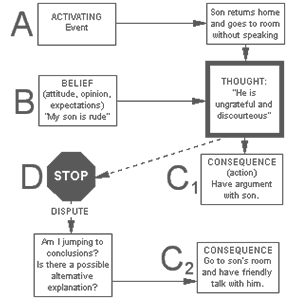
Rational Emotive Behavior Therapy (REBT), previously called rational therapy, is a form psychotherapy created and developed by the American psychologist Albert Ellis who was inspired by many of the teachings of Asian, Greek, Roman, and modern philosophers. REBT is one form of cognitive behavior therapy (CBT) and was first expounded by Ellis in the mid-1950s; development continued until his death in 2007.
Originally called ‘rational therapy,’ its appellation was revised to ‘rational emotive therapy’ in 1959, then to its current appellation in 1992. REBT was one of the first of the cognitive behavior therapies, as it was predicated in articles Ellis first published in 1956, nearly a decade before Aaron Beck first set forth his cognitive therapy.
read more »
Posted in Health, Philosophy |
2 Comments »
September 18, 2012

Religion and happiness have been studied by a number of researchers. The science of positive psychology has identified many components of happiness, and religion seems adapted to satisfy many of them. Some research suggests that both non-religious and religious meaning systems can be quite effective when it comes to managing death anxiety, and that the latter have a few additional advantages. There is extensive research suggesting that religious people are happier and less stressed.
There are a number of mechanisms through which religion may make a person happier, including social contact and support that result from religious pursuits, the mental activity that comes with optimism and volunteering, learned coping strategies that enhance one’s ability to deal with stress, and psychological factors such as ‘reason for being.’ It may also be that religious people engage in behaviors related to good health, such as less substance abuse) since the use of psychotropic substances is sometimes considered abuse. On the other hand, Rastafarians and others use cannabis as a religious sacrament.
read more »
Posted in Death, Health, Philosophy |
Leave a Comment »
September 18, 2012

Eudaimonia [yew-day-mo-nee-uh] is a Greek word commonly translated as ‘happiness’ or ‘welfare’; however, ‘human flourishing’ has been proposed as a more accurate translation. It is a central concept in Aristotelian ethics and political philosophy, along with the terms ‘aretē’ (‘virtue’ or ‘excellence’) and ‘phronesis’ (‘practical or ethical wisdom’).
In Aristotle’s works, eudaimonia was (based on older Greek tradition) used as the term for the highest human good, and so it is the aim of practical philosophy, including ethics and political philosophy, to consider (and also experience) what it really is, and how it can be achieved.
read more »
Posted in Health, Language, Philosophy |
Leave a Comment »
September 18, 2012

Identity negotiation refers to the processes through which people reach agreements regarding ‘who is who’ in their relationships. Once these agreements are reached, people are expected to remain faithful to the identities they have agreed to assume.
The process of identity negotiation thus establishes what people can expect of one another. Identity negotiation thus provides the interpersonal ‘glue that holds relationships together. The idea that identities are negotiated originated in the sociological literature during the middle of the 20th century. A leading figure in this movement was Goffman, who asserted that the first order of business in social interaction is establishing a ‘working consensus’ or agreement regarding the roles each person will assume in the interaction.
read more »
Posted in Health, Science, World |
Leave a Comment »
September 18, 2012


Basking in reflected glory (BIRGing) is a self-serving cognition whereby an individual associates themself with successful others such that another’s success becomes their own. What is interesting about BIRGing is that the simple affiliation of another’s success is enough to stimulate self glory. The person engaging in BIRGing does not even need to have been personally involved in the successful action with which they are affiliating themselves.
Examples of BIRGing include anything from sharing a home state with a past or present famous person, to religious affiliations, to sports teams. For example, a parent with a bumper sticker reading ‘My child is an honor student’ is basking in the reflected glory of their child. Within social psychology, BIRGing is thought to enhance self-esteem and to be a component of self-management.
read more »
Posted in Health, Language, Money |
Leave a Comment »
September 18, 2012
Mnemic [nee-mee] neglect (MN) is a term used in social psychology to describe a pattern of selective forgetting, in which people tend to be poorer at recalling information that is negative with their self-concept, while being unimpaired at recalling information that is positive with their self-concept.
It is proposed that MN arises as a result of a number of underlying motives, such as self-enhancement (the maintenance of self-enhancement).
read more »
Posted in Health |
Leave a Comment »
September 18, 2012

Pseudologia fantastica, mythomania, or pathological lying are three of several terms applied by psychiatrists to the behavior of habitual or compulsive lying. It was first described in the medical literature in 1891 by Anton Delbrueck. Although it is a controversial topic, pathological lying has been defined as ‘falsification entirely disproportionate to any discernible end in view, may be extensive and very complicated, and may manifest over a period of years or even a lifetime.’
A defining characteristic of pseudologia fantastica is that the stories told are not entirely improbable and often have some element of truth. They are not a manifestation of delusion or some broader type of psychosis: upon confrontation, the teller can admit them to be untrue, even if unwillingly.
read more »
Posted in Health, Language |
Leave a Comment »
September 17, 2012

The Jonah Complex is the fear of success which prevents self-actualization, or the realization of one’s potential. It is the fear of one’s own greatness, the evasion of one’s destiny, or the avoidance of exercising one’s talents. Just as the fear of achieving a personal worst can motivate personal growth, the fear of achieving a personal best can also hinder progress. Although psychologist Abraham Maslow is accredited for the term, the name was originally suggested by Maslow’s friend, Professor Frank Manuel. The name comes from the Biblical story of Prophet Jonah’s evasion of the destiny to prophesy the destruction of Ninevah. Maslow states, ‘So often we run away from the responsibilities dictated (or rather suggested) by nature, by fate, even sometimes by accident, just as Jonah tried—in vain—to run away from his fate.’
Any dilemma or challenge faced by an individual may trigger reactions related to the Jonah Complex. These challenges may vary in degree and intensity. Such challenges may include career changes, beginning new stages in life, moving to new locations, interviews or auditions, and undertaking new interpersonal commitments such as marriage. Other causes include: Fear of the sense of responsibility that often attends recognizing our own greatness, talents, potentials; Fear that an extraordinary life would be out of the ordinary, and hence not acceptable to others; Fear of seeming arrogant, self-centered; and Difficulty envisioning oneself as a prominent or authoritative figure.
Posted in Health, Philosophy |
Leave a Comment »


 The Daily Omnivore