November 28, 2011
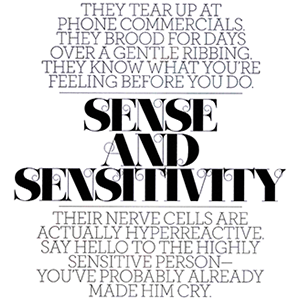
A highly sensitive person (HSP) is a person having the innate trait of high psychological sensitivity (or innate sensitiveness as Carl Jung originally coined it). According to American pyschologist Elaine N. Aron, who coined the term, highly sensitive people comprise about a fifth of the population, and process sensory data much more deeply and thoroughly due to a biological difference in their nervous systems.
This is a specific trait with key consequences that in the past has often been confused with innate shyness, social anxiety problems, inhibitedness, or even social phobia and innate fearfulness, introversion, and so on. The existence of the trait of innate sensitivity was demonstrated using a test that was shown to have both internal and external validity. Although the term is primarily used to describe humans, the trait is present in nearly all higher animals.
read more »
Posted in Health, Language, Philosophy |
Leave a Comment »
November 25, 2011


Salt therapy, halotherapy or speleotherapy is the therapeutic use of salt mines, caves or other forms of exposure to salt air. These natural deposits of mineral halite are derived from evaporated ancient lakes and seas. The unrefined rock salt, primarily sodium chloride, also includes varying concentrations of other mineral salts such as calcium and magnesium, manganese and sulfates which have additional therapeutic properties, depending on the source.
Modern use of this therapy started in Germany when Dr. Karl Hermann Spannagel noticed improvement in the health of his patients after they hid in the Kluterthöhle karst cave to escape heavy bombing. It is now practised in places such as Bystrianska in Slovakia, Wieliczka in Poland, and Solotvyno in Ukraine.
read more »
Posted in Health |
Leave a Comment »
November 25, 2011

Nabiximols (trade name Sativex) is a cannabinoid mouth spray developed by the UK company GW Pharmaceuticals for multiple sclerosis (MS) patients, who can use it to alleviate neuropathic pain, spasticity, overactive bladder, and other symptoms. Nabiximols is also being developed in Phase III trials as a potential treatment to alleviate pain due to cancer. It has also been researched in various models of peripheral and central neuropathic pain.
Nabiximols is distinct from all other pharmaceutically produced cannabinoids currently available because it is derived from cannabis plants, rather than a solely synthetic process. The drug is a pharmaceutical product standardized in composition, formulation, and dose, although it is still effectively a tincture of the cannabis plant. Its principal active cannabinoid components are the cannabinoids: tetrahydrocannabinol (THC) and cannabidiol (CBD). The product is formulated as an oromucosal spray which is administered into the mouth. Each spray delivers a fixed dose of 2.7 mg THC and 2.5 mg CBD.
Posted in Drugs, Health, Politics |
Leave a Comment »
November 25, 2011
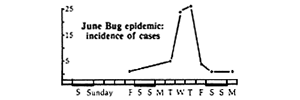

Hysterical contagion occurs when a group of people show signs of a physical problem or illness, when in reality there are psychological and social forces at work. It is a strong form of social contagion, which describes the copycat effect of imitative behavior based on the power of suggestion and word of mouth influence, because the symptoms often include those associated with clinical hysteria. The June bug epidemic serves as a classic example of hysterical contagion. In 1962 a mysterious disease broke out in a dressmaking department of a US textile factory. The symptoms included numbness, nausea, dizziness, and vomiting. Word of a bug in the factory that would bite its victims and develop the above symptoms quickly spread.
Soon sixty two employees developed this mysterious illness, some of whom were hospitalized. The news media reported on the case. After research by company physicians and experts from the US Public Health Service Communicable Disease Center, it was concluded that the case was one of mass hysteria. While the researchers believed some workers were bitten by the bug, anxiety was likely the cause of the symptoms. No evidence was ever found for a bug which could cause the above flu-like symptoms, nor did all workers demonstrate bites. Workers concluded that the environment was quite stressful; the plant had recently opened, was quite busy and organization was poor. Further, most of the victims reported high levels of stress in their lives. Social forces seemed at work too.
Posted in Health |
Leave a Comment »
November 23, 2011

Savant syndrome, sometimes referred to as savantism [sa-vahnt-iz-uhm], is a rare condition in which people with developmental disorders have one or more areas of expertise, ability, or brilliance that are in contrast with the individual’s overall limitations. Although not a recognized medical diagnosis, researcher Darold Treffert says the condition may be either genetic or acquired. Though it is even rarer than the savant condition itself, some savants have no apparent abnormalities other than their unique abilities. This does not mean that these abilities weren’t triggered by a brain dysfunction of some sort but does temper the theory that all savants are disabled and that some sort of trade-off is required.
According to Treffert, something that almost all savants have in common is a prodigious memory of a special type, a memory that he describes as ‘very deep, but exceedingly narrow.’ It is wide in the sense that they can recall but have a hard time putting it to use. Also, many savants are found to have superior artistic or musical ability. One in ten autistic people have savant skills. 50% of savants are autistic; the other 50% often have psychological disorders or mental illnesses.
read more »
Posted in Health, Science |
1 Comment »
November 23, 2011

No pain, no gain is an exercise motto that promises greater value rewards for the price of hard and even painful work. Under this conception competitive professionals such as athletes and artists are required to endure pain and pressure to achieve professional excellence. It came into prominence after 1982 when actress Jane Fonda began to produce a series of aerobics workout videos. In these videos, Fonda would use ‘No pain, no gain’ and ‘Feel the burn’ as catchphrases for the concept of working out past the point of experiencing muscle aches. It expresses the belief that solid large muscle are the result of training hard and suffering sore muscles repeatedly, implying that those who avoid pain will never reach a professional level as bodybuilders. In terms of the expression used for development, the discomfort caused may be beneficial in some instances while detrimental in others.
American author David B. Morris wrote, ‘No pain, no gain’ is an American modern mini-narrative: it compresses the story of a protagonist who understands that the road to achievement runs only through hardship.’
Posted in Games, Health, Language |
Leave a Comment »
November 22, 2011

The Asch conformity experiments were a series of studies published in the 1950s that demonstrated the power of conformity in groups. These are also known as the Asch Paradigm.
Experiments led by Solomon Asch of Swarthmore College asked groups of students to participate in a ‘vision test.’ In reality, all but one of the participants were confederates of the experimenter, and the study was really about how the remaining student would react to the confederates’ behavior.
read more »
Posted in Health, Politics, Science |
Leave a Comment »
November 22, 2011

Beer pong, also known as Beirut [bey-root], is a drinking game in which players throw a ping pong ball across a table with the intent of landing the ball in a cup of beer on the other end. The game typically consists of two two-to-four-player teams and multiple cups set up, in triangle formation, on each side. There are no official rules, and rules may vary widely, though usually there are six or ten plastic cups on each side. Each side then takes turns attempting to shoot ping pong balls into the opponent’s cups. If a ball lands in a cup, then the contents of that cup are consumed, and the cup is either placed aside or reinserted into the triangle. If the cup is reinserted and the other team knocks the cup over, it is removed. If the opposing team throws the ball into an empty cup, they must consume the contents of one of their cups. The first side to eliminate all of the opponent’s cups is the winner.
The order of play varies—both players on one team shoot followed by both players on the other team, or players on opposite teams can alternate back and forth. Beer pong is played at parties, North American colleges and universities, bars, and elsewhere, such as tailgating or other sporting events.
read more »
Posted in Food, Games, Health |
Leave a Comment »
November 22, 2011
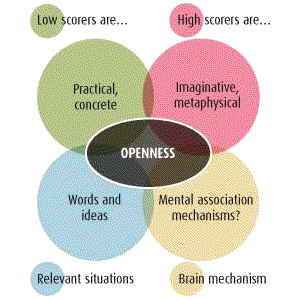
In contemporary psychology, the ‘Big Five’ are five broad domains or dimensions of personality which are used to describe human personality: openness, conscientiousness, extraversion, agreeableness, and neuroticism. Openness involves active imagination, aesthetic sensitivity, attentiveness to inner feelings, preference for variety, and intellectual curiosity.
A great deal of psychometric research has demonstrated that these qualities are statistically correlated. Thus, openness can be viewed as a global personality trait consisting of a set of specific traits, habits, and tendencies that cluster together.
read more »
Posted in Drugs, Health |
Leave a Comment »
November 22, 2011

In psychology, novelty seeking (NS) is a personality trait associated with exploratory activity in response to novel stimulation, impulsive decision making, extravagance in approach to reward cues, and quick loss of temper and avoidance of frustration. It is considered one of the temperament dimensions of personality. Like the other temperament dimensions, it has been found to be highly heritable.
High NS has been suggested to be related to high dopaminergic activity (which plays a major role in reward-motivated behavior). When novelty seeking is defined as a decision process (i.e in terms of the tradeoff between foregoing a familiar choice option in favor of deciding to explore a novel choice option), dopamine is directly shown to increase novelty seeking behavior. Specifically, blockade of the dopamine transporter, causing a rise in extracelluar dopamine levels, increases the propensity of monkeys to select novel over familiar choice options.
read more »
Posted in Health |
1 Comment »
November 22, 2011

Confabulation [kuhn-fab-yuh-ley-shuhn] is the process in which a memory is remembered falsely. Confabulations are indicative of a complicated and intricate process that can be led astray at any given point during encoding, storage, or recall of a memory. Two distinct types of confabulation are often distinguished. Spontaneous, or primary, confabulations do not occur in response to a cue and seem to be involuntary.
Provoked, or secondary, confabulations occur in response to something external, like a memory test. Another distinction found in confabulations is that between verbal and behavioral. Verbal confabulations are spoken false memories and are more common, while behavioral confabulations occur when an individual acts on their false memories. Confabulated memories of all types most often occur in autobiographical memory. A final characteristic of confabulations is the genuine confidence people have in their false memory, despite evidence contradicting its truthfulness.
read more »
Posted in Health, Science |
Leave a Comment »
November 22, 2011

Dysexecutive [dis-ig-zek-yuh-tiv] syndrome (DES) consists of a group of symptoms, usually resulting from brain damage, that fall into cognitive, behavioral and emotional categories and tend to occur together. The term was introduced by British psychologist Alan Baddeley to describe a common pattern of dysfunction in executive functions, such as planning, abstract thinking, flexibility and behavioral control.
It is thought to be Baddeley’s theory of working memory and the central executive that are the hypothetical systems impaired in DES. The syndrome was once known as frontal lobe syndrome, however dysexecutive syndrome is preferred because it emphasizes the functional pattern of deficits (the symptoms) over the location of the syndrome in the frontal lobe, which is often not the only area affected.
read more »
Posted in Health, Science |
Leave a Comment »



 The Daily Omnivore