October 1, 2015

The Dr. Fox effect states that even experts will be fooled by a nonsensical lecture if it is delivered with warmth, liveliness, and humor. A 1980 study found that the perceived prestige of research is increased by using a confounding writing style, with research competency being positively correlated to reading difficulty.
The original experiment was conducted at USC School Of Medicine in 1970. Two speakers gave lectures to a classroom of psychiatrists and psychologists on a topic the attendees were unfamiliar with (‘Mathematical Game Theory as Applied to Physician Education’). The control group was lectured by an actual scientist and the other by an actor who was given the identity ‘Dr. Myron L. Fox,’ a graduate of Albert Einstein College of Medicine.
read more »
Posted in Education, Health, Language |
1 Comment »
September 28, 2015


Jerry DeWitt is an American author and public speaker, and a prominent member of the American atheism movement. He is a former pastor of two evangelical churches, who publicly deconverted to atheism in 2011. DeWitt is the former executive director of ‘Recovering From Religion,’ a group which helps people find their way after a loss of faith.
He currently leads the ‘Community Mission Chapel,’ which DeWitt calls an ‘atheist church.’ In a story for the ‘New York Times,’ he said, ‘Just because we value critical thinking and the scientific method, that doesn’t mean we suddenly become disembodied and we can no longer benefit from our emotional lives.’
read more »
Posted in Health, Language, Philosophy |
Leave a Comment »
September 23, 2015


Fasting is primarily an act of willing abstinence or reduction from certain or all food, drink, or both, for a period of time. An absolute fast is normally defined as abstinence from all food and liquid for a defined period, usually 24 hours. Other fasts may be only partially restrictive, limiting particular foods or substances. The fast may also be intermittent in nature.
Fasting practices may preclude sexual intercourse and other activities as well as food. Extended fasting has been recommended as therapy for various conditions by health professionals of many cultures, throughout history, from ancient to modern. Fasting is also a part of many religious observances.
read more »
Posted in Food, Health, Philosophy |
1 Comment »
September 21, 2015


Trigger warnings are disclaimers that content contains strong writing or images which could unsettle those with mental health difficulties. Angus Johnston, a history professor at the City University of New York, said that trigger warnings can be a part of ‘sound pedagogy,’ noting that students encountering potentially triggering material are ‘coming to it as whole people with a wide range of experiences, and that the journey we’re going on together may at times be painful. It’s not coddling them to acknowledge that. In fact, it’s just the opposite.’
However, students at UC Santa Barbara passed a resolution in support of mandatory trigger warnings for classes that could contain potentially upsetting material. Professors would be required to alert students of such material and allow them to skip classes that could make them feel uncomfortable.
read more »
Posted in Health, Language, Politics |
Leave a Comment »
August 26, 2015
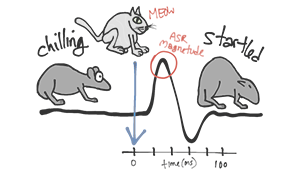

The startle response is a brainstem reflectory reaction (reflex) that serves to protect the back of the neck (whole-body startle) and the eyes (eyeblink) and facilitates escape from sudden stimuli. It is found across the lifespan of many species. An individual’s emotional state may lead to a variety of responses. The acoustic startle reflex is thought to be caused by an auditory stimulus greater than 80 decibels.
The anterior cingulate cortex in the brain is largely thought to be the main area associated with emotional response and awareness, which can contribute to the way an individual reacts to a startle inducing stimuli. Along with the anterior cingulate cortex, the amygdala and the hippocampus are known to have implications in this reflex. The amygdala is known to have a role in the ‘fight or flight’ response, and the hippocampus functions to form memories of the stimulus and the emotions associated with it.
Posted in Health, Science |
4 Comments »
August 22, 2015

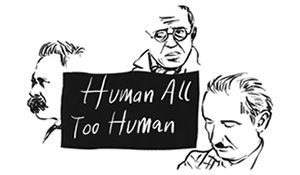
The moral credential effect is a bias that occurs when a person’s track record as a good egalitarian establishes in them an unconscious ethical certification, endorsement, or license that increases the likelihood of less egalitarian decisions later. This effect occurs even when the audience or moral peer group is unaware of the affected person’s previously established moral credential. For example, individuals who had the opportunity to recruit a woman or African American in one setting were more likely to say later, in a different setting, that a job would be better suited for a man or a Caucasian.
Moral credentials can also be obtained vicariously (i.e., a person may behave as if they themselves have moral credentials after observing someone from a group they identify with making an egalitarian decision). In research that draws on social identity theory it was also found that group membership moderates the effectiveness of moral credentials in mitigating perceptions of prejudice (e.g., displays of moral credentials have more effect between people who share in-group status). In 1878, philosopher Friedrich Nietzsche wrote of ‘innocent corruption’ in ‘Human, All Too Human’: ‘In all institutions that do not feel the sharp wind of public criticism (as, for example, in scholarly organizations and senates), an innocent corruption grows up, like a mushroom.’
Posted in Health, Philosophy, Politics |
Leave a Comment »
August 20, 2015

Baker-Miller Pink is a tone of pink that was originally created by mixing one gallon of pure white indoor latex paint with one pint of red trim semi-gloss outdoor paint. It is named for the two US Navy officers who first experimented with its use in the Naval Correctional Facility in Seattle, Washington at the behest of researcher Alexander Schauss. The color is also known as Schauss pink, after Alexander Schauss’s extensive research into the effects of the color on emotions and hormones, as well as P-618 and ‘Drunk-Tank Pink’ (so named because jails cells are painted this color because it is believed to calm inmates).
Contemporary research has shown conflicting results on the effects of Baker-Miller pink. While the initial results at the Naval Correctional facility in Seattle were positive, calming those exposed, inmates at the Santa Clara county jail were trying to scratch the paint from the walls with their fingernails when exposed for more than fifteen minutes. At Johns Hopkins, appetite suppression was observed and studied.
read more »
Posted in Health, Science, War |
1 Comment »
August 11, 2015

Phantom vibration syndrome or ‘phantom ringing’ is the mistaken feeling that one’s mobile phone is vibrating or ringing. Other terms for this concept include ringxiety (a portmanteau of ‘ring’ and ‘anxiety’) and ‘fauxcellarm’ (a play on ‘false alarm’). It is a form of pareidolia, a psychological phenomenon involving a stimulus (such as an image or a sound) wherein the mind perceives a familiar pattern where none actually exists. Phantom ringing may be experienced while taking a shower, watching television, or using a noisy device. Humans are particularly sensitive to auditory tones between 1,000 and 6,000 hertz, and basic mobile phone ringers often fall within this range.
In the comic strip ‘Dilbert,’ cartoonist Scott Adams referenced such a sensation in 1996 as ‘phantom-pager syndrome.’ The earliest published use of the term dates to a 2003 article in the ‘New Pittsburgh Courier,’ written by Robert D. Jones. In the conclusion of the article, Jones writes, ‘…should we be concerned about what our mind or body may be trying to tell us by the aggravating imaginary emanations from belts, pockets and even purses? Whether PVS is the result of physical nerve damage, a mental health issue, or both, this growing phenomenon seems to indicate that we may have crossed a line in this ‘always on’ society.’
Posted in Health, Science, Technology |
Leave a Comment »
August 6, 2015
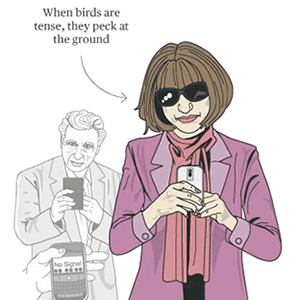
Vacuum activities are innate, fixed action patterns of animal behavior that are performed in the absence of the external stimuli (releaser) that normally elicit them. This type of abnormal behavior shows that a key stimulus is not always needed to produce an activity. Vacuum activities can be difficult to identify because it is necessary to determine whether any stimulus triggered the behavior.
For example, squirrels that have lived in metal cages without bedding all their lives do all the actions that a wild squirrel does when burying a nut. It scratches at the metal floor as if digging a hole, it acts as if it were taking a nut to the place where it scratched though there is no nut, then it pats the metal floor as if covering an imaginary buried nut.
read more »
Posted in Health, Science |
2 Comments »
August 3, 2015
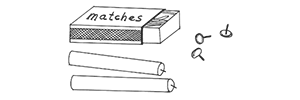
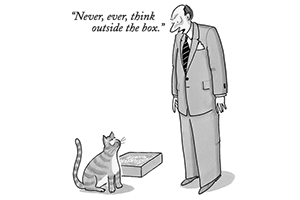
Functional fixedness [fiks-ed-nes] is a cognitive bias that limits a person to using an object only in the way it is traditionally used. The concept originated in Gestalt Psychology, which emphasizes holistic processing (e.g., ‘the whole is greater than the sum of its parts’). German American psychologist Karl Duncker defined functional fixedness as a ‘mental block against using an object in a new way that is required to solve a problem.’ This ‘block’ limits the ability of an individual to use components given to them to complete a task, as they cannot move past the original purpose of those components.
For example, if someone needs a paperweight, but they only have a hammer, they may not see how the hammer can be used as a paperweight. Functional fixedness is this inability to see a hammer’s use as anything other than for pounding nails; the person couldn’t think to use the hammer in a way other than in its conventional function. When tested, five year old children show no signs of functional fixedness. At that age, any goal to be achieved with an object is equivalent to any other goal. However, by age seven, children have acquired the tendency to treat the originally intended purpose of an object as special.
read more »
Posted in Education, Health, Technology |
1 Comment »
July 31, 2015


A double bind is an emotionally distressing dilemma in communication in which an individual (or group) receives two or more conflicting messages, and one message negates the other. This creates a situation in which a successful response to one message results in a failed response to the other (and vice versa), so that the person will automatically be wrong regardless of response. The double bind occurs when the person cannot confront the inherent dilemma, and therefore can neither resolve it nor opt out of the situation.
The classic example given of a negative double bind is of a mother telling her child that she loves him or her, while at the same time turning away in disgust (the words are socially acceptable; the body language is in conflict with it). The child doesn’t know how to respond to the conflict between the words and the body language and, because the child is dependent on the mother for basic needs, he or she is in a quandary. Small children have difficulty articulating contradictions verbally and can neither ignore them nor leave the relationship.
read more »
Posted in Health, Language, Science |
1 Comment »
July 30, 2015
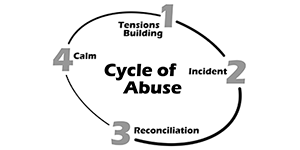

Battered person syndrome is a physical and psychological condition of a person who has suffered (usually persistent) emotional, physical, or sexual abuse from another person. The condition is the basis for the battered spouse defense that has been used in cases of spouses who have killed their abusers. The condition was first researched extensively by American psychologist Lenore E. Walker, founder of the Domestic Violence Institute, who used psychologist Martin Seligman’s ‘learned helplessness’ theory to explain why abused spouses stayed in destructive relationships.
The syndrome develops in response to a three-stage cycle found in domestic violence situations. First, tension builds in the relationship. Second, the abusive partner releases tension via misconduct while blaming the victim for having caused the event. Third, the abusive partner makes gestures of contrition, but does not find solutions to avoid another phase of tension building and release so the cycle repeats. The repetition of the cycle despite the abuser’s attempts to ‘make nice’ results in the abused partner feeling at fault for not preventing recurrences. However, since the victim is not at fault and the violence is internally driven by the abuser’s need to control, this self-blame results in feelings of helplessness rather than empowerment.
read more »
Posted in Health, Politics, Sex |
Leave a Comment »


 The Daily Omnivore