March 30, 2014

The Rock-afire Explosion is an animatronic robot band that played in Showbiz Pizza Place from 1980 to 1990, and in various Showbiz Pizza locations between 1990 and 1992 as Showbiz rebranded and the band was steadily replaced by Chuck E. Cheese characters. The characters in The Rock-afire Explosion were various animals ranging from a dog to a gorilla. They would perform medleys of classic rock, pop, and country music, as well as original compositions.
The show was a pioneer in commercial animatronics in the 1980s, featuring life-sized characters capable of facial expression; some were even programmed in such a way that they could actually play simple melodies on musical instruments. The show was created and manufactured by noted inventor Aaron Fechter, through his company Creative Engineering, Inc. in Orlando, Florida; in addition to overseeing the production of the animatronics, Fechter also provided the voices for several characters.
read more »
Posted in Art, Humor |
Leave a Comment »
March 27, 2014

Out of hacker culture, and especially the artificial intelligence community at MIT, there have sprung a number of humorous short stories about computer science dubbed hacker koans [koh-ahns]; most of these are recorded in an appendix to the Jargon File (a glossary of computer programmer slang). Most do not fit the usual pattern of koans, but they do tend to follow the form of being short, enigmatic, and often revealing an epiphany.
One notable example, titled ‘Uncarved block,’ describes an exchange between professor Marvin Minsky and student Jerry Sussman: ‘In the days when Sussman was a novice, Minsky once came to him as he sat hacking at the PDP-6. ‘What are you doing?’, asked Minsky. ‘I am training a randomly wired neural net to play Tic-tac-toe,’ Sussman replied. ‘Why is the net wired randomly?’, asked Minsky. ‘I do not want it to have any preconceptions of how to play,’ Sussman said. Minsky then shut his eyes. ‘Why do you close your eyes?’ Sussman asked his teacher. ‘So that the room will be empty.’ At that moment, Sussman was enlightened.’
read more »
Posted in Humor, Philosophy, Technology |
Leave a Comment »
March 14, 2014

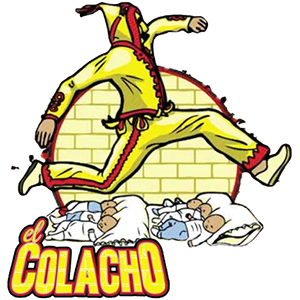
Although clowns are originally comic performers and characterized to humor and entertain people, the image of the evil clown is a development in popular culture, in which the playful trope is rendered disturbing through the use of horror elements and dark humor.
Philosopher Wolfgang M. Zucker points out the similarities between a clown’s appearance and the cultural depictions of demons and other infernal creatures, noting ‘[the clown’s] chalk-white face in which the eyes almost disappear, while the mouth is enlarged to a ghoulish bigness looks like the mask of death.’
read more »
Posted in Humor |
1 Comment »
March 12, 2014
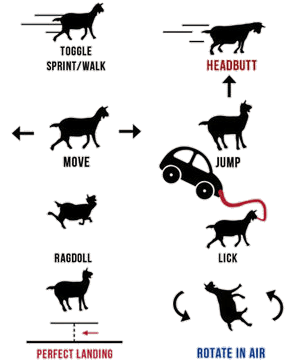
Goat Simulator is a third-person perspective game in which the player controls a goat. There does not appear to be any kind of storyline or plot. The player is free to explore the game’s world as a goat, destroying things in the environment, running, jumping, and biting. According to the developers, Coffee Stain Studios: ‘Goat Simulator is like an old school skating game, except instead of being a skater, you’re a goat, and instead of doing tricks, you wreck stuff.’
The game boasts the fact that various glitches and bugs have been intentionally left in the game, as to add to the light-hearted entertainment value. Another gameplay feature is the ability to ‘lick’ objects with the goat’s absurdly long tongue, which will then stick to the goat’s tongue and can be carried and swung around to provide an alternate method of wreaking havoc on the game environment.
Posted in Games, Humor |
Leave a Comment »
March 12, 2014

Surgeon Simulator 2013, a humorous medical sim, was initially created in a 48-hour period for the 2013 ‘Global Game Jam’ (the four developers spent an additional 48 days building the commercial version). The game is played in first-person perspective. A mouse is used to control the surgeon’s hand (holding the right button rotates the hand; the left button grabs items). Gameplay consists of various surgical procedures, for example a heart transplant. Extra modes are available after completion of the early operations, such as performing an operation in a moving ambulance with surgical instruments bouncing around at random, and operating in outer space where instruments float.
Reception for the game has been positive, with critics stating that although the game was hard to control, this difficulty was ‘part of the appeal.’ Ars Technica commented upon the narrator’s voice over, saying that it ‘belies the ridiculousness that unfolds as he flops and flails his way through surgery.’ ‘Rock, Paper, Shotgun, praised the game’s humor and fun, and said ”Surgeon Simulator 2013′ is not a brilliant game. But it is a brilliant joke. In the form of a game. It’s an idea that is a clean magnitude of awesome above 90% of what will be released this year because it is so absurd.’
Posted in Games, Health, Humor |
Leave a Comment »
March 11, 2014

Florentijn Hofman (b. 1977) is a Dutch artist known for playful urban installations such as the ‘Rubber Duck’ (a giant floating sculpture). They were built in various sizes, including one created in 2007 that is the largest rubber duck in the world at 105 feet long. Hofman’s tour was named ‘Spreading joy around the world.’ He aimed to recall everyone’s childhood memories by exhibiting the duck in 14 cities. The ducks are constructed with more than 200 pieces of PVC. There is an opening at the back of the body so that staff can perform maintenance. In addition, there is an electric fan in its body so that it can be inflated at any time, in either good or bad weather.
Since 2007, the ducks have been on display in Amsterdam, Belgium, Osaka, Sydney, Sao Paulo, Hong Kong, and Pittsburg. In 2009, while it was on display in Belgium, vandals stabbed the duck 42 times. The duck on display in Hong Kong was damaged and deflated in Taiwan after an earthquake, before bursting a few weeks later. In 2013, Sina Weibo, China’s most popular microblog, blocked the terms ‘Big Yellow Duck.’ The censorship occurred because a photoshopped version of ‘Tank Man’ (the Tiananmen Square protester), which swapped all tanks with this sculpture, had been circulating.
Posted in Art, Humor, World |
Leave a Comment »
February 27, 2014
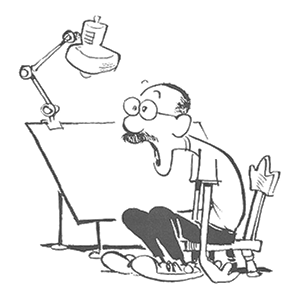
Bill Watterson (b. 1958) is an American artist and the author of the comic strip ‘Calvin and Hobbes,’ which was syndicated from 1985 to 1995. Watterson stopped drawing the strip at the end of 1995 with a short statement to newspaper editors and his readers that he felt he had achieved all he could in the medium.
Watterson is known for his views on licensing (he refused to merchandise his creations on the grounds that displaying their images on commercially sold mugs, stickers and T-shirts would devalue the characters and their personalities) and his move back into private life after ‘Calvin and Hobbes.’
read more »
Posted in Art, Humor, Language |
1 Comment »
February 26, 2014

The Jerky Boys is an American comedy act from Queens, New York, whose routine consists of prank telephone calls and other related skits. The act was started in 1989 by childhood friends Johnny Brennan and Kamal Ahmed (who left in 2000).
The calls were made by ringing up unsuspecting recipients, or in response to classified advertisements placed in local New York-based newspapers. Each call was made in character, usually with over the top voices influenced by the duo’s family members.
read more »
Posted in Humor |
1 Comment »
February 26, 2014

The Tube Bar prank calls are a series of prank calls made in the mid-1970s to the Tube Bar in Jersey City, in which pranksters would ask the proprietor of the bar if they could speak to a fictitiously named customer. The fictitious names given by the pranksters were pun-like/homophones for other—oftentimes more offensive—phrases. Recordings of the calls were circulated widely on duped cassette tapes and may have been the inspiration for a running gag in ‘The Simpsons.’
John Elmo and Jim Davidson, later known collectively as ‘Bum Bar Bastards,’ would call the Tube Bar, operated by heavyweight boxer Louis ‘Red’ Deutsch, asking for customers such as ‘Pepe Roni’ (pepperoni), ‘Hal Ja-Like-a-Kick’ (how’d you like a kick), ‘Phil My-Pockets’ (fill my pockets), ‘Al Coholic’ (alcoholic), and ‘Mike Hunt’ (my cunt). Most of the time, Deutsch would call out the names.
read more »
Posted in Humor, Language |
Leave a Comment »
February 20, 2014


‘Army Man‘ (tagline: ‘America’s Only Magazine’) was a short-lived comedy magazine published in the late 1980s by George Meyer, the acclaimed writer for ‘The Simpsons.’ The magazine consisted mostly of very short and very surreal jokes, along with some cartoons. Each issue also featured Jack Handey’s ‘Deep Thoughts,’ as well as other pieces written by him. Only three issues were ever published. Although Army Man was never widely distributed, it gathered a lot of attention in the comedy world.
Two of its writers (John Swartzwelder and Jon Vitti) were picked up alongside Meyer to be part of the original writing staff of ‘The Simpsons’ by the show’s developer and show-runner Sam Simon, an enormous fan of the magazine. Eventually other ‘Army Man’ writers would go on to write for ‘The Simpsons’ in later seasons. The writers were usually people Meyer knew from his years at the ‘Harvard Lampoon’ or who worked with him in TV shows like ‘Late Night with David Letterman,’ ‘The New Show,’ ‘Not Necessarily The News,’ and ‘Saturday Night Live.’
Posted in Art, Humor, Language |
Leave a Comment »
February 19, 2014
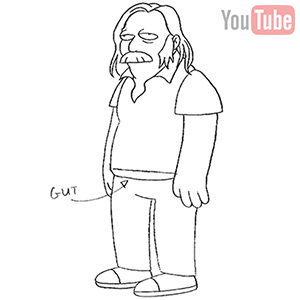
John Swartzwelder (b. 1950) is an American comedy writer and novelist, best known for his work on the animated television series ‘The Simpsons,’ as well as a number of novels. He is credited with writing the largest number of ‘Simpsons’ episodes by a large margin (59 full episodes, with contributions to several others). Swartzwelder was one of several writers recruited to show from the pages of George Meyer’s ‘Army Man’ magazine (a short-lived comedy periodical published in the late 1980s; Meyer would also go on to become an acclaimed ‘Simpsons’ writer).
Swartzwelder has been animated in the background of several episodes of ‘The Simpsons.’ His animated likeness closely resembles musician David Crosby, which prompted Matt Groening to state that anytime that David Crosby appears in a scene for no apparent reason, it is really John Swartzwelder. Additionally, Matt Groening has stated that the recurring character ‘Herman Hermann’ (the owner of Herman’s Military Antiques) was originally physically based on Swartzwelder–with the exception of his one arm.
read more »
Posted in Art, Humor, Language |
Leave a Comment »
February 6, 2014

A wardrobe malfunction is accidental exposure of intimate parts. It is different from indecent exposure or flashing, as the latter ones imply a deliberate exposure. There has been a long history of such incidents, though the term itself was coined in the mid-2000s and has become one of the most common fashion faux pas. In everyday context it often happens as a ‘nipple slip’ to women and is relatively common, but wardrobe malfunction suggests a public event or performance, particularly when there are allegations that it was deliberately staged for publicity reasons.
The American Dialect Society defines it as ‘an unanticipated exposure of bodily parts.’ Global Language Monitor, which tracks usage of words on the internet and in newspapers worldwide, identified the term as the top Hollywood contribution to English in 2004, surpassing words like ‘girlie men’ and ‘Yo!’
read more »
Posted in Humor, Politics, Sex |
Leave a Comment »


 The Daily Omnivore