October 20, 2014


In engineering, fiction, and thought experiments, unobtainium [uhn-uhb-tey-nee-uhm] is any fictional, extremely rare, costly, or impossible material, or (less commonly) device needed to fulfill a given design for a given application. The properties of any particular unobtainium depend on the intended use. For example, a pulley made of unobtainium might be massless and frictionless; however, if used in a nuclear rocket, unobtainium would be light, strong at high temperatures, and resistant to radiation damage. The concept of unobtainium is often applied flippantly or humorously.
Since the late 1950s, aerospace engineers have used the term when referring to unusual or costly materials, or when theoretically considering a material perfect for their needs in all respects, except that it does not exist. By the 1990s, the term was in wide use, even in formal engineering papers such as ‘Towards unobtainium [new composite materials for space applications].’ The word may well have been coined in the aerospace industry to refer to materials capable of withstanding the extreme temperatures expected in reentry. Aerospace engineers are frequently tempted to design aircraft which require parts with strength or resilience beyond that of currently available materials.
read more »
Posted in Art, Humor, Technology |
Leave a Comment »
October 3, 2014

Comic relief is the inclusion of a humorous character, scene, or witty dialogue in an otherwise serious work, often to relieve tension. It is a narrative technique that momentarily alleviates the stressful emotions and angst building up in a dramatic story. Comic relief often takes the form of a bumbling, wisecracking sidekick of the hero or villain in a work of fiction. The secondary character will often remark on the absurdity of the hero’s situation and make comments that would be inappropriate for a character who is to be taken seriously. Other characters may use comic relief as a means to irritate others or keep themselves confident.
Comic relief can also occur during dramatic moments in comedies. Greek tragedy does not allow any comic relief. Even the Elizabethan critic Sidney following Horace’s ‘Ars Poetic’ pleaded for the exclusion of comic elements from a tragic drama. But in Renaissance England, Marlowe among the University Wits (a group of late-16th-century English playwrights and pamphleteers who were educated at Oxford or Cambridge) introduced comic relief through the presentation of crude scenes in ‘Doctor Faustus’ following the native tradition of Interlude which was usually introduced between two tragic plays. In fact, in the classical tradition the mingling of the tragic and the comic was not allowed.
Posted in Art, Humor |
Leave a Comment »
October 2, 2014
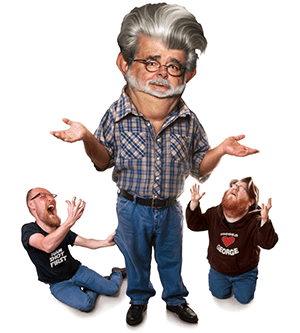
Jar Jar Binks is a fictional character from the Star Wars saga created by George Lucas for his prequel trilogy. He was the first lead computer generated character of the franchise, he was portrayed by Ahmed Best in most of his appearances. Jar Jar’s primary role in ‘Episode I’ was to provide comic relief for the audience, and was generally met with extremely negative comments from both critics and viewers. He is often acknowledged as one of the worst and most hated characters of all time.
Joe Morgenstern of ‘The Wall Street Journal’ described him as a ‘Rastafarian Stepin Fetchit on platform hoofs, crossed annoyingly with Butterfly McQueen.’ Race theorist Patricia J. Williams suggested that many aspects of Jar Jar’s character are reminiscent of blackface minstrelsy, while others have suggested the character is a ‘laid-back clown character’ representing a black Caribbean stereotype. George Lucas has denied any racist implications. Ahmed Best also rejected the allegations, saying that ‘Jar Jar has nothing to do with the Caribbean.’
read more »
Posted in Art, Humor |
Leave a Comment »
September 16, 2014

Blonde hair has several stereotypes associated with it. In women is has been considered attractive and desirable, but is also associate with the negative stereotypes of the women ‘who relies on her looks rather than on intelligence.’ The latter stereotype of a ‘dumb blonde’ is exploited in ‘blonde jokes.’ In cognitive linguistics, the stereotype uses expressivity of words to affect an emotional response which determines a gender role of a certain kind. In feminist critique, stereotypes like the blonde bombshell or the dumb blonde’ are seen as negative images that undermine the power of women.
Some blonde jokes rely on sexual humor to portray or stereotype their subjects as promiscuous. Many of these are rephrased ‘Valley girl’ or ‘Essex girl’ jokes. Others are based on long-running ethnic jokes, such as humor denigrating the intelligence of Polish people. Similar jokes about stereotyped minorities have circulated since the seventeenth century with only the wording and targeted groups changed. In 20th century, a class of meta-jokes about blondes (i.e. jokes about blonde jokes) has emerged where a blonde person complains about the unfairness of the stereotype propagated by blonde jokes, with a punch line actually reinforcing the stereotype.
read more »
Posted in Humor, Science, Sex |
Leave a Comment »
August 20, 2014
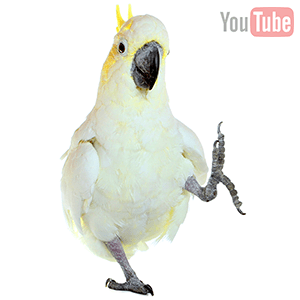
Snowball (hatched c. 1996) is a male Eleonora Cockatoo, noted as being the first non-human animal conclusively demonstrated to be capable of beat induction— perceiving music and synchronizing body movements to the beat (i.e., dancing).
Snowball’s abilities first became apparent after being acquired from a bird show at the age of six by his previous owner. He was observed bobbing his head in time to the Backstreet Boys song, ‘Everybody (Backstreet’s Back).’ The owner and his children encouraged this behavior and observed him developing rhythmic foot-lifting gestures, perhaps in imitation of his human companions’ arm-lifting gestures.
read more »
Posted in Art, Humor, Science |
Leave a Comment »
August 5, 2014
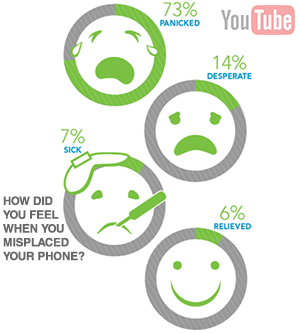
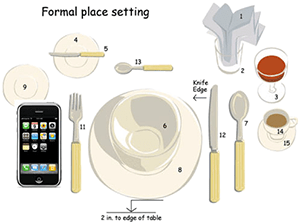
Nomophobia (‘no-mobile-phone phobia’) is the fear of being out of mobile phone contact. The term was coined during a 2010 study by the UK Post Office who commissioned YouGov, a UK-based research organization to look at anxieties suffered by mobile phone users. The study found that nearly 53% of mobile phone users in Britain tend to be anxious when they ‘lose their mobile phone, run out of battery or credit, or have no network coverage.’ The study found that about 58% of men and 47% of women suffer from the phobia, and an additional 9% feel stressed when their mobile phones are off.
The study indicated that stress levels induced by the average case of nomophobia are similar in severity to ‘wedding day jitters’ and trips to the dentists. Ten percent of those questioned said they needed to be contactable at all times because of work. It is, however, arguable that the word ‘phobia’ is misused and that in the majority of cases it is only a normal anxiety. More than one in two nomophobes never switch off their mobile phones. The study prompted two editorial columns authored by those who minimize their mobile phone use or choose not to own one at all, treating the condition with levity or outright disbelief.
Posted in Health, Humor, Technology |
Leave a Comment »
July 23, 2014

The picaresque [pik-uh-resk] novel (Spanish:’picaresca,’ from ‘pícaro,’ for ‘rogue’ or ‘rascal’) is a popular subgenre of prose fiction which might sometimes be satirical and depicts, in realistic and often humorous detail, the adventures of a roguish hero of low social class who lives by his wits in a corrupt society. This style of novel originated in 16th-century Spain and flourished throughout Europe in the 17th and 18th centuries. The word ‘picaro’ does not appear in ‘Lazarillo de Tormes’ (1554), the novella credited with founding the genre. The expression ‘picaresque novel’ was coined in 1810. The genre continues to influence modern literature.
Picaresque novels are usually written in first person as an autobiographical account. A Lazarillo or picaro character is an alienated outsider, whose ability to expose and ridicule individuals compromised with society gives him a revolutionary stance. Lazarillo states that the motivation for his writing is to communicate his experiences of overcoming deception, hypocrisy, and falsehood (desengaño).
read more »
Posted in Art, Humor |
1 Comment »
July 22, 2014
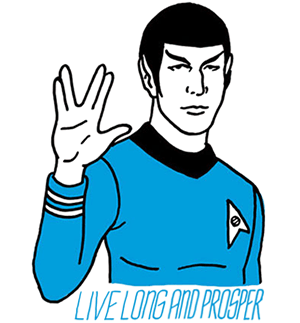
The Vulcan salute is a hand gesture consisting of a raised hand, palm forward with the fingers parted between the middle and ring finger, and the thumb extended. The salute was devised and popularized by Leonard Nimoy, who portrayed the half-Vulcan character Mr. Spock on the original ‘Star Trek’ television series in the late 1960s.
The gesture famously has a reputation for being difficult for some people to make without practice or the covert pre-positioning of the fingers, and actors on the original show reportedly had to position their fingers off-screen with the other hand before raising their hand into frame. This reputation may stem from variations in individuals’ manual dexterity. This reputation is parodied somewhat in the motion picture ‘Star Trek: First Contact’ when Zefram Cochrane, upon meeting a Vulcan for the first time in human history, is unable to return the Vulcan salute gesture and instead shakes the Vulcan’s hand.
read more »
Posted in Art, Humor |
Leave a Comment »
July 7, 2014


What happens on tour stays on tour is a notorious phrase or saying agreed to by men who get together and travel either interstate or overseas for sporting tours. In essence, the phrase means that all exploits during the tour must be kept strictly confidential, never to be discussed with anyone outside the group. In more recent years, the phrase has also been applied to men attending music gigs, going on business trips, and fishing holidays. The expression is also used in the US military when speaking of temporary duty assignment (‘what happens TDY stays TDY’)
The phrase has been described by Samantha Brett, a writer for the ‘Age,’ as an ‘unspoken male pact that for centuries can never be broken.’ In essence, if you were there you may discuss the events, but if you were not there, you get nothing. In contrast, ‘Rugby for Dummies’ describes the phrase as, particularly funny, embarrassing or debauched moments are for consumption only by the tourists themselves and not casual listeners back home.
read more »
Posted in Games, Humor, Sex |
Leave a Comment »
June 21, 2014
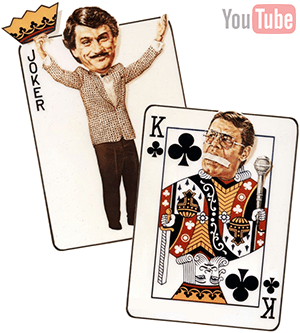
The King of Comedy is a 1983 American black comedy film starring Robert De Niro and Jerry Lewis, and directed by Martin Scorsese. The subject of the movie is celebrity worship and the American media culture.
DeNiro plays Rupert Pupkin, a stage-door autograph hound and aspiring stand-up comedian whose ambition far exceeds his talent. After meeting Jerry Langford (Lewis), a successful comedian and talk show host, Rupert believes his ‘big break’ has finally come. He attempts to get a place on the show but is continually rebuffed by Langford’s staff and, finally, by Langford himself.
read more »
Posted in Humor |
Leave a Comment »
June 12, 2014
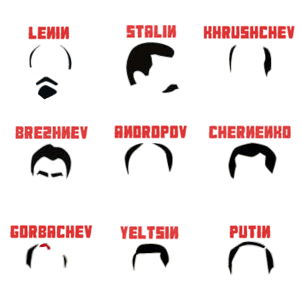
Bald–hairy is a common Russian joke that there is, apparently, a strict rule applying to the country’s politics for the latest two centuries: a bald (or balding) state leader is succeeded by a non-bald (‘hairy’) one, and vice versa. Whilst this pattern is most likely a coincidence, it has held true since 1825 (with the exception of Georgy Malenkov, who was Premier of the Soviet Union from 1953 to 1955), starting from Nicholas I. However, some videos of Joseph Stalin at the Potsdam Conference showed that he was balding.
Nicholas I’s son Alexander II formed the first ‘bald–hairy’ pair of the sequence with his father. The current pair of Russian rulers are the balding Vladimir Putin and the hairy Dmitry Medvedev. Putin was the president from 2000 until 2008, Medvedev held the post until 2012, and Putin became president again in 2012.
read more »
Posted in Humor, Politics, World |
1 Comment »
June 2, 2014

The genre of Menippean [meh-nip-pee-uhn] satire is a form of satire (ridicule of foolishness and moral failings), usually in prose, which has a length and structure similar to a novel and is characterized by attacking mental attitudes instead of specific individuals. Other features found in Menippean satire are different forms of parody and mythological burlesque (humorous caricatures of the gods), a critique of the myths inherited from traditional culture, a rhapsodic nature, a fragmented narrative, the combination of many different targets, and the rapid moving between styles and points of view.
The term is used by classical grammarians and by philologists mostly to refer to satires in prose. Typical mental attitudes attacked and ridiculed by Menippean satires are ‘pedants, bigots, cranks, parvenus, virtuosi, enthusiasts, rapacious and incompetent professional men of all kinds,’ which are treated as diseases of the intellect. The term Menippean satire distinguishes it from the earlier satire pioneered by Aristophanes, which was based on personal attacks.
read more »
Posted in Art, Humor, Language |
1 Comment »



