May 24, 2013
Yo Gabba Gabba! is an American children’s television show that airs on the Nick Jr. cable network. Created by Christian Jacobs (lead singer of the Aquabats) and Scott Schultz, the series premiered in 2007.
Popular artists appearing on the show include The Killers, Jimmy Eat World, Solange Knowles, Devo, Of Montreal, Chromeo, My Chemical Romance, Weezer, The Roots, MGMT, Jack Black, Tony Hawk, Elijah Wood, and The Ting Tings. Among the varied animation sequences during the show is ‘Super Martian Robot Girl,’ designed by indie cartoonists Evan Dorkin and Sarah Dyer. The toy models of the characters that appear at the beginning and end of each show were made by designer toy firm Kidrobot.
read more »
Posted in Art, Education, Humor |
Leave a Comment »
May 22, 2013
The concept of irreconcilable differences (sometimes called irremediable breakdown, irretrievable breakdown, or incompatibility) provides possible grounds for divorce in a number of jurisdictions. Australian family law uses a no-fault divorce approach, and irreconcilable differences is the sole grounds for divorce, with adequate proof being that the estranged couple have been separated for more than 12 months. In the United States, this is one of several possible grounds.
Often, it is used as justification for a no-fault divorce. In many cases, irreconcilable differences were the original and only grounds for no-fault divorce, such as in California, which enacted America’s first purely no-fault divorce law in 1969. California now lists one other possible basis, ‘incurable insanity,’ on its divorce petition form.
Posted in Humor, Language, Politics |
Leave a Comment »
May 22, 2013
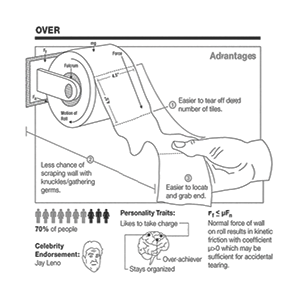
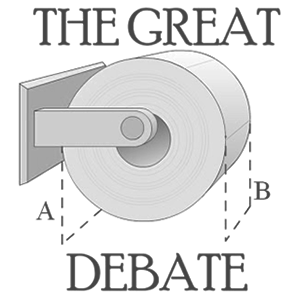
Toilet paper when used with a toilet roll holder with a horizontal axle parallel to the wall has two possible orientations: the toilet paper may hang over (in front of) or under (behind) the roll. The choice is largely a matter of personal preference, dictated by habit. In surveys of American consumers and of bath and kitchen specialists, 60–70% of respondents prefer over.
Despite its being an apparently trivial topic, some people hold strong opinions on the matter. Advice columnist Ann Landers said that the subject was the most controversial issue in her column’s history. Defenders of either position cite advantages ranging from aesthetics, hospitality, and cleanliness to paper conservation, the ease of detaching individual squares, and compatibility with a recreational vehicle or a cat. Celebrities and experts are found on both sides. Some writers have proposed connections to age, sex, or political philosophy; and survey evidence has shown a correlation with socioeconomic status.
read more »
Posted in Humor, Science |
Leave a Comment »
May 22, 2013
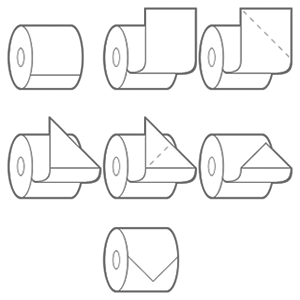
Hotel toilet paper folding is a common practice performed by hotels worldwide as a way of assuring guests that the bathroom has been cleaned. Elaborate folding is sometimes used to impress or delight guests with the management’s creativity and attention to detail.
The common fold normally involves creating a triangle or ‘V’ shape out of the first sheet or square on a toilet paper roll. Commonly, the two corners of the final sheet are tucked behind the paper symmetrically, forming a point at the end of the roll. More elaborate folding results in shapes like fans, sailboats, and even flowers.
read more »
Posted in Humor, Money |
Leave a Comment »
May 21, 2013
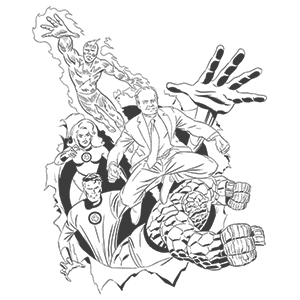
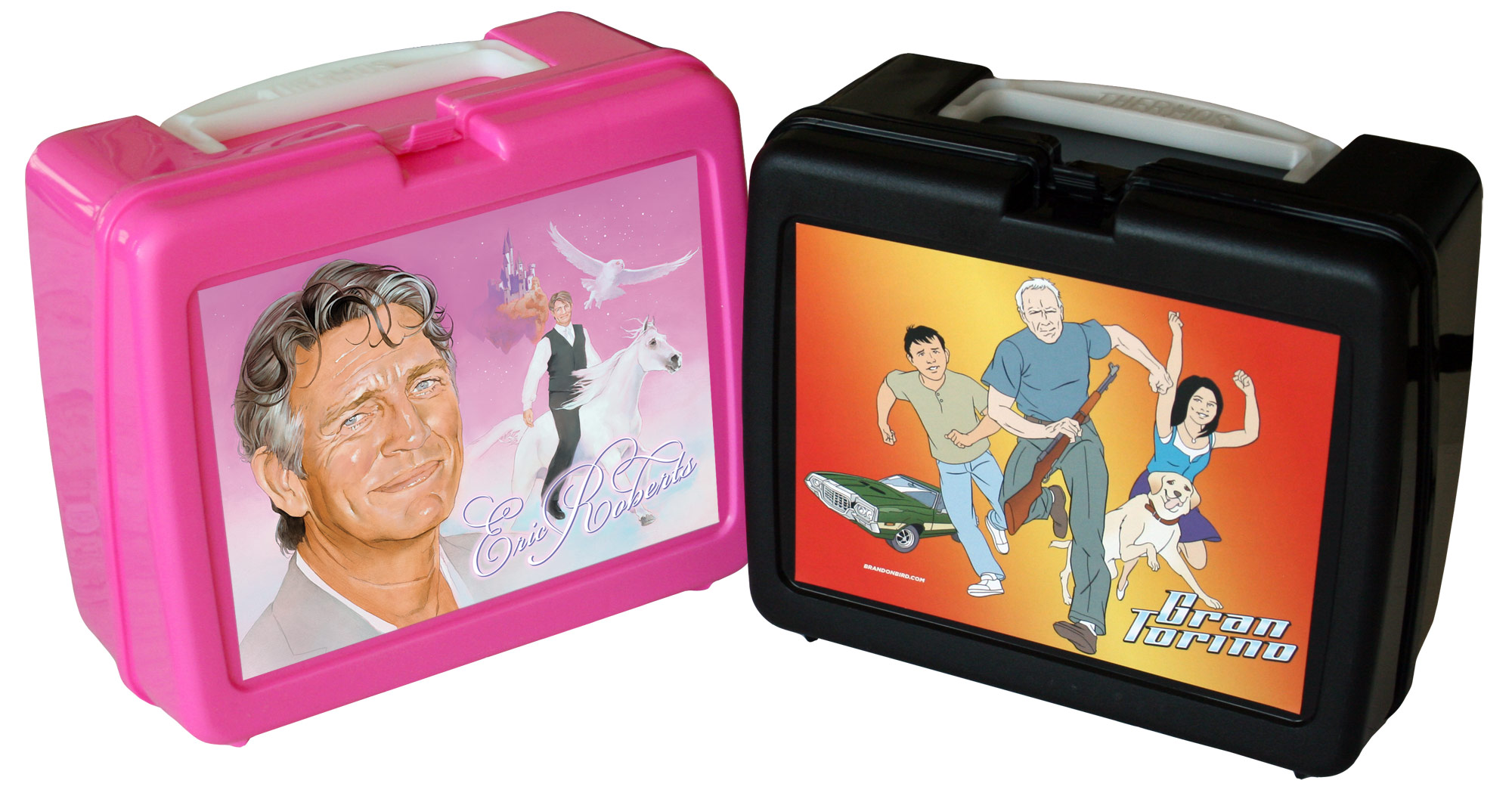
Brandon Bird (b. 1980) is an artist. He attended University of California, Santa Cruz and was an artist-in-residence from 2004-2006 at Risley Residential College at Cornell University.
His most common medium is oil paints on canvas, but works in a number of genres, including pen and ink and digital mediums. He has a significant cult following for his tendency to paint figures from history and popular culture such as Christopher Walken, Chuck Norris, and Abraham Lincoln, in absurd situations. He is a regular contributor to ‘The Believer’ (an American literary magazine that also covers other arts and general culture). He has also done work for ‘Las Vegas Weekly’ and rock band, The Aquabats.
Posted in Art, Humor |
Leave a Comment »
May 6, 2013
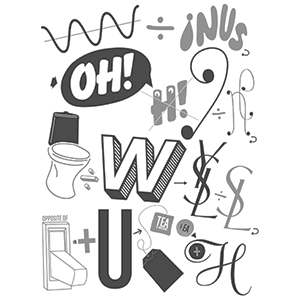
A rebus [ree-buhs] is an allusional device that uses pictures to represent words or parts of words. It was a favorite form of heraldic expression used in the Middle Ages to denote surnames, for example in its basic form three salmon fish to denote the name ‘Salmon.’
A more sophisticated example was the rebus of Bishop Walter Lyhart of Norwich, consisting of a stag (or hart) lying down in a conventional representation of water. The composition alludes to the name, profession or personal characteristics of the bearer, and speaks to the beholder ‘Non verbis, sed rebus’ (Latin: ‘not by words but by things’).
read more »
Posted in Games, Humor, Language |
Leave a Comment »
April 26, 2013
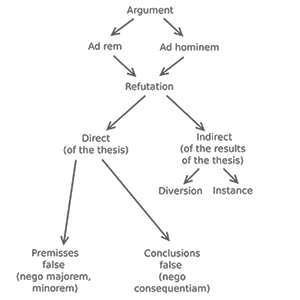
‘The Art of Being Right: 38 Ways to Win an Argument’ (1831) is an acidulous (biting) treatise written by the German philosopher Arthur Schopenhauer in sarcastic deadpan. He examines a total of thirty-eight methods of showing up one’s opponent in a debate. Schopenhauer introduces his essay with the idea that philosophers have concentrated in ample measure on the rules of logic, but have not (especially since the time of Immanuel Kant) engaged with the darker art of the dialectic, of controversy.
Whereas the purpose of logic is classically said to be a method of arriving at the truth, dialectic, says Schopenhauer, ‘…on the other hand, would treat of the intercourse between two rational beings who, because they are rational, ought to think in common, but who, as soon as they cease to agree like two clocks keeping exactly the same time, create a disputation, or intellectual contest.’
read more »
Posted in Humor, Language, Politics |
1 Comment »
April 24, 2013

American science writer Michael Shermer has described as ‘wronger than wrong‘ the mistake addressed in what he calls ‘Asimov’s axiom,’ after the noted author Isaac Asimov, who discussed the issue in his book of essays, ‘The Relativity of Wrong.’
A statement that equates two errors is wronger than wrong when one of the errors is clearly more wrong than the other. As Asimov put it: ‘When people thought the earth was flat, they were wrong. When people thought the earth was spherical, they were wrong. But if you think that thinking the earth is spherical is just as wrong as thinking the earth is flat, then your view is wronger than both of them put together.’
read more »
Posted in Humor, Language |
Leave a Comment »
April 24, 2013

The Relativity of Wrong is a 1988 essay collection by Isaac Asimov, which takes its title from the most ambitious essay it contains. Like most of the essays Asimov wrote for ‘F&SF Magazine,’ each one in ‘The Relativity of Wrong’ begins with an autobiographical anecdote which serves to set the tone.
Several of the essays form a sequence explaining the discovery and uses of isotopes; the introductory passages in these essays recount Asimov’s not particularly pleasant personal relationship with physical chemist Harold C. Urey, whom he met at Columbia University.
read more »
Posted in Humor, Language, Science |
Leave a Comment »
April 24, 2013
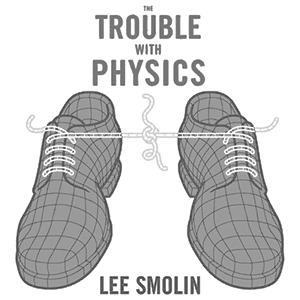
The phrase not even wrong is generally attributed to theoretical physicist Wolfgang Pauli, who was known for his colorful objections to incorrect or sloppy thinking. Rudolf Peierls writes that ‘a friend showed Pauli the paper of a young physicist which he suspected was not of great value but on which he wanted Pauli’s views. Pauli remarked sadly, ‘It is not even wrong.” Peierls remarks that quite a few apocryphal stories of this kind have been circulated and mentions that he listed only the ones personally vouched by him. He also quotes another example when Pauli replied to Lev Landau: ‘What you said was so confused that one could not tell whether it was nonsense or not.’
It has come to be used to describe any argument that purports to be scientific but fails at some fundamental level, usually in that it cannot be falsified (i.e., tested with the possibility of being rejected) by experiment or cannot be used to make predictions about the natural world. ‘Not even wrong’ has also been used by Peter Woit to mean proposed scientific theories that are well-meaning and based on current scientific knowledge, but can neither be used for prediction nor falsified. He has applied the phrase to aspects of string theory in physics on the grounds that, although mathematically elegant, it does not currently provide predictions or tests.
Posted in Humor, Language, Science |
Leave a Comment »
April 24, 2013
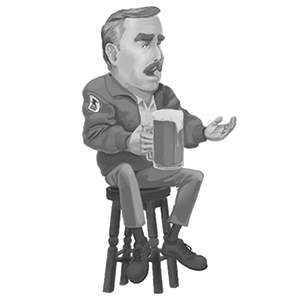
Bullshit (also bullcrap) is a common English expletive which may be shortened to the euphemism bull or the initialism BS. In British English, ‘bollocks’ is a comparable expletive, although bullshit is commonly used in British English. It is a slang profanity term meaning either (literally) bovine excrement or, more commonly, ‘nonsense,’ especially in a rebuking response to communication or actions viewed as deceiving, misleading, disingenuous, or false. As with many expletives, the term can be used as an interjection or as many other parts of speech, and can carry a wide variety of meanings.
It can be used either as a noun or as a verb. While the word is generally used in a deprecating sense, it may imply a measure of respect for language skills, or frivolity, among various other benign usages. In philosophy, Harry Frankfurt, among others, analyzed the concept of bullshit as related to but distinct from lying. Outside of the philosophical and discursive studies, the everyday phrase bullshit conveys a measure of dissatisfaction with something or someone, but does not generally describe any role of truth in the matter.
read more »
Posted in Humor, Language, Philosophy |
Leave a Comment »
April 18, 2013
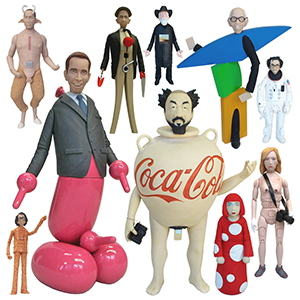
Michael Leavitt (b. 1977) is a visual artist based in Seattle, described as “the best caricature sculptor in the city.’ The ‘über-allround-cool-creator’ is most widely known for his ‘Art Army’ series of handmade action figures depicting visual artists, musicians, and entertainers. Through his company, Intuition Kitchen Productions, Leavitt is a ‘jack-of-all-trades’ responsible for a wide variety of conceptual art projects and performance artworks.
From a disinterest in convention, Leavitt proclaims, ‘I’d be afraid not to try other mediums.’ Growing up in the Pacific Northwest, Leavitt was influenced by the wood-craft and engineering of Native American, Scandinavian, and industrial manufacturing in the region. His parents practiced education, graphic design, and environmentalism by trade, formulating Leavitt’s early interests in both art and sociology.
read more »
Posted in Art, Humor, Money |
Leave a Comment »