November 7, 2012

‘Our Dumb Century: The Onion Presents 100 Years of Headlines from America’s Finest News Source’ is a satirical humor book written by the staff of ‘The Onion’ and published in 1999. The chief editor of the book was Scott Dikkers, with specific sections edited by Robert D. Siegel, Maria Schneider, and John Krewson.
The book, spun off from ‘The Onion’ weekly-newspaper format of dryly satirizing current events, features mocked-up newspaper front pages from the entire 20th century, presented as though ‘The Onion’ had been continuously in print since before 1900. The publication of the book is in itself a parody of other end of the century retrospectives that had been published in 1999, notably ‘Time’ magazine and ‘The New York Times.’
read more »
Posted in Humor, Language, Politics |
Leave a Comment »
November 7, 2012

The sign of the horns is a hand gesture with a variety of meanings and uses in various cultures. It is formed by extending the index and little fingers while holding the middle and ring fingers down with the thumb. When confronted with unfortunate events, or simply when these are mentioned, the sign of the horns may be given to ward off bad luck. It is a more vulgar equivalent of ‘knocking on wood.’
One can also ‘touch iron’ (‘tocca ferro’) or touch one’s nose. Males in some countries may grab their testicles, which is considered very vulgar. In Peru one says ‘contra’ (‘against’). In the Dominican Republic the expression is ‘zafa,’ said against curses. All of these gestures are meant to conjure supernatural protection. However, the sign of horns is used in Brazil, Cuba, Italy, Portugal, Spain and Uruguay to indicate a man whose wife is unfaithful.
read more »
Posted in Humor, Philosophy, World |
Leave a Comment »
November 5, 2012
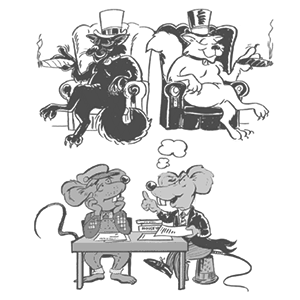
The Story of Mouseland was first told first by Canadian politician Clarence Gillis, and later and most famously by Tommy Douglas, leader of the Saskatchewan Co-operative Commonwealth Federation and, later, the New Democratic Party of Canada, both social democratic parties.
It was a political fable expressing the CCF’s view that the Canadian political system was flawed in offering voters a false dilemma: the choice of two parties, neither of which represented their interests. The mice voted in black cats, which represented the Progressive Conservative Party, and then they found out how hard life was. So they voted in the white cats, which symbolized the Liberal Party.
read more »
Posted in Humor, Politics, World |
Leave a Comment »
October 29, 2012
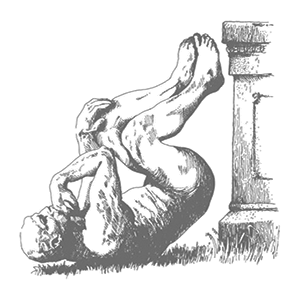
The Ig Nobel Prizes are a satirical award given each year in early October for ten unusual or trivial achievements in scientific research. The stated aim of the prizes is to ‘first make people laugh, and then make them think.’
Organized by the scientific humor magazine ‘Annals of Improbable Research’ (AIR), they are presented by a group that includes Nobel Laureates at a ceremony at Harvard University’s Sanders Theater, and they are followed by a set of public lectures by the winners at MIT. The name is a play on the words ‘ignoble’ (‘characterized by baseness, lowness, or meanness’) and the Nobel Prize. The pronunciation used during the ceremony is [ig-noh-bel], not like the word ‘ignoble.’
read more »
Posted in Education, Humor, Science |
Leave a Comment »
October 28, 2012
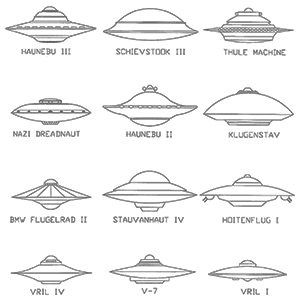
In science fiction, conspiracy theory, and underground comic books, stories or claims circulate linking UFOs to Nazi Germany.
These German UFO theories describe supposedly successful attempts to develop advanced aircraft or spacecraft prior to and during World War II, and further assert the post-war survival of these craft in secret underground bases in Antarctica, South America, or the United States, along with their creators.
read more »
Posted in Humor, Technology, War |
Leave a Comment »
October 24, 2012

The orgasmatron is a fictional device that appears in the 1973 movie ‘Sleeper,’ which also shows the effects of a related device, an orgasmic orb. Similar devices have appeared in other fictional works. The term has also been applied to a non-fictional device capable of triggering an orgasm-like sensation using electrodes implanted at the lower spine. Author Christopher Turner has suggested that the orgasmatron was a parody of Wilhelm Reich’s ‘orgone accumulator,’ a device which claims to concentrate ‘orgone,’ a bioenergy theorized by Reich.
The orgasmatron is a fictional device in the fictional future society of 2173 in the Woody Allen movie ‘Sleeper.’ It is a large cylinder big enough to contain one or two people. The orgasmatron was made by decorating an elevator in the home where the movie was filmed. Once entered, it contains some (otherwise undescribed) future technology that rapidly induces orgasms. This is required, as almost all people in the ‘Sleeper’ universe are impotent or frigid, although males of Italian descent are considered the least impotent of all groups.
read more »
Posted in Humor, Sex, Technology |
Leave a Comment »
October 18, 2012

Calvinball is a game played by Calvin and Hobbes as a rebellion against organized team sports; according to Hobbes, ‘No sport is less organized than Calvinball!’ The game was first introduced to the readers at the end of a 1990 storyline involving Calvin reluctantly joining recess baseball. It quickly became a staple of the comic afterwards.
The only hint at the true creation of the sport ironically comes from the last Calvinball strip, in which a game of football quickly devolves into a game of Calvinball. Calvin remarks that ‘sooner or later, all our games turn into Calvinball,’ Calvin and Hobbes usually play by themselves, although in one storyline Rosalyn (Calvin’s babysitter) plays in return for Calvin doing his homework, and plays very well once she realizes that the rules are made up on the spot.
read more »
Posted in Games, Humor |
Leave a Comment »
October 18, 2012

Cheating in video games involves a player using non-standard methods for creating an advantage beyond normal gameplay, usually to make the game easier. Cheats sometimes may take the form of ‘secrets’ placed by game developers themselves. Cheats may be activated from within the game itself (‘cheat code’ implemented by the original game developers); or created by third-party software (‘game trainer’) or hardware (‘cheat cartridge’).
They can also be realized by exploiting software bugs. Cheating in video games has existed for almost their entire history. The first cheat codes were put in place for play testing purposes. Playtesters had to rigorously test the mechanics of a game and introduced cheat codes to make this process easier. An early cheat code can be found in ‘Manic Miner,’ where typing ‘6031769’ (based on developer Matthew Smith’s driving licence) enables the cheat mode.
read more »
Posted in Games, Humor, Technology |
Leave a Comment »
October 10, 2012

The Adventures of Tintin: Breaking Free is an anarchist parody of the popular Tintin series of comics. An exercise in detournement (turning expressions of the capitalist system and its media culture against itself), the book was written under the pseudonym J. Daniels and published by Attack International in 1988. It has recently been re-printed by anarchist publishers Freedom Press which includes for the first time Tintin’s earlier adventures during the Wapping dispute as told in ‘The Scum,’ a 1986 pamphlet which was produced in solidarity with the printworkers.
The story features a number of characters based on those from the original series by Hergé, notably Tintin himself and Captain Haddock (referred to only as ‘the Captain’ and depicted here as being Tintin’s uncle), but not the original themes or plot. Snowy is featured on the cover – being especially visible on the first edition’s cover – but not in the narrative. The story tracks Tintin’s development from a disaffected, shoplifting youth to a revolutionary leader.
read more »
Posted in Humor, Money, Politics |
Leave a Comment »
October 10, 2012

The Dozens is a game of spoken words between two contestants, common in Hip-hop/Urban communities, where participants insult each other until one gives up or violence erupts. It is customary for the Dozens to be played in front of an audience of bystanders, who encourage the participants to reply with more egregious insults to heighten the tension and consequently, to be more interesting to watch. It is also known as ‘sounding,’ ‘joning,’ ‘woofing,’ ‘sigging,’ or ‘signifying,’ while the insults themselves are known as ‘snaps.’
The origin of the game is unclear, but it has roots in Africa: similar contests are held in Nigeria among the Igbo people, and in Ghana. Comments in the game focus on the opposite player’s intelligence, appearance, competency, social status, financial situation, and disparaging remarks about the other player’s family members—mothers in particular (‘yo′ mama…’)—are common. Commentary is often related to sexual issues, where the game is then referred to as the ‘Dirty Dozens.’
read more »
Posted in Games, Humor, Language |
Leave a Comment »
October 10, 2012

A roast is an event, almost exclusively in the United States, in which an individual is subjected to a public presentation of comedic insults, praise, outlandish true and untrue stories, and heartwarming tributes, the implication being that the roastee is able to take the jokes in good humor and not as serious criticism or insult, and therefore, show their good nature.
It is seen by some as a great honor to be roasted, as the individual is surrounded by friends, fans, and well-wishers, who can receive some of the same treatment as well during the course of the evening. The party and presentation itself are both referred to as a ‘roast.’ The host of the event is called the ‘roastmaster.’ Anyone who is honored in such a way is said to have been ‘roasted.’
read more »
Posted in Games, Humor, Language |
Leave a Comment »
October 7, 2012


In a 2006 episode of the satirical news show ‘The Colbert Report,’ Stephen Colbert announced the neologism ‘Wikiality‘ (a portmanteau of the words ‘Wiki’ and ‘reality’) defined as ‘truth by consensus’ (rather than fact), modeled after the approval-by-consensus format of Wikipedia. He ironically praised Wikipedia for following his philosophy of ‘truthiness,’ in which intuition and consensus is a better reflection of reality than fact:
‘You see, any user can change any entry, and if enough other users agree with them, it becomes true. … If only the entire body of human knowledge worked this way. And it can, thanks to tonight’s word: ‘Wikiality.’ Now, folks, I’m no fan of reality, and I’m no fan of encyclopedias. I’ve said it before. Who is Britannica to tell me that George Washington had slaves? If I want to say he didn’t, that’s my right. And now, thanks to Wikipedia, it’s also a fact. We should apply these principles to all information. All we need to do is convince a majority of people that some factoid is true. … What we’re doing is bringing democracy to knowledge.’
read more »
Posted in Humor, Language, Technology |
Leave a Comment »


 The Daily Omnivore