December 2, 2012
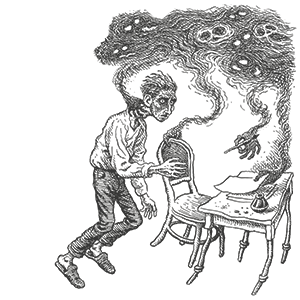
Introducing Kafka, also known as Kafka for Beginners, is a 1993 illustrated biography of Franz Kafka by David Zane Mairowitz and Robert Crumb. The book includes comic adaptations of some of Kafka’s most famous works including ‘The Metamorphosis,’ ‘A Hunger Artist,’ ‘In the Penal Colony,’ and ‘The Judgment,’ as well as brief sketches of his three novels ‘The Trial,’ ‘The Castle,’ and ‘Amerika.’
The book also details Kafka’s biography in a format that is part illustrated essay, part sequential comic panels. The book was released as part of the ‘Introducing…’ series by Totem Books which also features a volume each on Sigmund Freud and Wilhelm Reich. The popularity of Crumb’s renditions of Kafka’s works led to additional printings under the title ‘R. Crumb’s Kafka.’
Posted in Art, Humor, Language |
1 Comment »
December 2, 2012

Internet Killed Television is a web series which documents the lives of Charles Trippy, his wife Alli and their dogs Zoey and Marley. The show consists of episodes averaging around one to twenty minutes that are filmed, edited, and then aired every day onto YouTube by mid-afternoon Eastern Standard Time. The series was originally planned to last for only one year; however, after the success of the first season, the couple have decided to continue.
The YouTube series has now reached its fourth year and every year, so far, they have reached out to their audience, the CTFxC(ers) to create a montage featuring the main events that had occurred that year.
read more »
Posted in Art, Humor, Technology |
1 Comment »
November 30, 2012

David Rees (b. 1972) is a cartoonist and humorist whose best-known work combines bland clip art with outrageous ‘trash talk’ to incongruous effect. The comic strips have achieved wide popularity and some controversy.
Rees grew up in Chapel Hill, North Carolina and was an avid reader of ‘Rex Morgan, M.D.’ comics. He is a graduate of Oberlin College, and drew comics for the school’s newspaper. His office-cubicle humor is partly inspired by his experience working in a basement for Citicorp; he was later a part time fact-checker for ‘Maxim’ magazine and ‘Martha Stewart Weddings’ magazine, until he was laid off. Rees’s best-known and most controversial comic is ‘Get Your War On.’
read more »
Posted in Humor, Language, Money |
Leave a Comment »
November 30, 2012

Heisenbug is a whimsical computer programming jargon term for a software bug (glitch) that seems to disappear or alter its behavior when one attempts to study it.
The term is a pun on the name of Werner Heisenberg, the physicist who first asserted the observer effect of quantum mechanics, which states that the act of observing a system inevitably alters its state.
read more »
Posted in Humor, Technology |
1 Comment »
November 30, 2012

‘Rapture of the Nerds’ is a derisive term for the technological singularity (a theorized future period of superhuman intelligence). Some critics assert that no computer or machine will ever achieve human intelligence, while others hold that the definition of intelligence is irrelevant if the net result is the same.
Cognitive scientist Steven Pinker stated in 2008, ‘There is not the slightest reason to believe in a coming singularity. The fact that you can visualize a future in your imagination is not evidence that it is likely or even possible. Look at domed cities, jet-pack commuting, underwater cities, mile-high buildings, and nuclear-powered automobiles—all staples of futuristic fantasies when I was a child that have never arrived. Sheer processing power is not a pixie dust that magically solves all your problems.’
read more »
Posted in Humor, Technology |
Leave a Comment »
November 30, 2012

The South Butt, LLC was a clothing and accessories company founded in 2007 by Jimmy Winkelmann, a then 16-year-old student at Chaminade College Preparatory School. The company dissolved in 2011.
Winkelmann claimed the company was a parody of the The North Face, an American outdoor product company.
read more »
Posted in Humor, Money, Politics |
Leave a Comment »
November 29, 2012

The Merry Pranksters was a cohort that formed around American author Ken Kesey in 1964 and sometimes lived communally at his homes in California and Oregon. The group promoted the use of psychedelic drugs. Their motto was ‘Never Trust a Prankster.’
Kesey and the Merry Pranksters are noted for the sociological significance of a lengthy road trip they took in the summer of 1964, traveling across the United States in a psychedelic painted school bus enigmatically and variably labeled ‘Further.’ Their early escapades were chronicled by Tom Wolfe in ‘The Electric Kool-Aid Acid Test.’ Wolfe also documents a notorious 1966 trip on Further from Mexico through Houston, stopping to visit Kesey’s friend, novelist Larry McMurtry. Kesey was in flight from a drug charge at the time.
read more »
Posted in Drugs, Humor |
Leave a Comment »
November 28, 2012
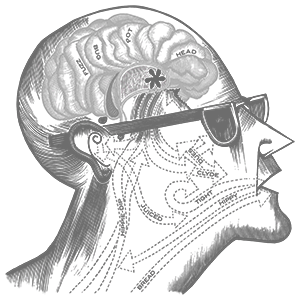
How to Speak Hip is a spoken-word comedy album by improv pioneer Del Close and John Brent, released by Mercury Records in 1959. The album is designed as a satire of language-learning records, where the secret language of the ‘hipster’ is treated as a foreign language.
Part of the joke, however, is that it actually does a good job of describing the Beat Generation/Beatnik sub-culture: Basic concepts such as ‘cool’ and ‘uncool’ are taught, as well as vocabulary building (‘dig,’ ‘dig it,’ ‘dig yourself, baby,’ ‘dig the chick,’ ‘dig the cat,’ ‘What a drag!’).
read more »
Posted in Art, Humor, Language |
Leave a Comment »
November 28, 2012

Harold is a structure used in longform theatrical improvisation. Developed by Del Close and brought to fruition through Close’s collaboration with Charna Halpern, the Harold has become the signature form of Chicago’s iO and the Upright Citizens Brigade Theater in New York and Los Angeles. It is now performed by improvisational theater troupes and teams across the world.
The Committee, a San Francisco improv group, performed the first Harold in Concord, California in 1967. They were invited to a high school and decided to do their improvisations on the war in Vietnam. On the way home they were discussing the performance when one of them asked what they should call it. Allaudin (Bill) Mathieu called out ‘Harold.’ It was a joking reference to a line from ‘A Hard Days Night’ where a reporter asked George Harrison what he called his haircut; he answered ‘Arthur.’ Close later remarked that he wished he had chosen a better name.
read more »
Posted in Art, Games, Humor |
Leave a Comment »
November 28, 2012

Del Close (1934 – 1999) is one of the premier influences on modern improvisational theater. He was also an actor appearing in a number of films and television shows.
He was a co-author of the book ‘Truth in Comedy,’ which outlines techniques now common to longform improvisational theater and describes the overall structure (he named ‘Harold’) which remains a common frame for longer improvisational scenes. His favorite framework for comedic storytelling was the structures of Wagner’s ‘Ring Cycle.’
read more »
Posted in Art, Games, Humor |
Leave a Comment »
November 28, 2012

Recess is an American animated television series created by Paul Germain and Joe Ansolabehere (credited as ‘Paul and Joe’) and produced by Walt Disney Television Animation. The series focuses on six elementary school students and their interaction with other classmates and teachers.
The title refers to the period of time during the school day in which children are not in lessons and are outside in the schoolyard, in North American society. One of the main features of the series is how the children form their own society, complete with government and a class structure, set against the backdrop of a regular school.
read more »
Posted in Art, Humor |
Leave a Comment »
November 18, 2012

The Comedy is a 2012 black comedy film directed and co-written by Rick Alverson, and starring Tim Heidecker. Supporting actors include Eric Wareheim (Tim and Eric), James Murphy (LCD Soundsystem), and Gregg Turkington (better known as Neil Hamburger).
Despite the title and use of comedians as actors, Sundance festival chief programmer Trevor Groth says that the film is not a comedy, but instead ‘a provocation, a critique of a culture based at its core around irony and sarcasm and about ultimately how hollow that is.’ Indifferent even to the prospects of inheriting his father’s estate, Swanson (Heidecker) whittles away his days with a group of aging Brooklyn hipsters, engaging in acts of recreational cruelty and pacified boredom. Desensitized and disenchanted, he strays into a series of reckless situations that may offer the promise of redemption or the threat of retribution.
Posted in Art, Humor |
Leave a Comment »


 The Daily Omnivore