August 6, 2012

Survival Research Laboratories (SRL) is a machine performance art group credited for pioneering the genre of large-scale machine performance. After about 30 years in San Francisco, SRL spent most of 2008 moving 40 miles north to Petaluma. Since its inception in 1978 SRL has operated as an organization of creative technicians and technical creatives dedicated to redirecting the techniques, tools, and tenets of industry, science, and the military away from their typical manifestations in practicality, product or warfare.
Since 1979, SRL has staged over 45 mechanized presentations in the United States and Europe. Each performance consists of a unique set of ritualized interactions between machines, robots, and special-effects devices, employed in developing themes of socio-political satire. Humans are present only as audience or operators.
read more »
Posted in Art, Humor, Technology |
Leave a Comment »
July 31, 2012
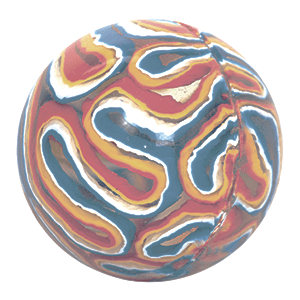
A SuperBall or bouncy ball is a toy, invented in 1964 by chemist Norman Stingley by compressing a synthetic rubber material under high pressure. It is an extremely elastic ball made of Zectron, which contains the synthetic rubber polymer polybutadiene, as well as hydrated silica, zinc oxide, stearic acid, and other ingredients, vulcanized with sulfur at a temperature of 165 degrees Celsius and at a pressure of 3,500psi.
The Super Ball has an amazingly high coefficient of restitution. Dropped from shoulder level, balls snap nearly all the way back; thrown down by an average adult, it can leap over a three-story building. Toys similar to SuperBalls are more generally known as bouncy balls, a term which covers other more or less similar balls by different manufacturers with different formulations.
read more »
Posted in Games, Humor |
Leave a Comment »
July 27, 2012
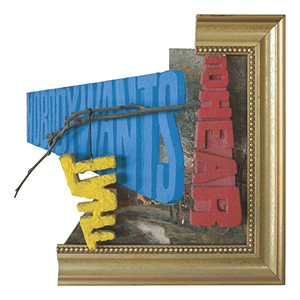
Wayne White is an American artist, art director, cartoonist, and illustrator. He started his art career working as a cartoonist and illustrator for a number of publications including ‘The East Village Eye,’ ‘Raw,’ ‘The New York Times,’ and ‘The Village Voice.’ In 1986 he worked on ‘Pee Wee’s Playhouse’ where his work for his set and puppet designs won three Emmy awards; he also supplied a number of voices on the show.
Other television credits include production and set design for ‘Shining Time Station,’ ‘Riders in the Sky,’ ‘The Weird Al Show,’ and ‘Beakman’s World.’ He art directed two seminal music videos, Peter Gabriel’s ‘Big Time’ in 1986, and in 1996 he designed all the Georges Méliès inspired sets for the award-winning video for the Smashing Pumpkins, ‘Tonight, Tonight.’
read more »
Posted in Art, Humor |
1 Comment »
July 25, 2012
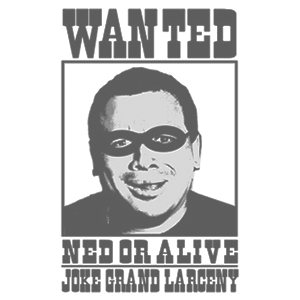
Joke thievery is the act of performing and taking credit for comic material written by another person without their consent. This is a form of plagiarism and sometimes can be copyright infringement. A common epithet for a joke thief is ‘hack,’ which is derived from the term, ‘hackneyed’ (over used and thus cheapened, or trite).
From the music hall and vaudeville beginnings of stand-up comedy, joke thievery was common as there were few chances that a performer from one area would meet one from another and a single twenty-minute set could sustain a comic for a decade. Most jokes at the time were one-liners and there was little in the way of proof of a joke’s origin, but the value of each joke was immeasurable to a comedian. Milton Berle and Bob Hope had a long-standing feud due to Hope’s accusation that Berle had stolen some of his jokes. Berle never refuted the claim, but instead embraced the title ‘The Thief of Bad Gag.’
read more »
Posted in Humor, Language, Money |
Leave a Comment »
July 25, 2012

Truthiness is a quality characterizing a ‘truth’ that a person claims to know intuitively ‘from the gut’ or because it ‘feels right’ without regard to evidence, logic, intellectual examination, or facts. American television comedian Stephen Colbert coined the word in this meaning as the subject of a segment called ‘The Wørd’ during the 2005 pilot episode of his political satire program ‘The Colbert Report.’
By using this as part of his routine, Colbert satirized the misuse of appeal to emotion and ‘gut feeling’ as a rhetorical device in contemporaneous socio-political discourse. He particularly applied it to President George W. Bush’s nomination of Harriet Miers to the Supreme Court and the decision to invade Iraq in 2003. Colbert later ascribed truthiness to other institutions and organizations, including Wikipedia. Colbert has sometimes used a mock Latin version of the term, ‘Veritasiness.’
read more »
Posted in Humor, Language, Politics |
Leave a Comment »
July 24, 2012


Pronoia [proh-noi-uh] is a neologism that is defined as the opposite state of mind as paranoia: having the sense that there is a conspiracy that exists to help the person. It is also used to describe a philosophy that the world is set up to secretly benefit people. The writer and Electronic Frontier Foundation co-founder John Perry Barlow defined pronoia as ‘the suspicion the Universe is a conspiracy on your behalf.’ The academic journal ‘Social Problems’ published an article entitled ‘Pronoia’ by Fred H. Goldner in 1982.
According to Goldner: ‘Pronoia is the positive counterpart of paranoia. It is the delusion that others think well of one. Actions and the products of one’s efforts are thought to be well received and praised by others. Mere acquaintances are thought to be close friends; politeness and the exchange of pleasantries are taken as expressions of deep attachment and the promise of future support. Pronoia appears rooted in the social complexity and cultural ambiguity of our lives: we have become increasingly dependent on the opinions of others based on uncertain criteria.’
read more »
Posted in Health, Humor, Language |
1 Comment »
July 24, 2012
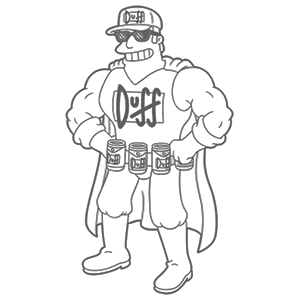
Duff Beer is a brand of beer that originally started as a fictional beverage on the animated series ‘The Simpsons,’ since then it has become a real brand of beer in a number of countries without permission or consent from it’s original creator, Matt Groening, and has resulted in legal battles with varying results. Groening has stated that he will not license the Duff trademark to brew an actual beer, over concern that it would encourage children to drink.
It is Homer Simpson’s beer of choice and a parody of stereotypical commercial beer: very cheaply priced, poor-quality, and advertised everywhere. The name was inspired by one-syllable beer names in the US (such as ‘Bud’). In an excerpt from his autobiography, former Guns N’ Roses bassist Duff McKagan claimed that the beer was named after him as the writers were fans of the band and he was known for his extreme alcohol consumption.
read more »
Posted in Drugs, Food, Humor |
Leave a Comment »
July 23, 2012
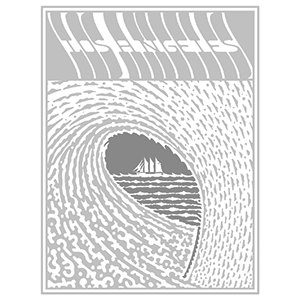
Inherent Vice is a novel by Thomas Pynchon, originally published in 2009. The term ‘inherent vice’ as a legal phrase refers to a ‘hidden defect (or the very nature) of a good or property which of itself is the cause of (or contributes to) its deterioration, damage, or wastage. Such characteristics or defects make the item an unacceptable risk to a carrier or insurer. If the characteristic or defect is not visible, and if the carrier or the insurer has not been warned of it, neither of them may be liable for any claim arising solely out of the inherent vice.’ The phrase appears often in William Gaddis’ ‘The Recognitions,’ a novel that influenced American post-modern literature and Pynchon. Gaddis’ novel uses the term to refer to defects in works of art.
In a generally favorable review, Michiko Kakutani of ‘The New York Times’ called it ‘Pynchon Lite,’ describing it as ‘a simple shaggy-dog detective story that pits likable dopers against the Los Angeles Police Department and its ‘countersubversive’ agents, a novel in which paranoia is less a political or metaphysical state than a byproduct of smoking too much weed.’
Posted in Art, Humor, Language |
2 Comments »
July 23, 2012

PaRappa the Rapper is a rhythm video game (e.g. ‘Dance Dance Revolution’ and ‘Guitar Hero’) for the Sony PlayStation created by Masaya Matsuura (the former leader of the Japanese ‘Hyper Pop Unit’ PSY S) and his NanaOn-Sha company.
While the gameplay is not challenging for experienced gamers, the game is remembered for its unique graphic design, its quirky soundtrack and its bizarre plot. Despite being made in Japan, all of the game’s songs and dialogue are spoken in English in all versions. The game is named after its protagonist, Parappa, a 2D rapping dog with the motto, ‘I gotta believe!’ His name comes from the Japanese term for ‘paper thin.’
read more »
Posted in Games, Humor, Technology |
Leave a Comment »
July 18, 2012

Yhprum’s Law is the opposite of Murphy’s Law (Yhprum = Murphy backwards). The simple formula of Yhprum’s Law is: ‘Everything, that can work, will work. It is attributed to Richard Zeckhauser, a professor for political economy at Harvard University: ‘Sometimes systems that should not work, work nevertheless.’
In 2006, Paul Resnick of the University of Michigan School of Information used this law to describe how intensive and seemingly altruistic participation by giving ranking is observed in the eBay system.
Posted in Humor, Language |
1 Comment »
July 18, 2012

Hanlon’s Razor is an eponymous adage that reads: ‘Never attribute to malice that which is adequately explained by stupidity.’
A common (and more laconic) British English variation, coined by Sir Bernard Ingham, is the saying ‘cock-up before conspiracy,’ deriving from this quotation: ‘Many journalists have fallen for the conspiracy theory of government. I do assure you that they would produce more accurate work if they adhered to the cock-up theory.’
read more »
Posted in Humor, Language |
1 Comment »
July 18, 2012
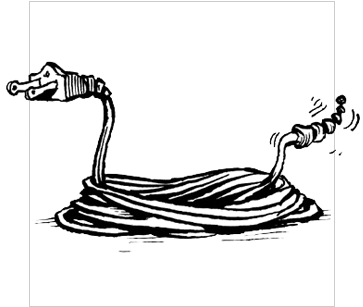
Resistentialism [ri-zis-ten-shul-iz-um] is a jocular theory to describe ‘seemingly spiteful behavior manifested by inanimate objects.’ For example, objects that cause problems (like lost keys or a fleeing bouncy ball) exhibit a high degree of malice toward humans and lend support to resistentialist beliefs. In other words, a war is being fought between humans and inanimate objects, and all the little annoyances objects give people throughout the day are battles between the two.
The term was coined by humorist Paul Jennings in a piece titled ‘Report on Resistentialism,’ published in ‘The Spectator’ in 1948 and reprinted in ‘The New York Times.’ The movement is a spoof of existentialism in general, and Jean-Paul Sartre in particular (Jennings gives the inventor of Resistentialism as Pierre-Marie Ventre). The slogan of Resistentialism is ‘Les choses sont contre nous’ — ‘Things are against us.’
read more »
Posted in Humor, Language, Philosophy |
Leave a Comment »


 The Daily Omnivore