July 24, 2012


Pronoia [proh-noi-uh] is a neologism that is defined as the opposite state of mind as paranoia: having the sense that there is a conspiracy that exists to help the person. It is also used to describe a philosophy that the world is set up to secretly benefit people. The writer and Electronic Frontier Foundation co-founder John Perry Barlow defined pronoia as ‘the suspicion the Universe is a conspiracy on your behalf.’ The academic journal ‘Social Problems’ published an article entitled ‘Pronoia’ by Fred H. Goldner in 1982.
According to Goldner: ‘Pronoia is the positive counterpart of paranoia. It is the delusion that others think well of one. Actions and the products of one’s efforts are thought to be well received and praised by others. Mere acquaintances are thought to be close friends; politeness and the exchange of pleasantries are taken as expressions of deep attachment and the promise of future support. Pronoia appears rooted in the social complexity and cultural ambiguity of our lives: we have become increasingly dependent on the opinions of others based on uncertain criteria.’
read more »
Posted in Health, Humor, Language |
1 Comment »
July 24, 2012
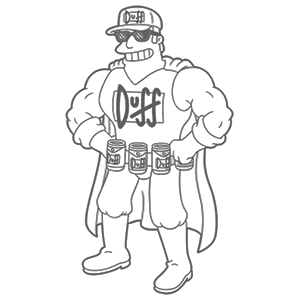
Duff Beer is a brand of beer that originally started as a fictional beverage on the animated series ‘The Simpsons,’ since then it has become a real brand of beer in a number of countries without permission or consent from it’s original creator, Matt Groening, and has resulted in legal battles with varying results. Groening has stated that he will not license the Duff trademark to brew an actual beer, over concern that it would encourage children to drink.
It is Homer Simpson’s beer of choice and a parody of stereotypical commercial beer: very cheaply priced, poor-quality, and advertised everywhere. The name was inspired by one-syllable beer names in the US (such as ‘Bud’). In an excerpt from his autobiography, former Guns N’ Roses bassist Duff McKagan claimed that the beer was named after him as the writers were fans of the band and he was known for his extreme alcohol consumption.
read more »
Posted in Drugs, Food, Humor |
Leave a Comment »
July 23, 2012
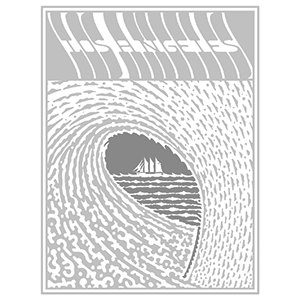
Inherent Vice is a novel by Thomas Pynchon, originally published in 2009. The term ‘inherent vice’ as a legal phrase refers to a ‘hidden defect (or the very nature) of a good or property which of itself is the cause of (or contributes to) its deterioration, damage, or wastage. Such characteristics or defects make the item an unacceptable risk to a carrier or insurer. If the characteristic or defect is not visible, and if the carrier or the insurer has not been warned of it, neither of them may be liable for any claim arising solely out of the inherent vice.’ The phrase appears often in William Gaddis’ ‘The Recognitions,’ a novel that influenced American post-modern literature and Pynchon. Gaddis’ novel uses the term to refer to defects in works of art.
In a generally favorable review, Michiko Kakutani of ‘The New York Times’ called it ‘Pynchon Lite,’ describing it as ‘a simple shaggy-dog detective story that pits likable dopers against the Los Angeles Police Department and its ‘countersubversive’ agents, a novel in which paranoia is less a political or metaphysical state than a byproduct of smoking too much weed.’
Posted in Art, Humor, Language |
2 Comments »
July 23, 2012

PaRappa the Rapper is a rhythm video game (e.g. ‘Dance Dance Revolution’ and ‘Guitar Hero’) for the Sony PlayStation created by Masaya Matsuura (the former leader of the Japanese ‘Hyper Pop Unit’ PSY S) and his NanaOn-Sha company.
While the gameplay is not challenging for experienced gamers, the game is remembered for its unique graphic design, its quirky soundtrack and its bizarre plot. Despite being made in Japan, all of the game’s songs and dialogue are spoken in English in all versions. The game is named after its protagonist, Parappa, a 2D rapping dog with the motto, ‘I gotta believe!’ His name comes from the Japanese term for ‘paper thin.’
read more »
Posted in Games, Humor, Technology |
Leave a Comment »
July 18, 2012

Yhprum’s Law is the opposite of Murphy’s Law (Yhprum = Murphy backwards). The simple formula of Yhprum’s Law is: ‘Everything, that can work, will work. It is attributed to Richard Zeckhauser, a professor for political economy at Harvard University: ‘Sometimes systems that should not work, work nevertheless.’
In 2006, Paul Resnick of the University of Michigan School of Information used this law to describe how intensive and seemingly altruistic participation by giving ranking is observed in the eBay system.
Posted in Humor, Language |
1 Comment »
July 18, 2012

Hanlon’s Razor is an eponymous adage that reads: ‘Never attribute to malice that which is adequately explained by stupidity.’
A common (and more laconic) British English variation, coined by Sir Bernard Ingham, is the saying ‘cock-up before conspiracy,’ deriving from this quotation: ‘Many journalists have fallen for the conspiracy theory of government. I do assure you that they would produce more accurate work if they adhered to the cock-up theory.’
read more »
Posted in Humor, Language |
1 Comment »
July 18, 2012
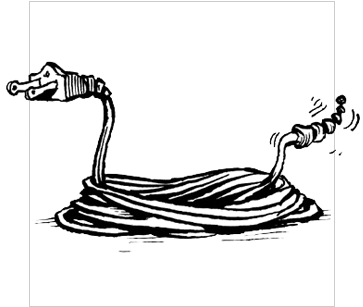
Resistentialism [ri-zis-ten-shul-iz-um] is a jocular theory to describe ‘seemingly spiteful behavior manifested by inanimate objects.’ For example, objects that cause problems (like lost keys or a fleeing bouncy ball) exhibit a high degree of malice toward humans and lend support to resistentialist beliefs. In other words, a war is being fought between humans and inanimate objects, and all the little annoyances objects give people throughout the day are battles between the two.
The term was coined by humorist Paul Jennings in a piece titled ‘Report on Resistentialism,’ published in ‘The Spectator’ in 1948 and reprinted in ‘The New York Times.’ The movement is a spoof of existentialism in general, and Jean-Paul Sartre in particular (Jennings gives the inventor of Resistentialism as Pierre-Marie Ventre). The slogan of Resistentialism is ‘Les choses sont contre nous’ — ‘Things are against us.’
read more »
Posted in Humor, Language, Philosophy |
Leave a Comment »
July 9, 2012
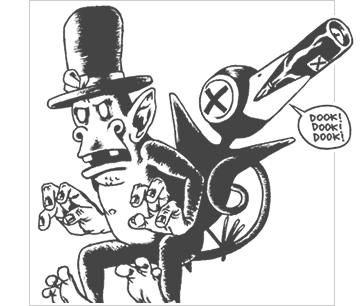
Maakies is a syndicated weekly comic strip by Tony Millionaire. It began publication in 1994 in the ‘New York Press.’ It currently runs in many American alternative newsweeklies including ‘The Stranger,’ ‘LA Weekly,’ and ‘Only.’ It also appears in several international venues including the Italian comics magazine ‘Linus’ and the Swedish comics magazine ‘Rocky.’
The strip focuses on the darkly comic misadventures of Uncle Gabby (a drunken Irish sock monkey) and Drinky Crow (an alcoholic crow), two antiheroes with a propensity for drunkenness, violence, suicide, and venereal disease. According to Millionaire, ”Maakies’ is me spilling my guts… Writing and drawing about all the things that make me want to jump in the river, laughing at the horror of being alive.’ Maakies strips typically take place in an early 19th century nautical setting. There is rarely any continuity between strips.
read more »
Posted in Art, Drugs, Humor |
Leave a Comment »
July 9, 2012

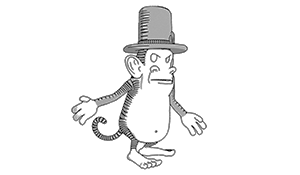
Tony Millionaire (b. 1956) (real name Scott Richardson) is an American cartoonist, illustrator and author known for his syndicated comic strip ‘Maakies’ and the ‘Sock Monkey’ series of comics and picture books. The nautical settings of much of Millionaire’s work draw inspiration from his childhood memories of his grandparents’ artwork and seaside home in Massachusetts as well as the novels of Patrick O’Brian, of which he is an avid reader. He draws in a lush style that mingles naturalistic detail with strong doses of the fanciful and grotesque. His linework resembles that of Johnny Gruelle, whom he cites as one of his main sources of inspiration along with Ernest Shepard and ‘all those freaks from the twenties and thirties who did the newspaper strips’; many of Millionaire’s admirers adduce a similarity to the work of E. C. Segar in particular. He draws with a fountain pen.
When asked in interviews why he uses a pseudonym, Millionaire maintains that he does not, and that ‘Tony Millionaire’ is his real name: ‘It is my legal name, and it’s been around a lot longer than I’ve been a cartoonist.’ He has claimed that his unusual surname is an Old French word meaning ‘a person who owns a thousand serfs.’ Skeptics trace the origin of the name to a character in an episode of the ’60s TV series ‘I Dream of Jeannie.’ Millionaire has speculated that in the future he may publish some family-friendly works of his under a different moniker in order to dissociate them from his other, more ribald output.
read more »
Posted in Art, Humor, Language |
Leave a Comment »
July 9, 2012
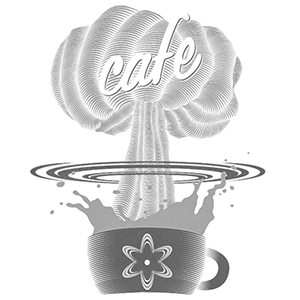
The Atomic Cafe is a 1982 American documentary film produced and directed by Jayne Loader, Kevin Rafferty, and Pierce Rafferty.
The film covers the beginnings of the era of nuclear warfare, created from a broad range of archival film from the 1940s, 1950s, and early 1960s – including newsreel clips, television news footage, U.S. government-produced films (including military training films), advertisements, television and radio programs. News footage reflected the prevailing understandings of the media and public.
read more »
Posted in Humor, Politics, War |
Leave a Comment »
July 4, 2012
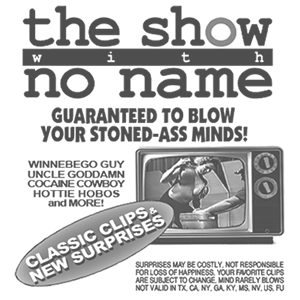
The Show With No Name was a long-running and highly popular Public-access television cable TV show in Austin, Texas, hosted by Charlie Sotelo and the mysterious ‘Cinco.’ Each show featured clips of TV, film and music ephemera along with commentary by the hosts and calls from a predictably unruly Public-access television audience.
The clips were usually video snippets that captured a crazy moment of ephemeral history, such as Ed McMahon drunk on ‘The Tonight Show,’ an early live TV appearance by Frank Zappa playing the bicycle and other found instruments, or the famously disastrous Andy Kaufman appearance on ‘Fridays’ (ABC’s weekly late-night live comedy show). Often they were obscure cult favorites only circulated underground, such as ‘Heavy Metal Parking Lot,’ the profane bloopers of an actor in a Winnebago sales video, or Corey Haim’s ‘Me, Myself, and I.’ Many other clips simply presented a zeitgeist gone by: a trailer for an Akira Kurosawa or Sam Peckinpah film, a Bill Hicks comedy set, or Bob Dylan appearing on the Johnny Cash show.
read more »
Posted in Art, Humor |
Leave a Comment »
July 4, 2012

The Found Footage Festival is a live comedy event and screening featuring unusual and humorous clips from VHS videotapes gathered from thrift stores, garage sales, warehouses, estate sales, and dumpsters throughout the United States. Founded in 2004, the Festival originated in Wisconsin and Minnesota by Joe Pickett, Nick Prueher and Geoff Haas, childhood friends from Wisconsin. While still in high school, Pickett and Prueher began collecting videos from garage sales, training videos from odd jobs, and copies of tapes from a video production house. The friends would then play selections from this collection for entertainment at parties.
In 2004, Pickett and Prueher quit their day jobs to focus on production of their first feature documentary, ‘Dirty Country.’ They started the touring ‘Found Footage Festival’ show to fund the production of the documentary. In addition to its regular touring schedule, the Festival has appeared at the HBO ‘US Comedy Arts Festival,’ ‘Just For Laughs’ (the Montreal comedy festival), the ‘New York Comedy Festival,’ the Impakt Festival in the Netherlands, and the ‘Central Standard Film Festival’ in Minneapolis. The Festival is currently based out of New York City.
read more »
Posted in Art, Humor, Money |
Leave a Comment »



