August 23, 2012

Pocket dialing (also known as butt dialing) refers to the accidental placement of a phone call while a person’s mobile phone or cordless phone is in the owner’s pocket or handbag. If the caller remains unaware, the recipient will sometimes overhear whatever is happening in the caller’s vicinity. Typically, the call is caused by objects in a person’s pocket or bag poking buttons on the phone. Because of typical sequences of button presses, the accidentally dialed number is often one that has been recently called from that phone, or one near the beginning or end of the phone’s contact list; a consequence of this is that people whose names begin with letters near the beginning or the end of the alphabet sometimes receive more accidental calls.
The keypad lock feature found on most mobile phones is intended to help prevent accidental dialing. However, it is still possible to forget to activate this lock (if the phone does not automatically activate it after a timeout), or to deactivate it accidentally. Many phones allow the emergency number to be called even when the keylock is active. In addition to the inconvenience and embarrassment that may result from an erroneously dialed number, the phenomenon can have other consequences including using up a phone user’s airtime minutes. Apps to prevent pocket dialing exist for smartphones. Several are available for Android based phones such as Call Confirm.
Posted in Humor, Language, Technology |
1 Comment »
August 22, 2012

The Redneck Games are held in East Dublin, Georgia annually. The games were started by the general manager of WQZY, Mac Davis, in response to a comment made by the media; that when the 1996 Olympic Games went to Atlanta, it would be held by a group of rednecks. Taking offense to this, Davis and some locals set up the annual Redneck Games to reinforce the stereotype the media held. In 2001, Drew Scott of Wild Country 96.5 ‘borrowed’ the games to set up a fundraising event for the Franklin County NY Make-A-Wish Foundation.
Some events that are held during the Redneck Games include: The cigarette flip; Bobbing for pig’s trotters; Seed spitting; Toilet seat throwing; Mud pit belly flop; Big-hair contest; Wet T-shirt contest; Armpit serenade; Bug zapping by spitball; Dumpster diving; and Hubcap hurling. For each of the events, a trophy is awarded: a half crushed, empty mounted beer can. The Minto Canadian Redneck Games in Minto, Ontario started in 2006. Events include: Mud Pit Slip & Slide; Bobbin’ for Pig’s Feet; Mud Pit Tug-of-War; Mud Pit Belly Flop Contest; Redneck Horseshoes; Hubcap Hurl; and Mud Pit Volleyball.
Posted in Games, Humor, Money |
Leave a Comment »
August 22, 2012

Here Comes Honey Boo Boo is an American reality series that debuted on TLC in 2012. It is a spinoff of ‘Toddlers & Tiaras,’ based around T&T contestant Alana ‘Honey Boo Boo’ Thompson and her family, who reside in rural McIntyre, Georgia. The series follows the Thompsons, focusing on the daily interactions between the family members and mother June’s attempts to enter Alana into beauty pageants. Other focal points in the series are the teen pregnancy of eldest daughter Anna, Jessica’s attempts to lose weight, as well as visits to the Redneck Games and auctions.
The ‘A.V. Club’ called the first episodes a ‘horror story posing as a reality television program,’ with others worrying about potential child exploitation. A reviewer for ‘Forbes’ criticized TLC as trying to ‘portray Alana’s family as a horde of lice-picking, lard-eating, nose-thumbing hooligans south of the Mason-Dixon line,’ stating that ‘it falls flat, because there’s no true dysfunction here, save for the beauty pageant stuff.’ ‘The Guardian’ also criticized the attempt to portray the Thompsons as something to ‘point and snicker at,’ saying, ‘none of the women or girls who participate in the show seems to hate themselves for their poverty, their weight, their less-than-urbane lifestyle, or the ways in which they diverge from the socially-acceptable beauty standard.’
Posted in Games, Humor, Money |
Leave a Comment »
August 22, 2012

The Mindset List is an annual compilation of the values that shape the worldview (or ‘mindset’) of students about 18 years old and entering college and, to a lesser extent, adulthood. It is co-authored by Ron Nief, ‘Public Affairs’ Director Emeritus, and Tom McBride, Professor of English and Keefer Professor of Humanities, both at Beloit College in Wisconsin.
It originated in 1997 as an e-mail forward, without author credits, passed on by then College Statistician Richard Miller to Ron Nief, who passed it on to peers at other schools. The first Beloit-created Mindset List appeared in the fall of 1998 after requests from peers who mistook the forward as having originated with Nief. It now appears every August as American first-year students enter college.
Posted in Education, Humor, Language |
Leave a Comment »
August 10, 2012

Yoyodyne is a fictitious defense contractor introduced in Thomas Pynchon’s ‘V.’ (1963) and featured prominently in his novel ‘The Crying of Lot 49’ (1966). Described in the latter book as ‘a giant of the aerospace industry,’ Yoyodyne was founded by World War II veteran Clayton ‘Bloody’ Chiclitz. The company has a large manufacturing plant in the fictional town of San Narciso, California.
The name is reminiscent of several real high-tech companies, including Teledyne, Teradyne, which was founded a few years before Pynchon wrote ‘The Crying of Lot 49,’ and Rocketdyne, an aerospace company that manufactured, among other things, propulsion systems. The ‘dyne’ is the standard unit of force in the centimeter-gram-second system of units (largely obsolete but still widely recognized), derived from the Greek word dynamis meaning ‘power’ or ‘force.’
read more »
Posted in Humor, Money, War |
Leave a Comment »
August 10, 2012

Thomas Pynchon [pin-chuhn] (b. 1937) is an American novelist. A MacArthur Fellow, he is noted for his dense and complex novels. Both his fiction and non-fiction writings encompass a vast array of subject matter, styles, and themes, including (but not limited to) the fields of history, science, and mathematics. For his most praised novel, ‘Gravity’s Rainbow,’ Pynchon won the 1974 U.S. National Book Award for Fiction (which he declined).
After publishing several short stories in the late 1950s and early 1960s, he began composing the novels for which he is best known: ‘V.’ (1963), ‘The Crying of Lot 49’ (1966), ‘Gravity’s Rainbow’ (1973), and ‘Mason & Dixon’ (1997). Pynchon is also known for being very private; very few photographs of him have ever been published, and rumors about his location and identity have circulated since the 1960s.
read more »
Posted in Art, Humor, Language |
Leave a Comment »
August 10, 2012

Gravity’s Rainbow is a 1973 book written by Thomas Pynchon; it is his third and most celebrated novel. The narrative is set primarily in Europe at the end of World War II and centers on the design, production and dispatch of V-2 rockets by the German military, and, in particular, the quest undertaken by several characters to uncover the secret of a mysterious device named the ‘Schwarzgerät’ (‘black device’) that is to be installed in a rocket with the serial number ‘00000.’
Gravity’s Rainbow is transgressive, as it questions and inverts social standards of deviance and disgust and transgresses boundaries of Western culture and reason.
read more »
Posted in Humor, Language, War |
1 Comment »
August 6, 2012

Survival Research Laboratories (SRL) is a machine performance art group credited for pioneering the genre of large-scale machine performance. After about 30 years in San Francisco, SRL spent most of 2008 moving 40 miles north to Petaluma. Since its inception in 1978 SRL has operated as an organization of creative technicians and technical creatives dedicated to redirecting the techniques, tools, and tenets of industry, science, and the military away from their typical manifestations in practicality, product or warfare.
Since 1979, SRL has staged over 45 mechanized presentations in the United States and Europe. Each performance consists of a unique set of ritualized interactions between machines, robots, and special-effects devices, employed in developing themes of socio-political satire. Humans are present only as audience or operators.
read more »
Posted in Art, Humor, Technology |
Leave a Comment »
July 31, 2012

A SuperBall or bouncy ball is a toy, invented in 1964 by chemist Norman Stingley by compressing a synthetic rubber material under high pressure. It is an extremely elastic ball made of Zectron, which contains the synthetic rubber polymer polybutadiene, as well as hydrated silica, zinc oxide, stearic acid, and other ingredients, vulcanized with sulfur at a temperature of 165 degrees Celsius and at a pressure of 3,500psi.
The Super Ball has an amazingly high coefficient of restitution. Dropped from shoulder level, balls snap nearly all the way back; thrown down by an average adult, it can leap over a three-story building. Toys similar to SuperBalls are more generally known as bouncy balls, a term which covers other more or less similar balls by different manufacturers with different formulations.
read more »
Posted in Games, Humor |
Leave a Comment »
July 27, 2012

Wayne White is an American artist, art director, cartoonist, and illustrator. He started his art career working as a cartoonist and illustrator for a number of publications including ‘The East Village Eye,’ ‘Raw,’ ‘The New York Times,’ and ‘The Village Voice.’ In 1986 he worked on ‘Pee Wee’s Playhouse’ where his work for his set and puppet designs won three Emmy awards; he also supplied a number of voices on the show.
Other television credits include production and set design for ‘Shining Time Station,’ ‘Riders in the Sky,’ ‘The Weird Al Show,’ and ‘Beakman’s World.’ He art directed two seminal music videos, Peter Gabriel’s ‘Big Time’ in 1986, and in 1996 he designed all the Georges Méliès inspired sets for the award-winning video for the Smashing Pumpkins, ‘Tonight, Tonight.’
read more »
Posted in Art, Humor |
1 Comment »
July 25, 2012
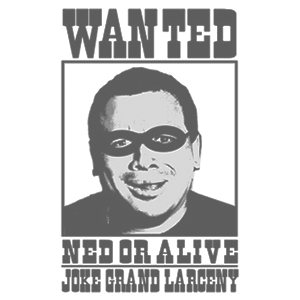
Joke thievery is the act of performing and taking credit for comic material written by another person without their consent. This is a form of plagiarism and sometimes can be copyright infringement. A common epithet for a joke thief is ‘hack,’ which is derived from the term, ‘hackneyed’ (over used and thus cheapened, or trite).
From the music hall and vaudeville beginnings of stand-up comedy, joke thievery was common as there were few chances that a performer from one area would meet one from another and a single twenty-minute set could sustain a comic for a decade. Most jokes at the time were one-liners and there was little in the way of proof of a joke’s origin, but the value of each joke was immeasurable to a comedian. Milton Berle and Bob Hope had a long-standing feud due to Hope’s accusation that Berle had stolen some of his jokes. Berle never refuted the claim, but instead embraced the title ‘The Thief of Bad Gag.’
read more »
Posted in Humor, Language, Money |
Leave a Comment »
July 25, 2012

Truthiness is a quality characterizing a ‘truth’ that a person claims to know intuitively ‘from the gut’ or because it ‘feels right’ without regard to evidence, logic, intellectual examination, or facts. American television comedian Stephen Colbert coined the word in this meaning as the subject of a segment called ‘The Wørd’ during the 2005 pilot episode of his political satire program ‘The Colbert Report.’
By using this as part of his routine, Colbert satirized the misuse of appeal to emotion and ‘gut feeling’ as a rhetorical device in contemporaneous socio-political discourse. He particularly applied it to President George W. Bush’s nomination of Harriet Miers to the Supreme Court and the decision to invade Iraq in 2003. Colbert later ascribed truthiness to other institutions and organizations, including Wikipedia. Colbert has sometimes used a mock Latin version of the term, ‘Veritasiness.’
read more »
Posted in Humor, Language, Politics |
Leave a Comment »



