April 10, 2012

The Compass Players (or Compass Theater) was a cabaret revue show started by alumni, dropouts and hangers-on from the University of Chicago from 1955-1958 in Chicago and St. Louis. Several of the members went on to form The Second City Theater in 1959. Founded by David Shepherd, the original idea was to produce a new play derived through improvisation from outlines (in the tradition of the Italian commedia dell’arte) or scenarios written by members of the ensemble.
Shepherd turned to director Paul Sills to head this venture based on his experience working with Sills on an earlier Chicago theater effort. He noticed that Sills in rehearsal employed theater games, structures designed to create spontaneous theatrical play between actors that had been developed and named by Sills’ mother, Viola Spolin (who would later author the ‘bible’ of theater games, ‘Improvisation for the Theatre’).
read more »
Posted in Art, Games, Humor |
Leave a Comment »
April 10, 2012

Viola Spolin (1906 — 1994) was an important innovator of the American theater in the 20th century. She created directorial techniques to help actors to be focused in the present moment and to find choices improvisationally, as if in real life. These acting exercises she later called ‘Theater Games’ and formed the first body of work that enabled other directors and actors to create improvisational theater.
Her book, ‘Improvisation for the Theater,’ which published these techniques, includes her philosophy, as well as her teaching and coaching methods and is considered the ‘bible of improvisational theater.’ Spolin’s contributions were seminal to the improvisational theater movement in the U.S. She is considered to be the mother of Improvisational theater. Her work has influenced American theater, television and film by providing new tools and techniques that are now used by actors, directors and writers.
read more »
Posted in Art, Games, Humor |
Leave a Comment »
April 10, 2012


The Groundlings are an improvisational comedy troupe based in Los Angeles formed by Gary Austin in 1974. It uses an improv format influenced by Viola Spolin to produce sketches and improvised scenes. Its name is taken from ‘Hamlet’: ‘…to split the ears of the groundlings, who for the most part are capable of nothing but inexplicable dumbshows and noise.’ The Groundlings School holds new sessions every six weeks with over 300 students per session, with over 2,000 students per year going through the program. The competitive program consists of 4 levels (Basic, Intermediate, Writing Lab and Advanced).
Participants must be successfully advanced from each level by the instructor. After completing the Advanced level, one may be voted into the Sunday Company, which performs every Sunday at 7:30pm. Members of the Main Company are selected from members of the Sunday Company. The Main Company (now capped at no more than 30 members at any time) collectively acts as the organization’s artistic director, democratically making business and creative decisions as a group. Notable alumni include: Adam Carolla, Abby Elliott, Jimmy Fallon, Will Ferrell, Will Forte, Ana Gasteyer, Kathy Griffin, Rachael Harris, Phil Hartman, Cheryl Hines, Chris Kattan, Lisa Kudrow, Jon Lovitz, Pat Morita, Conan O’Brien, Cheri Oteri, Paul Reubens, Maya Rudolph, Dax Shepard, and Kristen Wiig.
Posted in Art, Humor, Language |
Leave a Comment »
April 6, 2012

Squidward Tentacles is a fictional character on the television cartoon series ‘SpongeBob SquarePants.’ He is voiced by Rodger Bumpass. Squidward appears in 270 episodes of the series, second only to SpongeBob’s 305. Unlike most characters in the series, Squidward is generally grumpy, tactless, short-tempered, sarcastic, and narcissistic. He dislikes many things, including his consistently annoying neighbors SpongeBob and Patrick, his job at the Krusty Krab, and is constantly aloof towards the citizens of Bikini Bottom. He is very open about his dissatisfaction with his job, and has frequently displayed unprofessional behavior such as sleeping at his counter, failing to clean his workplace, and reading art magazines instead of attending to customers.
Squidward enjoys playing his clarinet (at an elementary level with frequent missed notes and poor intonation, though Squidward considers himself a brilliant musical prodigy), modern dance, abstract art, relaxing, public radio, select television programs, and just about anything else that he considers ‘fancy.’ He does not like anyone, except his mother. Although Squidward likes to consider himself as above the mundane and often immature activities of his peers, he has constantly exhibited an unhealthy obsession with and dedication to such activities when exposed to them.
Posted in Art, Humor |
Leave a Comment »
April 6, 2012

The Troubadour is a nightclub located in West Hollywood, founded in 1957 by Doug Weston. It was a major center for folk music in the 1960s, and subsequently for singer-songwriters and rock.
The Troubadour played an important role in the careers of Elton John, Linda Ronstadt, Hoyt Axton, the Eagles, The Byrds, Joni Mitchell, James Taylor, Carole King, Bonnie Raitt, J.D. Souther, Jackson Browne, Van Morrison, Buffalo Springfield and other prominent and successful performers, who played performances there establishing their future fame.
read more »
Posted in Art, Humor, Money |
Leave a Comment »
April 4, 2012

Giggle incontinence, giggle enuresis or enuresis risoria, is the involuntary release of urine in response to giggling or laughter. The bladder may empty completely or only partially. Giggle incontinence is more common in children than adults, typically appearing at ages 5 to 7, and is most common in girls near the onset of puberty. The condition tends to improve with age, with fewer episodes during the teenage years, but may persist into adulthood. Giggle incontinence is a special form of urge incontinence (an involuntary loss of urine occurring for no apparent reason while feeling urinary urgency, a sudden need or urge to urinate), and is not the same as stress incontinence, which is generally brought on by participating in vigorous sport.
In voluntary urination, the bladder’s normally relaxed detrusor muscle contracts to squeeze urine from the bladder. One study concluded that the cause of giggle incontinence is involuntary contraction of the detrusor muscle induced by laughter. Because the complaint is difficult to reproduce under controlled conditions, its triggering mechanism is not clearly understood, but may be related to cataplexy, a sudden transient episode of loss of muscle tone often triggered by strong emotions.
Posted in Health, Humor |
Leave a Comment »
March 29, 2012

TV Tropes is a wiki that collects and expands on various conventions and devices (tropes) found within creative works. Since its establishment in 2004, the site has gone from covering only television and film tropes to also covering those in a number of other media such as literature, comics, video-games, and even advertisements and toys. It is known for approaching topics with a casual and humorous tone.
The site initially focused on the television show ‘Buffy the Vampire Slayer,’ and has since increased its scope to include thousands of other series, films, novels, plays, video games, anime, manga, comic strips and books, fan fiction, and other subjects, including Internet works such as Wikipedia, which is referred to in-wiki as ‘The Other Wiki.’ Some believe that use of ‘TV Tropes’ teaches the user to analyze and dissect works of media. An unanticipated side effect causes some readers to become jaded and cynical, ‘[replacing] surprise almost entirely with recognition.’ This is referred to on the site as ‘TV Tropes Will Ruin Your Life,’ referring to the inability to read books, watch films, etc. without identifying each trope as it occurs.
Posted in Art, Games, Humor |
Leave a Comment »
March 27, 2012

The Baidu 10 Mythical Creatures was initially a humorous hoax from the interactive encyclopedia ‘Baidu Baike’ which became a popular and widespread Internet meme in China in early 2009. These hoaxes, ten in number, originated in response to increasingly pervasive and draconian online censorship in China, and have become an icon of citizens’ resistance to censorship. The meme initially began as a series of vandalized contributions to ‘Baidu Baike,’ through the creation of humorous articles describing a series of fictional creatures, each with names vaguely referring to Chinese profanities (utilizing homophones and characters using different tones). Eventually, images, videos (such as faux-documentaries) and even a song regarding aspects of the meme were released.
It was thought that the Baidu hoaxes were written in response to recent strict enforcements of keyword filters in China, introduced in 2009, which attempted to eliminate all forms of profanity. The ‘Baidu Baike’ ‘articles’ initially began with ‘Four Mythical Creatures’ (‘Grass Mud Horse,’ ‘French-Croatian Squid,’ ‘Small Elegant Butterfly,’ and ‘Chrysanthemum Silkworms’), and were later extended to ten. The memes became widely discussed on Chinese Internet forums, and most netizens concluded that the initial aim of the hoaxes were to satirize and ridicule the pointlessness of the new keyword filters. The meme is interpreted by most Chinese online as a form of direct protest rather than motiveless intentional disruption to ‘Baidu’ services. After the hoaxes were posted, news of the articles spread quickly online on joke websites, popular web portals and forums.
Posted in Humor, Politics |
Leave a Comment »
March 27, 2012

The Grass Mud Horse or Caoníma, is a Chinese Internet meme widely used as a form of symbolic defiance of the widespread Internet censorship in China. It is a play on the Mandarin language words which translate literally to, ‘fuck your mother,’ and is one of the so-called ’10 mythical creatures’ created in a hoax article on ‘Baidu Baike’ (a collaborative encyclopedia) in early 2009 whose names form obscene puns. Official ‘cleanup’ of the internet, which threatens the Caonima, has led Chinese internet users to create other ‘Mud Horse’ variants, such as the ‘Rolling Mud Horse’ and ‘Working Mud Horse,’ which are also puns for ‘fuck your mother.’
The ‘China Digital Times’ sees Caonima as the ‘de facto mascot of netizens in China fighting for free expression, inspiring poetry, photos and videos, artwork, lines of clothing, and more.’ It is an illustration of the ‘resistance discourse’ of Chinese internet users with ‘increasingly dynamic and sometimes surprising presence of an alternative political discourse: images, frames, metaphors and narratives that have been generated from Internet memes [that] undermine the values and ideology that reproduce compliance with the Chinese Communist Party’s authoritarian regime, and, as such, force an opening for free expression and civil society in China.’
read more »
Posted in Humor, Language, Politics |
1 Comment »
March 27, 2012

Very erotic very violent is a Chinese internet meme that originated from a news report on China Central Television’s flagship ‘Xinwen Lianbo’ program (a daily news show) allegedly quoting a schoolgirl describing a web page. On the Chinese Internet, this incident was widely parodied and weakened the credibility of the state broadcaster’s newscasts. This Chinese phrase follows the form of ‘very good very mighty,’ a snowclone (cliché template) for Internet slang popularized earlier that year.
In late 2007, ‘Xinwen Lianbo’ aired a report about the wide and easy availability of explicit content on the internet. The report appealed to juristic institutions and those seeking legislation in order to purify the internet environment. In the report, a young student described a pop-up advertisement she saw as being ‘very erotic, [and] very violent.’ After the airing of the report, internet users began to ridicule and parody the quote and question the program’s credibility, believing that it would be unlikely for a person of that age to find a web page to be both erotic and violent at the same time.
Posted in Humor, Politics, Sex |
Leave a Comment »
March 27, 2012

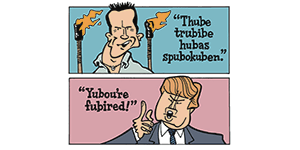
A language game (also called secret language or ludling or argot) is a system of manipulating spoken words to render them incomprehensible to the untrained ear. Language games are used primarily by groups attempting to conceal their conversations from others.
Some common examples are Pig Latin, which is used all over the globe; the Gibberish family, prevalent in the United States and Sweden; and Verlan, spoken in France. Each of these language games involves a usually simple standard transformation to speech, thus encoding it. The languages can be easily mentally encoded and decoded by a skilled speaker at the rate of normal speech, while those who either don’t know the key or aren’t practiced in rapid speech are left hearing nothing but gibberish.
read more »
Posted in Games, Humor, Language |
Leave a Comment »
March 26, 2012

Fishing with John is a 1991 television series conceived, directed by and starring actor and musician John Lurie, which earned a cult following. On the surface, the series resembles a standard travel or fishing show: in each episode, Lurie takes a famous guest on a fishing expedition.
Since Lurie has no expert knowledge of fishing, the interest is in the interaction between Lurie and his guests, all of whom are his friends. Nothing particularly unusual actually happens, but the show is edited and narrated in a way to suggest that Lurie and his guest are involved in dramatic and even supernatural adventures. Guests included Jim Jarmusch, Matt Dillon, Tom Waits, Willem Dafoe, and Dennis Hopper. Each episode has voice-over narration by Robb Webb, which is sometimes bizarre and off-topic. The soundtrack is by Lurie, with several guest performers.
Posted in Food, Games, Humor |
1 Comment »


 The Daily Omnivore