May 11, 2012

Donald Glover (b. 1983) is an American actor, writer, comedian, and musician. Glover first came to attention for his work in the sketch group Derrick Comedy. He is best known for being a writer for ’30 Rock,’ and for his role the NBC comedy series ‘Community.’ In 2011, Glover signed to Glassnote Records under the stage name Childish Gambino; his first studio album, ‘Camp,’ was released in 2011. Glover DJs and produces his own music under the moniker ‘mcDJ.’
His music is of the electronic/remix variety and is often made available for free download via his official site. Glover raps as Childish Gambino, a name he found from a Wu-Tang Clan name generator. His work touches on family issues, schoolyard bullying, troubled romantic relationships, suicidal thoughts, and alcoholism. He has disowned his 2005 album, ‘The Younger I Get,’ as the too-raw ramblings of what he calls a ‘decrepit Drake.’
Posted in Art, Humor |
Leave a Comment »
May 10, 2012
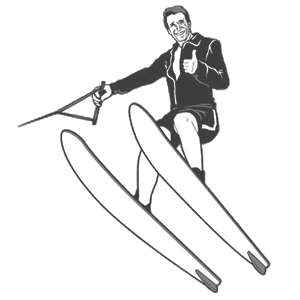
Jumping the shark is an idiom created by American radio personality Jon Hein to describe the moment in the evolution of a television show when it begins a decline in quality that is beyond recovery. The phrase is also used to refer to a particular scene, episode or aspect of a show in which the writers use some type of ‘gimmick’ in a desperate attempt to keep viewers’ interest.
The phrase refers to a scene in the fifth season premiere of ‘Happy Days in 1977: the gang visits Los Angeles, where a waterskiing Fonzie, wearing swim trunks and his trademark leather jacket, jumps over a confined shark, in response to a challenge. For a show that in its early seasons depicted universally relatable experiences against a backdrop of 1950s nostalgia, this marked an audacious, cartoonish turn towards attention-seeking gimmickry and continued the faddish lionization of an increasingly superhuman Fonzie.
Posted in Humor, Language |
Leave a Comment »
May 9, 2012

MC Skat Kat is an animated cat who appeared with Paula Abdul in the video for her song ‘Opposites Attract’ in 1989. The idea of Skat Kat came from the Gene Kelly movie ‘Anchors Aweigh,’ in which Kelly’s character dances with Jerry, the mouse from the ‘Tom and Jerry’ cartoon series. According to Virgin Records’ media information, Skat Kat is a ‘street philosopher with an alley Kat point of view.’ He likes to dance, is interested in the ladies, and ‘remains on the smooth tip with an old school rap influence which adds the street to his new school hip hop.’
The character was animated by members of the Disney animation team, working outside the studio between major projects, under the direction of Chris Bailey. He was created by Michael Patterson and performed by The Wild Pair duo of Bruce DeShazer and Marv Gunn. He was also voiced by Romany Malco for the first rap of the song and by Derrick ‘Delite’ Stevens for the second rap, the latter of whom would provide vocals for the character in the MC Skat Kat solo album. The character released an album entitled ‘The Adventures of MC Skat Kat and the Stray Mob’ in 1991, but it flopped instantly.
Posted in Art, Humor |
Leave a Comment »
May 7, 2012

Why I Want to Fuck Ronald Reagan is a short work by dystopian English author J.G. Ballard, first published in 1968 as a pamphlet by the Unicorn Bookshop in Brighton, England. It was later collected in ‘The Atrocity Exhibition’ (an experimental collection of Ballard’s ‘condensed novels’).
It is written in the style of a scientific paper and catalogs an apocryphal series of bizarre experiments intended to measure the psychosexual appeal of Ronald Reagan, who was then the Governor of California and candidate for the 1968 Republican presidential nomination.
read more »
Posted in Humor, Politics, Sex |
Leave a Comment »
May 6, 2012

A parking chair is a chair that is used by a vehicle owner to informally mark a parking space as reserved for oneself. Other items are also used for this purpose, including trash cans, ladders, ironing boards, and other similar-sized objects that are commonly found in households. For curbside parking spaces, two or more items are normally used.
The practice of using parking chairs is common in inclement weather in urban residential areas of the United States where parking is scarce and vehicle owners do not wish to risk losing their vehicle’s previously occupied space in its absence. Other spaces may be scarce due to accumulation of plowed snow, and the owner of the vehicle may have invested considerable work in clearing the space, just to get the car out in the first place. This practice is considered especially common in the cities of Pittsburgh, Chicago, Philadelphia, and other cities in the Upper Midwest and Great Lakes regions.
read more »
Posted in Humor, World |
Leave a Comment »
May 4, 2012

Inattentional blindness, also known as perceptual blindness, is when a person fails to notice some stimulus that is in plain sight. This stimulus is usually unexpected but fully visible. This typically happens when humans are overloaded with inputs. It is impossible to pay attention to every single input that is presented. A person’s attention cannot be focused on everything, and therefore, everyone experiences inattentional blindness. People can falsely believe that they do not experience inattentional blindness.
This is due to the fact that they are unaware that they are missing things. Inattentional blindness also has an effect on people’s perception. There have been multiple experiments performed that demonstrate this phenomenon. The term ‘inattentional blindness’ was coined by Arien Mack and Irvin Rock in 1992. It was used as the title of their book on the topic published by MIT Press in 1998.
read more »
Posted in Health, Humor, Science |
Leave a Comment »
May 4, 2012
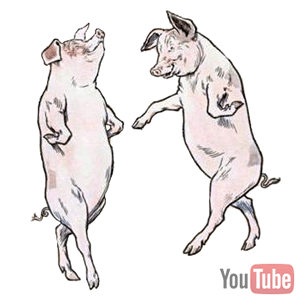
In computer security, the dancing pigs problem (also known as the dancing bunnies problem) is a statement on user attitudes to computer security: that users primarily desire features without considering security, and so security must be designed in without the computer having to ask a technically ignorant user.
The term has its origin in a remark by computer scientists Edward Felten and Gary McGraw: ‘Given a choice between dancing pigs and security, users will pick dancing pigs every time.’
read more »
Posted in Humor, Money, Technology |
Leave a Comment »
May 4, 2012

The cute cat theory of digital activism is a theory concerning Internet activism, Web censorship, and ‘cute cats’ (a term used for any low-value, but popular online activity) developed in 2008 by Ethan Zuckerman, director of the MIT Center for Civic Media. It posits that most people are not interested in activism; instead, they want to use the web for mundane activities, including surfing for pornography and lolcats (‘cute cats’).
The tools that they develop for that, however, are very useful to social movement activists, who often lack resources to develop dedicated tools themselves, but instead, use the tools developed by others (such as Facebook, Flickr, Blogger, Twitter, and similar platforms), even though such tools were not originally intended for activism.
read more »
Posted in Humor, Politics, Technology |
Leave a Comment »
May 4, 2012

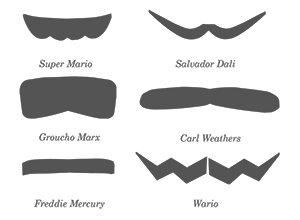
The American Mustache Institute (AMI) is an advocacy organization and registered not-for-profit based in St. Louis, Missouri. When founded in 1965, AMI was the only organization in the world working towards facial hair advocacy. AMI’s full-time staff supports a more than 700 global chapters which advocate for greater acceptance of mustaches in the workplace and throughout modern culture.
Efforts by AMI have included a 2007 campaign against ‘widespread and unacceptable discrimination in the workplace and society,’ as chronicled by media including the ‘Daily Telegraph.’
read more »
Posted in Humor, Politics |
1 Comment »
April 29, 2012

‘Earache My Eye‘ is a comedy routine and song by Cheech and Chong which features ‘Alice Bowie’ (one of Cheech Marin’s characters). It first appeared on ‘Cheech & Chong’s Wedding Album’ (1974). Cheech And Chong also lip sync to the recording (with Chong behind the drumkit) in their first movie ‘Up in Smoke’ (1978). This piece has been featured repeatedly on the ‘Doctor Demento’ radio show. According to Tommy Chong’s autobiography, the famous guitar riff is played by Gaye Delorme, who also composed the music for the song. Additionally, Chong states that drums on the song are played by famed international percussionist Airto Moreira.
The B-side, ‘Turn That Thing Down’ features the remainder of the musical track, from the point of Marin’s monologue about his wealth, without the actual dialogue, complete to its conclusion. It is possible to assemble the full-length version of the song by editing the two sections together. Several radio stations refused to play the song. Once the song hit its peak on the charts, radio station managers pulled the song out of the format of airplay, due to complaints by parents, teachers, psychologists, principals, and counselors, who stated that this song mostly appealed to junkies, dropouts, drug addicts, and drunks, as well as for students playing hooky from class, giving them a bad example of behavior.
Posted in Art, Drugs, Humor |
Leave a Comment »
April 27, 2012

Lisa Frank is an American commercial artist and founder of Lisa Frank Incorporated, headquartered in Tucson, Arizona. The artist’s work appears on various commercial elementary and middle-school products, mostly school supplies. Also common among Lisa Frank-related items are stickers and a variety of other merchandise such as clothing and toys marketed towards young girls. Frank founded the company in 1979 at the age of 24, and her success resulted from her sticker line.
The company’s headquarters is easily visible because of the bright hearts, stars, and music notes decorating the side of the building. There is currently a quarterly magazine also named ‘Lisa Frank.’ Her corporation’s artwork features extremely bright and vibrant colors, and round, smooth, reflective surfaces. A number of characters recur on ‘Lisa Frank’ branded items, such as a Hollywood Bear, and Markie the unicorn. Rainbows and especially the color purple are abundant in Lisa Frank’s art.
Posted in Art, Humor, Money |
2 Comments »
April 23, 2012
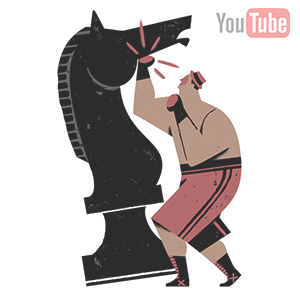
Chessboxing is a hybrid sport that combines chess with boxing in alternating rounds. The sport was invented by Dutch artist Iepe Rubingh, who was inspired by a French comic book ‘Le Froid Equateur’ by artist and filmmaker Enki Bilal. A match consists of up to eleven alternating rounds of boxing and chess. The match begins with a four-minute chess round. This is followed by three minutes of boxing, with rounds of chess and boxing alternating until the end. There is a one minute break between rounds.
Competitors may win by a knockout, achieving a checkmate, by the judges’ decision, or if their opponent’s twelve minutes of chess time is exceeded. If a competitor fails to make a move during the chess round, he is issued a warning and he must move within the next 10 seconds. Repeated warnings may result in a disqualification. The players put on headphones during the chess portion so that they do not hear any shouted assistance from the audience or the live chess commentary. If the chess game reaches a stalemate, the scores from the boxing rounds are used to determine the winner. If the boxing score is also a tie, the player with the black pieces wins.
Posted in Games, Humor |
Leave a Comment »




