November 29, 2011
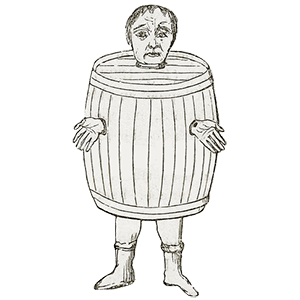
A Drunkard’s cloak was a type of pillory used in various jurisdictions to punish miscreants. An early description of the drunkard’s cloak appears in Ralph Gardiner’s ‘England’s Grievance Discovered,’ first published in 1655. A John Willis claimed to have travelled to Newcastle and seen ‘men drove up and down the streets, with a great tub, or barrel, opened in the sides, with a hole in one end, to put through their heads, and to cover their shoulders and bodies, down to the small of their legs, and then close the same, called the new fashioned cloak, and so make them march to the view of all beholders; and this is their punishment for drunkards, or the like.’
Drunkenness was first made a civil offence in England by the Ale Houses Act 1551; the drunkard’s cloak became a common method of punishing recidivists, especially during the Commonwealth of England. From 1655 Oliver Cromwell suppressed many of England’s alehouses, particularly in Royalist areas, and the authorities made regular use of the cloak.
Posted in Drugs, Humor, Politics |
Leave a Comment »
November 29, 2011

A calculator watch is a watch with a calculator built into it. Calculator watches first appeared in the Mid 1970s introduced by Pulsar and Hewlett Packard. Several watch manufacturers have made calculator watches over the years, but the Japanese electronics company Casio produced the largest variety of models. In the mid-1980s, Casio created the Data Bank calculator watch, which not only performed calculator functions, but also stored appointments, names, addresses, and phone numbers. The modern eData version of its Data Bank watch has greater memory and the ability to store computer passwords.
When mass produced calculator watches appeared in the early 1980s (with the most being produced in the middle of the decade), the high-tech community’s demand created a ‘feature war’ of one-up-manship between watch manufacturers. However, as the novelty of this new electronic fad watch wore off, they became, much like pocket protectors and thick glasses, associated with nerds and today are no longer considered to be in vogue. Recently, they have come back in style and are worn ‘ironically’ by hipsters.
Posted in Humor, Money, Technology |
Leave a Comment »
November 28, 2011

Novelty architecture is a type of architecture in which buildings and other structures are given unusual shapes as a novelty, such as advertising, notoriety as a landmark, or simple eccentricity of the owner or architect. Many examples of novelty architecture take the form of buildings that resemble the products sold inside to attract drive-by customers.
Others are attractions all by themselves, such as giant animals, fruits, and vegetables, or replicas of famous buildings. And others are merely unusual shapes or made of unusual building materials.
read more »
Posted in Art, Humor, Money |
1 Comment »
November 23, 2011

Riding shotgun refers to the practice of sitting alongside the driver in a moving vehicle. The expression was apparently not used in the days of actual stagecoach travel. At that time, the position next to the driver was said to be occupied by an ‘express messenger’ or sometimes colloquially a ‘shotgun messenger.’ The phrase ‘riding shotgun’ (not found before 1905) was applied later to print and especially film depiction of stagecoaches and wagons in the Old West in danger of being robbed or attacked by bandits. A special armed employee of the express service using the stage for transportation of bullion or cash would sit beside the driver, carrying a short shotgun, to provide an armed response in case of threat to the cargo, which was usually a strongbox. Absence of an armed person in that position often signaled that the stage was not carrying a strongbox, but only passengers.
More recently, the term has been applied to a game, typically played by groups of friends to determine who rides beside the driver in a car. Typically, this involves claiming the right to ride shotgun by calling out ‘shotgun’ first. There may be elaborate rules involved in the game, such as a requirement that the vehicle be in sight. The phrase also has been used to mean giving actual or figurative support or aid to someone in a situation or project, i.e. to ‘watch their back.’
Posted in Humor, Language |
Leave a Comment »
November 22, 2011

In the field of social psychology, a breaching experiment is an experiment that seeks to examine people’s reactions to violations of commonly accepted social rules or norms. Breaching experiments are most commonly associated with ethnomethodology (the study of the everyday methods people use for the production of social order), and in particular the work of Harold Garfinkel. The conduct of a breaching experiment is sometimes referred to as ‘Garfinkeling.’ A famous breaching experiment was conducted on the New York City subway in the 1970s, when experimenters boarded crowded trains and asked able-bodied but seated riders, with no explanation, to give up their seats. Reportedly, the experimenters themselves were deeply troubled by being involved in such a seemingly minor violation of a social norm. The experiment was supervised by American psychologist Stanley Milgram.
Erving Goffman’s seminal study ‘Behavior in Public Places’ gives some classic examples of behavioral norms, such as ‘it is inconsiderate to litter – put your garbage in the trash can.’ A breaching experiment studies people’s reaction to an experimenter who breaks this kind of small, everyday rule. The strength of the reaction is taken as an indication of the strength of the rule. ‘The inexplicable do-gooder’: Social science researcher Earl R. Babbie writes that ‘it is a social rule that ordinary citizens should not pick up garbage from the street, or mend street signs, or otherwise fix problems.’ Babbie claims that people have negative reactions when they see somebody fixing something that is not his/her ‘job’ to fix; in some cases, altruistic actions are viewed as personal intrusions.
Posted in Humor, Science |
2 Comments »
November 22, 2011

‘Space Jazz: The soundtrack of the book Battlefield Earth’ is a music album and soundtrack companion to the novel ‘Battlefield Earth’ by L. Ron Hubbard, released in 1982. Hubbard composed the music for the album. A 1983 press release put out by the Church of Spiritual Technology subsidiary company Author Services Inc. marketed the concept album as ‘the only original sound track ever produced for a book before it becomes a movie.’
The album includes performances by Chick Corea, Stanley Clarke, Nicky Hopkins and Gayle Moran. The album included music from the Fairlight CMI synthesizer; it was one of the first professional uses of this device. A demonstration of the ‘computer space jazz’ soundtrack was one of the festival displays at the 1982 US Festival rock concert in California.
Posted in Art, Humor |
Leave a Comment »
November 22, 2011

A motivational poster (or affirmation poster or inspirational poster) is a type of poster commonly designed for use in schools and offices. The intent of motivational posters is to make people achieve more, or to think differently about the things that they may be learning or doing. Motivational posters can have behavioral effects. For example, the University of Glasgow found in one study that their placement of a motivational poster that promotes stair use in front of an escalator and a parallel staircase, in an underground station, doubled the amount of stair use.
This kind of poster has been repeatedly parodied, and parody motivational posters have become an Internet meme. One famous motivational poster features a kitten hanging from a tree branch along with the phrase ‘Hang in There, Baby!’ This has been the target of various reproductions and parodies, such as an appearance on ‘The Simpsons’ episode ‘The Twisted World of Marge Simpson’ where Marge Simpson notices the copyright date (1968) and comments, ‘…determined or not, that cat must be long dead. That’s kind of a downer.’ Despair, Inc. has made a business out of such parody and cynical posters, with ‘demotivational posters’ ranging from a picture of a tree bent over by wind with the caption ‘ADVERSITY: That which does not kill me postpones the inevitable.’ to a picture of a sinking ship with the caption ‘MISTAKES: It could be that the purpose of your life is only to serve as a warning to others.’
Posted in Humor, Language, Money |
Leave a Comment »
November 21, 2011

Let’s trim our hair in accordance with the socialist lifestyle was part of a North Korean government propaganda campaign promulgating grooming and dress standards in 2004. It was broadcast on state-run Korean Central Television in the capital of Pyongyang and clips from the program were later rebroadcast on the BBC. The television program claimed that hair length can affect human intelligence, in part because of the deprivation to the rest of the body of nutrients required for hair to grow. It was one part of longstanding North Korean government restrictions on haircuts and fashions deemed at odds with ‘Socialist values.’
Such dress and hair standards have long been a fixture of North Korean society. Kim Jong-Il was known for his so called ‘Speed Battle Cut’ crew cut when he first came to prominence in the early 1980s, though he later reverted to the short sided bouffant favored by his father. After Kim Jong-Il succeeded his father, some of the state’s restrictions on Western fashion were relaxed. Women were allowed permanent waves, men could grow slightly longer hair, and even public dancing was allowed. Despite such slight concessions during the early years of Kim Jong-Il’s rule, obvious emblems of Western fashion such as jeans continued to be entirely banned, and long hair on men could lead to arrest and forced haircuts.
read more »
Posted in Humor, Politics, World |
Leave a Comment »
November 21, 2011
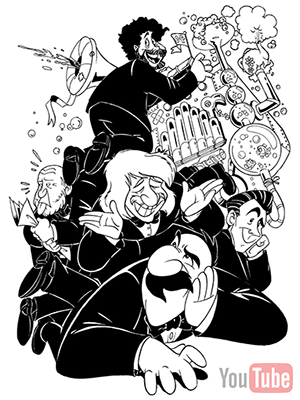
Les Luthiers [loo-tee-ers] is an Argentine comedy-musical group, very popular also in several other Spanish-speaking countries. They were formed in 1967 by Gerardo Masana, during the height of a period of very intense Choral Music activity in Argentina’s state universities.
Their outstanding characteristic is the home-made musical instruments (hence the name luthiers, French for ‘musical instrument maker’), some of them extremely sophisticated, which they skillfully employ in their recitals to produce music and texts full of high class and refined humor.
read more »
Posted in Art, Humor, World |
1 Comment »
November 20, 2011

Famous for being famous, in popular culture terminology, refers to someone who attains celebrity status for no particular identifiable reason, or who achieves fame through association with a celebrity. The term is a pejorative, suggesting that the individual has no particular talents or abilities. Even when their fame arises from a particular talent or action on their part, the term will sometimes still apply if their fame is perceived as disproportionate to what they earned through their own talent or work.
The term originates from an analysis of the media dominated world called ‘The Image: A Guide to Pseudo-events in America’ (1961), by historian and social theorist Daniel J. Boorstin. In it, he defined the celebrity as ‘a person who is known for his well-knownness.’ He further argued that the graphic revolution in journalism and other forms of communication had severed fame from greatness, and that this severance hastened the decay of fame into mere notoriety. Over the years, the phrase has been glossed as ‘a celebrity is someone who is famous for being famous’.
read more »
Posted in Humor, Language, Money |
1 Comment »
November 20, 2011

Car Talk is a radio talk show broadcast weekly on National Public Radio stations throughout the United States and elsewhere. The hosts are brothers Tom and Ray Magliozzi, also known as Click and Clack, the Tappet Brothers. Car Talk is structured as a call-in radio show: listeners call with questions related to motor vehicle maintenance and repair. Most of the advice sought is diagnostic, with callers describing symptoms and demonstrating sounds of an ailing vehicle while the Magliozzis make an attempt at identifying the malfunction.
While the hosts pepper their call-in sessions with jokes directed at both the caller and at themselves, the depth and breadth of their knowledge of automobiles is extensive, and they are usually able to arrive at a diagnosis and give helpful advice. Also, if a caller has an unusual name, they will inquire about the spelling, pronunciation, and/or origin of their name. They may also comment about the caller’s hometown.
read more »
Posted in Humor, Language, Technology |
Leave a Comment »
November 19, 2011
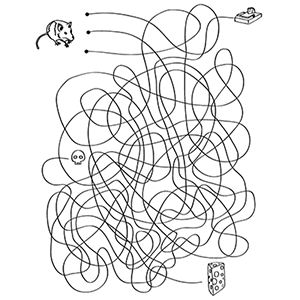
Rat running or cut-through driving refers to the use of secondary roads or residential side streets instead of the intended main roads in urban or suburban areas in order to avoid heavy traffic, lengthy traffic signals, or other obstacles lengthening a journey, even though traffic calming measures may be in place to discourage them and there may be laws against taking certain routes. Rat runs are frequently taken by motorists who are familiar with the local geography. They will often take such short cuts to avoid busy main roads and junctions (intersections).
The associations with ‘beating the crowd,’ the rush hour, and the rat race may have given rise to the term, or perhaps similarities were observed between the patterns of rat running driving routes and a rat running a maze.
read more »
Posted in Humor, Language, World |
Leave a Comment »


 The Daily Omnivore