December 14, 2011

Bananadine is a fictional psychoactive substance which is supposedly extracted from banana peels. A hoax recipe for its ‘extraction’ from banana peel was originally published in 1967 in the ‘Berkeley Barb,’ an underground newspaper. It became more widely known when William Powell, believing it to be true, reproduced the method in ‘The Anarchist Cookbook’ in 1970 under the name ‘Musa sapientum Bananadine’ (referring to the banana’s old binomial nomenclature). The original hoax was designed to raise questions about the ethics of making psychoactive drugs illegal and prosecuting those who took them: ‘what if the common banana contained psychoactive properties, how would the government react?’
Researchers at New York University have found that banana peel contains no intoxicating chemicals, and that smoking it produces only a placebo effect. Over the years, there has been considerable speculation regarding the psychoactive properties of banana skins. Donovan’s hit single ‘Mellow Yellow’ was released a few months prior to the ‘Berkeley Barb’ article, and in the popular culture of the era, the song was assumed to be about smoking banana peels.
Posted in Drugs, Food, Humor |
Leave a Comment »
December 14, 2011
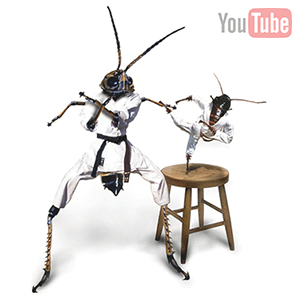
Insect fighting is an activity involving insects (and sometimes, arachnids, centipedes, millipedes and mollusks). It is practiced in areas in China, Japan, Vietnam, and Thailand. Cricket fighting is a traditional Chinese pastime that dates back to the Tang Dynasty (618-907). Originally nurtured by emperors, it was later popularized by commoners. It is also a casual activity for youth in western countries and is known colloquially as ‘bugfighting.’
Some of the most popular species used are the Stag Beetle, Rhinoceros Beetle, Kabutomushi, Jerusalem Cricket, and Goliath Beetle, as their sheer size and jumping ability make them formidable opponents. They are trained by their owners to become stronger and more aggressive. With beetles, a small noisemaker is used that duplicates the female’s mating call (fighting beetles are male). Getting beetles to fight requires patience and is much different than other types of animal fighting. The loser is pushed onto its back by the winner, pushed off of a tree limb, or a predetermined area, or is killed.
Posted in Games, Humor, World |
Leave a Comment »
December 14, 2011
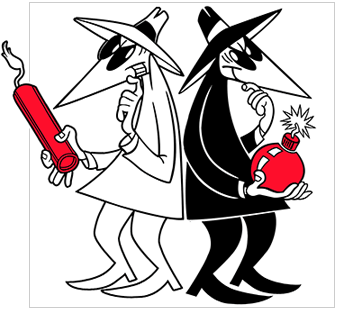
Spy vs. Spy is a black and white comic strip that debuted in ‘Mad Magazine’ #60, in 1961, and was originally published by EC Comics. The strip always features two spies, who are completely identical save for the fact that one is dressed in white and the other black.
The pair are constantly warring with each other, using a variety of booby-traps to inflict harm on the other. The spies usually alternate between victory and defeat with each new strip. They were created by Antonio Prohías, a prolific cartoonist in Cuba known for political satire.
read more »
Posted in Art, Humor, Language |
Leave a Comment »
December 13, 2011

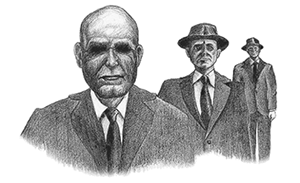
Men in Black (MIB), in American popular culture and in UFO conspiracy theories, are men dressed in black suits who claim to be government agents who harass or threaten UFO witnesses to keep them quiet about what they have seen. It is sometimes implied that they may be aliens themselves. The term is also frequently used to describe mysterious men working for unknown organizations, as well as to various branches of government allegedly designed to protect secrets or perform other strange activities. The term is a generic one, used to refer to any unusual, threatening or strangely behaved individual whose appearance on the scene can be linked in some fashion with a UFO sighting.
Early reports of Men in Black often described them as men of short stature with swarthy complexions, as if they were deeply tanned. Some reported them as Gypsies. Sunglasses, black suits and black cars have been a feature for the entire period since modern sightings began in 1947. According to the accounts of those reporting encountering them, Men in Black always seem to have detailed information on the persons they contact, as if the individual had been under surveillance for a long period of time.
read more »
Posted in Humor |
1 Comment »
December 13, 2011

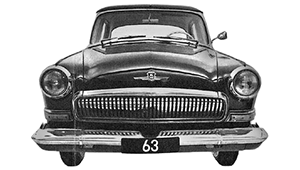
Black Volga [vol-guh] refers to an urban legend widespread in Poland, Russia, Belarus, Ukraine, and Mongolia, mainly in the 1960s and 1970s. It was about a black (in some versions red) Volga limousine (with white wheel rims, white curtains or other white elements) that was allegedly used to abduct people, especially children. According to different versions, it was driven by priests, nuns, Jews, vampires, satanists or Satan himself. Children were kidnapped to use their blood as a cure for rich westerners or Arabs suffering from leukemia; other variants used organ theft as the motive, combining it with another famous legend about kidney theft by the KGB.
The legend surfaced again in the late 20th century, with a BMW or Mercedes car taking the Volga’s place, sometimes depicted with horns instead of wing mirrors. In this version, the driver would ask passers-by for the time and kill them when they approached the car to answer (in another version of the legend, they died at the same time a day later).
Posted in Humor, World |
1 Comment »
December 13, 2011
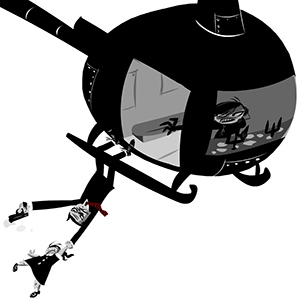
Black helicopters is a term which became popular in the US militia movement and its associated political circles in the 1990s as a symbol and warning sign of an alleged conspiratorial military takeover, though it has also been associated with men in black and similar conspiracies. Rumors circulated that, for instance, the UN patrolled the States with unmarked black helicopters, or that federal agents used black helicopters to enforce wildlife laws.
The concept springs from the basic truth that many government agencies and corporations do use helicopters, and that some of these helicopters are dark-colored or black. For instance, dark-colored military helicopters were deployed in the standoff at Ruby Ridge. Earlier tales from the 1970s linked them with UFO conspiracy theories.
read more »
Posted in Humor, Politics, War |
1 Comment »
December 13, 2011

The Billboard Liberation Front practices culture jamming (a tactic used by anti-consumerist social movements to disrupt or subvert mainstream cultural institutions, including corporate advertising) by altering billboards by changing key words to radically alter the message, often to an anti-corporate message.
It started in San Francisco in 1977 as an outgrowth of the Cacophony Society, a secret society responsible for a number of anarchic pranks.
Posted in Humor, Money, Politics |
Leave a Comment »
December 13, 2011


Wok racing was developed by the German TV host Stefan Raab. Modified Chinese woks are used to make timed runs down an Olympic bobsled track. There are competitions for one-person-woksleds and four-person-woksleds, the latter using four woks per sled. Wok racing was inspired by a bet on a German TV show in 2003. Participants are mostly b-list celebrities. The typical racing woks are the ordinary round-bottomed Chinese pans, usually directly imported from China. The only modifications are that the bottom is reinforced with an epoxy filling and the edges of the wok are coated with polyurethane foam to avoid injuries.
Four-person woksleds consist of two pairs of woks, each of them is held together by a rounded frame. The two pairs are connected by a coupling. Due to the rather risky nature of the sport the participants wear heavy protective gear, usually similar to ice hockey equipment. To further reduce friction and the risk of injuries, the athletes wear ladles under their feet. To improve performance, the underside of the woks are often heated with a blowlamp before the race.
Posted in Games, Humor, World |
Leave a Comment »
December 13, 2011
Zoobomb is a weekly bicycling activity in Portland, Oregon during which participants ride bicycles rapidly downhill in the city’s West Hills. Zoobomb began in 2002. Participants carry their bikes on MAX Light Rail to the Washington Park station next to the Oregon Zoo. From there, participants take the elevator to the surface and then ride their bikes down the hills in the vicinity. This process is often repeated several times throughout the night. ‘The people that are going 35-mph-plus have backgrounds in BMX, mountain biking, bike messengering or downhill skateboarding. I don’t know that people showing up for the first time understand this.’
There is an emphasis on unusual bicycles, first and foremost the children’s bicycles or ‘minibikes,’ but extending to tall bikes, swing bikes, choppers, non-functional bicycles, skateboards, etc. The event is treated in a very lighthearted fashion, including a large amount of socializing between rides. Riders often dress up in costume or decorate their bicycles. Though many riders bring their own bicycles, the participants maintain a ‘Zoobomb pile,’ a tower of minibikes anchored to a bicycle rack at the Zoobomb meeting point for riders to borrow. The pile has become a local landmark.[3][5]A legally blind person ‘The Blind Bomber’ regularly attends (on a tandem bike, behind a sighted rider). Though not technically a race, there is some prestige in getting down the hill first.
Posted in Games, Humor |
Leave a Comment »
December 13, 2011

Kinetic sculpture races are organized contests of human-powered amphibious all-terrain works of art. The original event, the Kinetic Grand Championship in Humboldt County, California, is also called the ‘Triathlon of the Art World’ because art and engineering are combined with physical endurance during a three day cross country race that includes sand, mud, pavement, a bay crossing, a river crossing and major hills.
The concept of kinetic sculpture racing originated in Ferndale, California in 1969 when local sculptor Hobart Brown ‘improved’ the appearance of his son’s tricycle by welding on two additional wheels and other embellishments. Seeing this ‘Pentacycle,’ fellow artist Jack Mays challenged him to a race.
read more »
Posted in Art, Games, Humor |
Leave a Comment »
December 13, 2011

The Idiotarod is a shopping cart race in which teams of five ‘idiots’ tie themselves to a (sometimes modified) shopping cart and run through the streets of a major metropolitan area. The race usually features people in costumes and themed floats. The races are fun competitions where sabotage, costume, and presentation are rewarded. Sabotage such as tripping competitors, throwing marbles or large obstacles in their paths, and the spreading of misinformation such as false route information are common.
The Idiotarod is named after the Iditarod, a 1,000 mile dog-sledding race in Alaska. Idiotarods take place in Austin, Boston, Chicago, Denver, New York City, Phoenix, Portland, Salt Lake City, Seattle, St. Louis, Toronto, Los Angeles, Vancouver and Washington, D.C. though the original race was founded in San Francisco in 1994 as the ‘Urban Iditarod.’
Posted in Games, Humor |
Leave a Comment »
December 13, 2011

The Fools Guild is a Los Angeles organization themed around the medieval and renaissance idea of the Court jester. It’s central activity is producing three annual parties on Halloween, New Year’s Eve, and April Fool’s Day.
The Guild was born in 1979 at the Renaissance Pleasure Faire of Southern California, where the original improvisational team met while performing as jesters, jugglers, pass-the-hat-acts, and mimes. In 1982 they moved to West Hollywood, renting a house with a giant main room and very high ceilings, where the Fools began to host parties, workshops and other performance-centered events. Very quickly a social club of comedic performers evolved and the house became known as the Guild Hall.
read more »
Posted in Humor, Language |
Leave a Comment »



