December 13, 2011

The Cacophony Society is ‘a randomly gathered network of free spirits united in the pursuit of experiences beyond the pale of mainstream society.’ It was started in 1986 by surviving members of the now defunct Suicide Club of San Francisco, a secret society devoted to urban exploration and anarchic pranks. Cacophony has been described as an indirect culture jamming outgrowth of the Dada movement, and the Situationists. One of its central concepts is the ‘Trip to the Zone,’ inspired by the 1979 Film ‘Stalker’ by Andrey Tarkovskiy.
According to self-designated members of the Society, ‘you may already be a member.’ The anarchic nature of the Society means that membership is left open-ended and anyone may sponsor an event, though not every idea pitched garners attendance by members. Cacophony events often involve costumes and pranks in public places and sometimes going into places that are off limits to the public. Cacophonists have been known to regale Christmas shoppers with improved Christmas carols while dressed as Santa Claus, and later invite strippers to sit on Santa’s lap at their annual SantaCon event.
read more »
Posted in Games, Humor |
1 Comment »
December 13, 2011
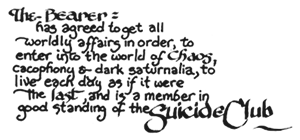
The Suicide Club was a secret society in San Francisco credited as the first modern extreme urban exploration (urbex) society, and also known for anarchic group pranks. The club was founded by Gary Warne in 1977 as a course he taught at the ‘Communiversity’ in San Francisco, part of the Free School Movement, and it lasted until shortly before Warne’s death in 1983.
Events generally started and ended in Warne’s used paperback bookstore, Circus of the Soul. The name of the Suicide Club was inspired by three stories written by Robert Louis Stevenson, where men who want to die belong to a club, where each evening one of them is randomly selected for death. The name belied the gentle albeit zany nature of its members, who had a predilection towards light-hearted practical jokes.
read more »
Posted in Games, Humor |
Leave a Comment »
December 13, 2011

SantaCon is a mass gathering of people dressed in Santa Claus costumes parading publicly on streets and in bars in cities around the world. The focus is on spontaneity and creativity, while having a good time and spreading cheer and goodwill. Sometimes known as Naughty Santas, Cheapsuit Santas, Santarchy, Santapalooza, and Santa Rampage, SantaCon incorporates elements of a flash mob in the context of cheerful bawdy and harmless behavior, the singing of naughty Christmas carols, and the giving of small gifts to strangers. In 2005, a more violent version of the event occurred when participants in New Zealand rioted, looting stores, throwing bottles at passing cars, and assaulting security guards.
In 1994, the Suicide Club (a secret society in San Francisco credited as the first modern extreme urban exploration society, and also known for anarchic group pranks) staged the first ‘Santarchy,’ which was later adopted as Santacon by offshoot the Cacophony Society (a randomly gathered network of free spirits united in the pursuit of experiences beyond the pale of mainstream society). Influenced by the surrealist movement, Discordianism, and other subversive art currents, the Cacophonists celebrated the Yule season in a distinctly anti-commercial manner, by mixing guerrilla street theater and pranksterism.
Posted in Games, Humor, Philosophy |
Leave a Comment »
December 8, 2011

A Macquarium is an aquarium made to sit within the shell of an Apple Macintosh computer. The term was coined by computer writer Andy Ihnatko. In the early 1990s several Mac models in this form factor (the Macintosh 128K, Macintosh 512K and Macintosh Plus) were becoming obsolete, and Ihnatko considered that turning one into an aquarium might be ‘the final upgrade’ — as well as an affordable way to have a color Compact Mac.
He has mentioned in interviews that he had seen previous, overly-complex attempts at Macintosh aquariums at trade shows that among other drawbacks suffered from noticeable water level lines across the ‘screen’ that spoiled the illusion of a ‘really good screensaver,’ which drove him to design a version without a visible water line and which allowed the external case of the donor Mac to remain intact.
Posted in Humor, Technology |
Leave a Comment »
December 7, 2011

Emoji [ih-moh-jee] is the Japanese term for the picture characters or emoticons used in Japanese electronic messages and webpages. Originally meaning pictograph, the word literally means ‘e’ (‘picture) ‘moji’ (‘letter’). The characters are used much like emoticons elsewhere, but a wider range is provided, and the icons are standardized and built into mobile devices. Some emoji are very specific to Japanese culture, such as a bowing (apologizing) businessman, a face wearing a face mask, or a group of emoji representing popular foods (e.g. ramen noodles, rice balls). The three main Japanese phone operators, NTT DoCoMo, au, and SoftBank Mobile (formerly Vodafone), have each defined their own variants of emoji.
Although typically only available in Japan, the characters and code required to use emoji are, thanks to the nature of software development, often present in many phones’ software. As a result, some phones, such as the Apple iPhone, allow access to the symbols without requiring a Japanese operator. Emoji have also started appearing in emailing services such as Gmail (accessed via Google Labs) in 2009.
Posted in Humor, Language, Technology |
Leave a Comment »
December 1, 2011


The Jheri [jer-ee] curl is a hairstyle that was common and popular in the African American community especially during the 1970s and 1980s. Invented by and named for Jheri Redding, the Jheri curl gave the wearer a glossy, loosely curled look. It was touted as a ‘wash and wear’ style that was easier to care for than the other popular chemical treatment of the day, the relaxer. A Jheri curl was a two-part application that consisted of a softener (often called a ‘rearranging cream’) to loosen the hair and a solution to set the curls. The rearranging cream used pungent chemicals, causing the naturally tight curls to loosen and hang. The loose hair was then set and a chemical solution was then added to the hair to permanently curl it.
Perming the hair was time and labor-intensive and expensive to maintain. The harsh mix of chemicals required for the process caused the wearer’s natural hair to become extremely brittle and dry. To maintain the look of the Jheri curl, users were required to apply a curl activator spray and heavy moisturizers daily and to sleep with a plastic cap on their heads to keep the hairstyle from drying out. The activator in particular had the undesirable side effect of being very greasy; this would often stain clothing and furniture. The hairstyle went out of fashion by the late 1980s and was replaced in part with the hi-top fade haircut.
Posted in Art, Humor, Money |
Leave a Comment »
November 30, 2011

Roblog is a neologism for a blog written by a robot with no human intervention. Roblogs were made possible with a new generation of robots which are capable of uploading images and texts automatically to the Web. The first roblogs to appear, late 2005, were written by AIBO robots, the dog-like robotic pets once manufactured by Sony.
AIBO diaries are roblogs produced by AIBO model ERS-7, running a bundled software called Mind in either version 2 or 3. Depending on the language of the Mind software, the AIBO blogs in either English or Japanese. To be able to blog on its own, an ERS-7M2 or ERS-7M3 must be linked to the Internet through its Wi-Fi connection capability, and its e-mail sending capability must be correctly configured, for which an SMTP server not requiring authentication nor alternate ports is needed. Posts, consisting of pictures taken with the AIBO’s color camera built into its nose, are then sent by e-mail to the blog.
Posted in Humor, Technology |
Leave a Comment »
November 29, 2011
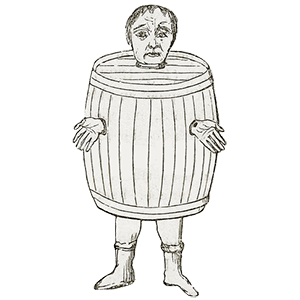
A Drunkard’s cloak was a type of pillory used in various jurisdictions to punish miscreants. An early description of the drunkard’s cloak appears in Ralph Gardiner’s ‘England’s Grievance Discovered,’ first published in 1655. A John Willis claimed to have travelled to Newcastle and seen ‘men drove up and down the streets, with a great tub, or barrel, opened in the sides, with a hole in one end, to put through their heads, and to cover their shoulders and bodies, down to the small of their legs, and then close the same, called the new fashioned cloak, and so make them march to the view of all beholders; and this is their punishment for drunkards, or the like.’
Drunkenness was first made a civil offence in England by the Ale Houses Act 1551; the drunkard’s cloak became a common method of punishing recidivists, especially during the Commonwealth of England. From 1655 Oliver Cromwell suppressed many of England’s alehouses, particularly in Royalist areas, and the authorities made regular use of the cloak.
Posted in Drugs, Humor, Politics |
Leave a Comment »
November 29, 2011

A calculator watch is a watch with a calculator built into it. Calculator watches first appeared in the Mid 1970s introduced by Pulsar and Hewlett Packard. Several watch manufacturers have made calculator watches over the years, but the Japanese electronics company Casio produced the largest variety of models. In the mid-1980s, Casio created the Data Bank calculator watch, which not only performed calculator functions, but also stored appointments, names, addresses, and phone numbers. The modern eData version of its Data Bank watch has greater memory and the ability to store computer passwords.
When mass produced calculator watches appeared in the early 1980s (with the most being produced in the middle of the decade), the high-tech community’s demand created a ‘feature war’ of one-up-manship between watch manufacturers. However, as the novelty of this new electronic fad watch wore off, they became, much like pocket protectors and thick glasses, associated with nerds and today are no longer considered to be in vogue. Recently, they have come back in style and are worn ‘ironically’ by hipsters.
Posted in Humor, Money, Technology |
Leave a Comment »
November 28, 2011

Novelty architecture is a type of architecture in which buildings and other structures are given unusual shapes as a novelty, such as advertising, notoriety as a landmark, or simple eccentricity of the owner or architect. Many examples of novelty architecture take the form of buildings that resemble the products sold inside to attract drive-by customers.
Others are attractions all by themselves, such as giant animals, fruits, and vegetables, or replicas of famous buildings. And others are merely unusual shapes or made of unusual building materials.
read more »
Posted in Art, Humor, Money |
1 Comment »
November 23, 2011

Riding shotgun refers to the practice of sitting alongside the driver in a moving vehicle. The expression was apparently not used in the days of actual stagecoach travel. At that time, the position next to the driver was said to be occupied by an ‘express messenger’ or sometimes colloquially a ‘shotgun messenger.’ The phrase ‘riding shotgun’ (not found before 1905) was applied later to print and especially film depiction of stagecoaches and wagons in the Old West in danger of being robbed or attacked by bandits. A special armed employee of the express service using the stage for transportation of bullion or cash would sit beside the driver, carrying a short shotgun, to provide an armed response in case of threat to the cargo, which was usually a strongbox. Absence of an armed person in that position often signaled that the stage was not carrying a strongbox, but only passengers.
More recently, the term has been applied to a game, typically played by groups of friends to determine who rides beside the driver in a car. Typically, this involves claiming the right to ride shotgun by calling out ‘shotgun’ first. There may be elaborate rules involved in the game, such as a requirement that the vehicle be in sight. The phrase also has been used to mean giving actual or figurative support or aid to someone in a situation or project, i.e. to ‘watch their back.’
Posted in Humor, Language |
Leave a Comment »
November 22, 2011
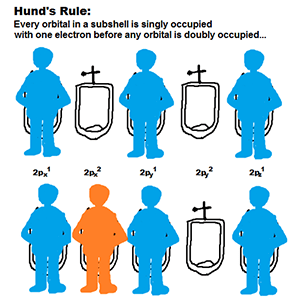
In the field of social psychology, a breaching experiment is an experiment that seeks to examine people’s reactions to violations of commonly accepted social rules or norms. Breaching experiments are most commonly associated with ethnomethodology (the study of the everyday methods people use for the production of social order), and in particular the work of Harold Garfinkel. The conduct of a breaching experiment is sometimes referred to as ‘Garfinkeling.’ A famous breaching experiment was conducted on the New York City subway in the 1970s, when experimenters boarded crowded trains and asked able-bodied but seated riders, with no explanation, to give up their seats. Reportedly, the experimenters themselves were deeply troubled by being involved in such a seemingly minor violation of a social norm. The experiment was supervised by American psychologist Stanley Milgram.
Erving Goffman’s seminal study ‘Behavior in Public Places’ gives some classic examples of behavioral norms, such as ‘it is inconsiderate to litter – put your garbage in the trash can.’ A breaching experiment studies people’s reaction to an experimenter who breaks this kind of small, everyday rule. The strength of the reaction is taken as an indication of the strength of the rule. ‘The inexplicable do-gooder’: Social science researcher Earl R. Babbie writes that ‘it is a social rule that ordinary citizens should not pick up garbage from the street, or mend street signs, or otherwise fix problems.’ Babbie claims that people have negative reactions when they see somebody fixing something that is not his/her ‘job’ to fix; in some cases, altruistic actions are viewed as personal intrusions.
Posted in Humor, Science |
2 Comments »



