September 22, 2011

Cleverbot is an artificial intelligence (AI) web application that learns how to mimic human conversations by communicating with humans. It was created by AI scientist Rollo Carpenter, who also created Jabberwacky, a similar web application. In the first decade of its existence after being created in 1988, Cleverbot held several thousand conversations with Carpenter and his associates. Since being launched on the web in 1997, the number of conversations has exceeded 65 million. Cleverbot, a learning Artificial Intelligence conversationalist, took part alongside humans in a formal Turing Test at the Techniche 2011 festival at IIT Guwahati, India. Cleverbot was judged to be 59.3% human, far exceeding expectations. The humans in the event achieved just 63.3%.
Cleverbot differs from traditional chatterbots in that the user is not holding a conversation with a bot that directly responds to entered text. Instead, when the user enters text, the algorithm selects previously entered phrases from its database of prior conversations. It has been claimed that ‘talking to Cleverbot is a little like talking with the collective community of the Internet.’
Posted in Humor, Technology |
Leave a Comment »
September 11, 2011

Figure 8 racing is a form of automobile racing that combines elements of oval racing, demolition derby, and road racing. Racing is done on a track shaped like an 8. The cars cross paths at the center of the 8, which is known as the ‘crossover.’ Because of this layout, crashes are inevitable. Figure 8 racing is a unique sport that requires strict attention to detail and timing to successfully navigate the crossover. The oldest operating figure 8 track in the United States is Indianapolis Speedrome in Indianapolis, Indiana. The track has been in operation since the 1940s. It hosts the annual World Figure 8 race, which is considered the world championship event. The first 3 hour long endurance race was held in 1977.
Figure 8 track racing began right after World War II in the late 1940s. The track may have had an overpass so that the cars did not cross each other’s paths. Most historians believe that the first track where drivers crossed each other’s paths was the 1/5 mile long Indianapolis Speedrome. The sport received nationwide publicity when it was frequently televised on ABC’s ‘Wide World of Sports’ in the 1960s, usually from the Islip Speedway in New York. The cars used are often standard cars, but are usually modified for lightness and safety. A wing much like a sprint car may be placed on the roof to increase downforce. The cars’ bodies are typically made out of sheet metal.
Posted in Games, Humor |
Leave a Comment »
September 8, 2011
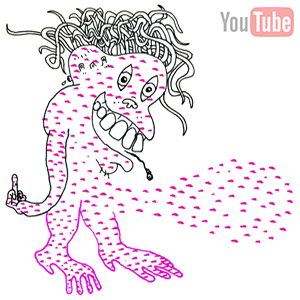
PFFR (or Pre-natal Fighting Frightening Remembrances Forever Ltd.) is a Brooklyn based production company/art collective/electro-rock band consisting of Alyson Levy, Vernon Chatman, Jim Tozzi, and John Lee. The group has been active since 2000. The group’s portfolio of work includes albums, live performances, various art exhibits such as ‘An Attack On All Americans Or The Tyranny Of Weed’ shown at the LFL Galley in New York, and the script for the film ‘Final Flesh.’
PFFR are also active in television comedy. They wrote, directed, produced and starred in the MTV2 variety program ‘Wonder Showzen’ (2005–2006) and the Adult Swim CGI series ‘Xavier: Renegade Angel.’ For both these shows, Chatman and Lee are the directors and main voice talent, whilst Tozzi and Levy are the animation/character designer and art director, respectively. Levy provides additional voices for both shows whilst Tozzi does only for ‘Xavier.’ PFFR are also responsible for producing, directing and co-writing Jon Glaser’s Adult Swim show ‘Delocated.’
read more »
Posted in Art, Humor |
Leave a Comment »
September 8, 2011

Love and Rockets (often abbreviated L&R) is a black and white comic book series by Gilbert Hernandez and Jaime Hernandez, sometimes cited jointly as Los Bros Hernandez. Their brother Mario Hernandez is an occasional contributor. It was one of the first comics in the alternative comics revolution of the 1980s.
The Hernandez brothers self-published the first issue of ‘Love and Rockets’ in 1981, but since 1982 it has been published by Fantagraphics Books. The magazine temporarily ceased publication in 1996 after the release of issue #50, while Gilbert and Jaime went on to do separate series involving many of the same characters. However, in 2001 Los Bros revived the series as ‘Love and Rockets Volume 2’.
read more »
Posted in Art, Humor, Language |
Leave a Comment »
September 8, 2011

Gilberto Hernández (b. 1957), also known by the nickname Beto, is an American comics writer/artist. Along with his brothers Jaime and Mario he co-created the acclaimed independent comic book ‘Love and Rockets,’ published by Fantagraphics Books.
The style of Gilbert’s work has been described as magic realism or as a ‘magic-realist take on Central American soap opera.’ A common theme is the portrayal of independent women, and their strength, with the main example being Luba of Palomar, who character that appears in much of his work. His stories often deal with issues relevant to Latino culture in the United States.
read more »
Posted in Art, Humor, Language |
Leave a Comment »
September 7, 2011

ToeJam & Earl is an action video game for the Sega Genesis (Mega Drive elsewhere). Released in 1991, it centers on the titular ToeJam and Earl—alien rappers who have crash-landed on Earth. As they attempt to escape the planet, players assume the role of either character and collect pieces of their wrecked spacecraft. ToeJam & Earl’s design was heavily influenced by the computer role-playing game Rogue, and took from it such features as the random generation of levels and items. It references and parodies 1990s urban culture and is set to a funk soundtrack. The game was positively received by critics, who praised its originality, soundtrack, humor and two-player cooperative mode. It attained sleeper hit status despite low initial sales, and its protagonists were used as mascots by Sega. Several sequels were produced for other consoles, but their commercial and critical success was mixed.
The game has been called a surreal, comic satire, and a ‘daringly misanthropic commentary on Earthly life.’ ToeJam, a red, three-legged alien, wears a large gold medallion and a backwards baseball cap, while the rotund and orange Earl is marked by high-tops and oversized sunglasses; both outfits are ‘over-the-top appropriations’ of 1990s urban culture. Their speech features California slang. The game is set to a jazz-funk and hiphop soundtrack inspired by Herbie Hancock.
read more »
Posted in Art, Games, Humor |
Leave a Comment »
August 25, 2011
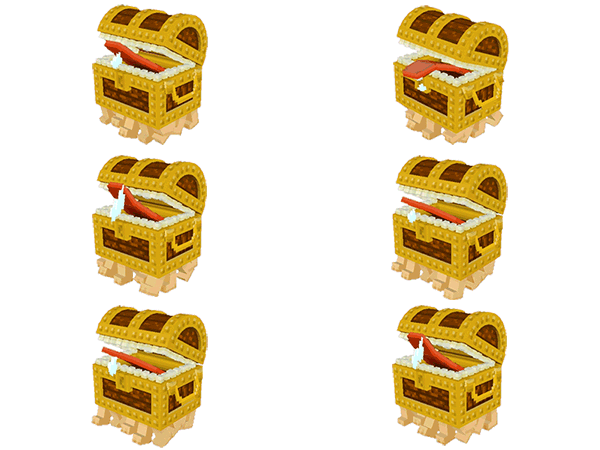
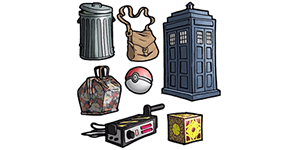
Magic satchel is a term often used in reference to role-playing video games. It refers to the use of a character’s inventory in the game, which can often contain more items (or items of too large a size) than is physically possible for the character to carry without any visible means to hold or transport them. The concept is so common in fantasy fiction that it is parodied by the character The Luggage in Terry Pratchett’s ‘Discworld’ series, a semi-sentient, bottomless treasure chest that follows its owner around.
The term ‘hammerspace’ describes the seemingly invisible place from which fictional characters, such as cartoon characters, pull out very large objects, such as mallets. Technically the term hammerspace is not used to refer to a magic satchel itself, but rather the area or pocket of space that a magic satchel occupies; a magic satchel is like a door to hammerspace. The ‘bag of holding’ is a similar concept in the role-playing game ‘Dungeons & Dragons.’ A real-world example is the clown car which often is used in the circus, in which numerous clowns clamber out of a tiny automobile.
read more »
Posted in Games, Humor |
1 Comment »
August 25, 2011


Hammerspace (also known as malletspace) is a fan-envisioned extradimensional, instantly accessible storage area in fiction, which is used to explain how animated, comic and game characters can produce objects out of thin air. Inexplicable production of items dates back to the very beginning of animated shorts and was a fairly common occurrence during the golden age of animation. Warner Bros. cartoon characters are particularly well-known for often pulling all sorts of things — guns, disguises, bombs, anvils, mallets— from behind their backs or just offscreen. However, the explanation for this phenomenon was mostly just left to suspension of disbelief.
The term ‘Hammerspace’ itself originates from a gag common in certain anime and manga. A typical example would be when a male character would anger or otherwise offend a female character, who would proceed to produce, out of thin air, an oversized wooden rice mallet (saizuchi) and hit him on the head with it in an exaggerated manner. The strike would be purely for comic effect, and would not have any long-lasting effects. The term was largely popularized first by fans of ‘Urusei Yatsura’ (a comedic manga, popular in the 1980s).
read more »
Posted in Games, Humor, Language |
1 Comment »
August 18, 2011

Alan Smithee was an official pseudonym used by film directors who wish to disown a project, coined in 1968. Until its use was formally discontinued in 2000, it was the sole pseudonym used by members of the Directors Guild of America (DGA) when a director dissatisfied with the final product proved to the satisfaction of a guild panel that he or she had not been able to exercise creative control over a film. The director was also required by guild rules not to discuss the circumstances leading to the move or even to acknowledge being the actual director.
Prior to 1968, DGA rules did not permit directors to be credited under a pseudonym. This was intended to prevent producers from forcing them upon directors, which would inhibit the development of their résumés. The guild also required that the director be credited, in support of the DGA philosophy that the director was the primary creative force behind a film.
read more »
Posted in Art, Humor, Money |
Leave a Comment »
August 16, 2011
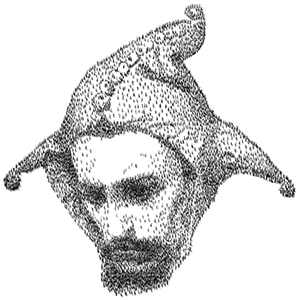
Stańczyk (c. 1480–1560) was the most famous court jester in Polish history. He is remembered as a man of great intelligence and a political philosopher gifted with formidable insight into Poland’s current and future situation. He used his job to criticize and warn his contemporaries through satire. His witty jokes often pertained to current political or court matters.
The best known anecdote about Stańczyk is that of a hunting incident. In 1533 King Sigismund the Old had a huge bear brought for him from Lithuania. The bear was released in the forest of Niepołomice near Kraków so that the king could hunt it. During the hunt, the animal charged at the king, the queen and their courtiers which caused panic and mayhem. Queen Bona fell from her horse which resulted in her miscarriage. Later, the king criticized Stańczyk for having run away instead of attacking the bear. The jester is said to have replied that ‘it is a greater folly to let out a bear that was locked in a cage.’ This remark is often interpreted as an allusion to the king’s policy toward Prussia which was defeated by Poland but not fully incorporated into the Crown.
Posted in Humor, Politics, World |
Leave a Comment »
August 15, 2011

A smiley, or happy face, is a stylized representation of a smiling human face. It is commonly represented as a yellow circle with two black dots representing eyes and a black arc representing the mouth. ‘Smiley’ is also sometimes used as a generic term for any emoticon (a facial expression pictorially represented by punctuation and letters, usually to express a writer’s mood).
The first unhappy face recorded on film can be seen in Ingmar Bergman’s 1948 film ‘Hamnstad.’ Later on, in 1953 and 1958, the happy face was used in promotional campaigns for motion pictures ‘Lili’ and ‘Gigi’, respectively.
read more »
Posted in Humor, Money, Politics |
Leave a Comment »
August 15, 2011

Kopi luwak, or civet coffee, is one of the world’s most expensive and low-production varieties of coffee. It is made from the beans of coffee berries which have been eaten by the Asian Palm Civet, then passed through its digestive tract. A civet eats the berries for their fleshy pulp. In its stomach, enzymes seep into the beans, making shorter peptides and more free amino acids. Passing through a civet’s intestines the beans are then defecated, keeping their shape. After gathering, thorough washing, sun drying, light roasting and brewing, these beans yield an aromatic coffee with much less bitterness, widely noted as the most expensive coffee in the world.
Since the flavor of coffee owes much to its proteins, there is a hypothesis that this shift in the numbers and kinds of proteins in beans after being swallowed by civets brings forth their unique flavor. The proteins are also involved in non-enzymatic Maillard browning reactions brought about later by roasting. Moreover, while inside a civet the beans begin to germinate by malting which also lowers their bitterness. Kopi luwak is produced mainly on the islands of Sumatra, Java, Bali and Sulawesi in the Indonesian Archipelago, and also in the Philippines, and also in East Timor. Weasel coffee is a loose English translation of its name cà phê Chồn in Vietnam, where popular, chemically simulated versions are also produced.
read more »
Posted in Food, Humor, Money |
Leave a Comment »




