October 19, 2011
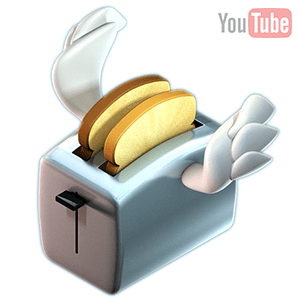
After Dark is a series of computer screensaver software introduced in 1989 by Berkeley Systems for the Macintosh, and later for Windows. Following the original, new editions were introduced including ‘More After Dark’ and ‘Before Dark,’ as well as editions themed around licensed properties such as ‘Star Trek,’ ‘The Simpsons,’ and Disney. The screensaver modules were often noted for their intertextuality, such as the flying toasters appearing in the Fish screensaver, and the cat from Boris screensaver appearing in the Bad Dog screensaver.
Of the screensaver modules included, the most famous is the iconic Flying Toasters which featured 1940s-style chrome toasters sporting bird-like wings, flying across the screen with pieces of toast. A slider enabled users to adjust the toast’s darkness and an updated Flying Toasters Pro module added a choice of music: Richard Wagner’s ‘Ride of the Valkyries’ or a flying toaster anthem with optional karaoke lyrics. Yet another version called ‘Flying Toasters!’ added bagels and pastries, baby toasters, and more elaborate toaster animation.
Posted in Humor, Technology |
1 Comment »
October 19, 2011

Birth control glasses, officially called GI glasses, are eyeglasses issued by the American military to its service members. At one time they were officially designated as ‘Regulation Prescription Glasses,’ or RPGs. This was commonly said to mean ‘Rape Prevention Glasses’ due to their unstylish appearance. The glasses are relatively thick frames made of brown translucent plastic, with a thin metal wire extending down the center of each of the earpieces.
The shape of the corrective lenses is nearly rectangular, with rounded edges, and a slight diagonal angle adjacent to the integrated nose pieces. This design reflects a specification for durability at the lowest possible cost. There are two designs available for female and male soldiers who require prescription eye wear.
read more »
Posted in Humor, Sex, War |
Leave a Comment »
October 18, 2011
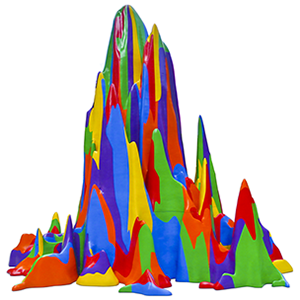
Plop art (or Plonk art) is a pejorative slang term for public art (usually large, abstract, modernist or contemporary sculpture) made for government or corporate plazas, spaces in front of office buildings, skyscraper atriums, parks, and other public venues. The term connotes that the work is unattractive or inappropriate to its surroundings – that is, it has been thoughtlessly ‘plopped’ where it lies.
The very word ‘plop’ suggested something falling wetly and heavily in the manner of excrement — extruded, as it were, from the fundament of the art world, and often at public expense. Plop art is a play on the term pop art. The term was coined by architect James Wines in 1969. Wines was critical of the failure of much public art to take an environmentally-oriented approach to the relationship between public art and architecture.
Posted in Art, Humor, Language |
Leave a Comment »
October 16, 2011

The Tinkerbell effect is a term describing things that are thought to exist only because people believe in them. The effect is named for Tinker Bell, the fairy in the play Peter Pan who is revived from near death by the belief of the audience.
Claimed cases include: private property; the value of a nation’s money in a fiat system; the value of gold; civil society; and the ‘rule of law.’
Posted in Humor, Money, Politics |
Leave a Comment »
October 15, 2011

The Chewbacca defense is a fictional legal strategy used in an episode of ‘South Park’ in1998. The aim of the argument is to deliberately confuse the jury by making use of the fallacy known as ignoratio elenchi, or a red herring. It starts by stating that Chewbacca lives on the planet Endor (doubly incorrect: No longer sedentary, he used to live on a different planet, Kashyyyk.). The argument continues from there, the false premise leading to a series of nonsense conclusions. The concept satirized attorney Johnnie Cochran’s closing argument defending O. J. Simpson in his murder trial. The Associated Press noted it as an example of Cochran’s position in popular culture. The concept has become a minor Internet phenomenon, used frequently as a running gag on satirical sites and in forums as a form of rhetoric.
‘Why would a Wookiee, an 8-foot-tall Wookiee, want to live on Endor, with a bunch of 2-foot-tall Ewoks? That does not make sense! But more important, you have to ask yourself: What does this have to do with this case? Nothing. Ladies and gentlemen, it has nothing to do with this case! It does not make sense! Look at me. I’m a lawyer defending a major record company, and I’m talkin’ about Chewbacca! Does that make sense? Ladies and gentlemen, I am not making any sense! None of this makes sense! And so you have to remember, when you’re in that jury room deliberatin’ and conjugatin’ the Emancipation Proclamation, does it make sense? No! Ladies and gentlemen of this supposed jury, it does not make sense! If Chewbacca lives on Endor, you must acquit! The defense rests.’
Posted in Humor, Politics |
Leave a Comment »
October 11, 2011

Humans United Against Robots (often abbreviated as HUAR) is a semi-tongue-in-cheek organization designed to unify the human race and prepare them for a futuristic robotic uprising. HUAR was created by humorist Keith Malley.
‘HUAR was designed to educate and awaken the citizenry of the world to the impending attack that computers and robots will put into effect against humans. It is a collection of human beings that spread the word of this impending doom as well as doing what they can to help minimize the threat. Between computer programs that can identify human speech and match that up with their computerized dictionaries in order to understand our weaknesses to jokester scientists building robots specifically made to breathe fire from their mouths and shoot lasers from their eyes, it is evident that a task force had to be formed of members that take being at the top of the food chain seriously. Robots will uprise. HUAR will be there.’
Posted in Humor, Technology, War |
Leave a Comment »
September 30, 2011
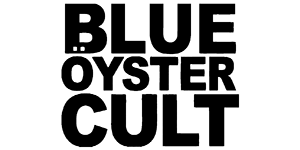

A metal umlaut [oom-lout] (also known as röck döts) is a trema (in Germanic languages called Umlaut) that is sometimes used gratuitously or decoratively over letters in the names of hard rock or heavy metal bands—for example those of Mötley Crüe and Motörhead. Amongst English speakers, the use of umlaut marks and other diacritics with a blackletter style typeface is a form of foreign branding intended to give a band’s logo a Teutonic quality—denoting stereotypes of boldness and strength commonly attributed to ancient northern European peoples, such as the Vikings and Goths. Its use has been attributed to a desire for a ‘Gothic horror’ feel. The metal umlaut is not generally intended to affect the pronunciation of the band’s name.
These decorative umlauts have been parodied in film and fiction; in the mockumentary film ‘This Is Spinal Tap’ (spelled with an umlaut mark over the n and a dotless i), fictional rocker David St. Hubbins (Michael McKean) says, ‘It’s like a pair of eyes. You’re looking at the umlaut, and it’s looking at you.’
read more »
Posted in Art, Humor, Language |
1 Comment »
September 29, 2011

The concept known as the law of the instrument, Maslow’s hammer, or a golden hammer is an over-reliance on a familiar tool; as psychologist Abraham Maslow said in 1966, ‘It is tempting, if the only tool you have is a hammer, to treat everything as if it were a nail.’ The sentiment that people look for cure-alls, and over-use familiar tools, is likely traditional; see panacea. Likewise, the use of a hammer and nail as imagery are likely as old as hammers and nails, or even the use of rocks as tools, which the hammer evokes.
The hammer and nail metaphor may not be original to Kaplan or Maslow, and has been attributed to Mark Twain, though there is no documentation of this origin in Twain’s published writings. Under the name of ‘Baruch’s Observation,’ it is also been attributed to Bernard M. Baruch, a stock market speculator and author.
read more »
Posted in Humor, Philosophy, Technology |
Leave a Comment »
September 28, 2011

From the late 1860s until the 1970s, several American cities had ugly laws making it illegal for persons with ‘unsightly or disgusting’ disabilities to appear in public. Some of these laws were called Unsightly Beggar Ordinances. The goal of these laws was seemingly to preserve the quality of life for the community, similar in spirit to current homeowners association regulations and by-laws: ‘No person who is diseased, maimed, mutilated or in any way deformed so as to be an unsightly or disgusting object or improper person to be allowed in or on the public ways or other public places in this city, or shall therein or thereon expose himself to public view, under a penalty of not less than one dollar nor more than fifty dollars for each offense.’
Many states’ ugly laws were not repealed until the mid 1970s. Omaha repealed its Ugly Law in 1967. Columbus withdrew its in 1972. Chicago was the last to repeal its Ugly Law as late as 1974. The recantation of Ugly Laws were tied to the passing of the Americans with Disabilities Act of 1990 where certain rights were granted to people with disabilities: ‘Individuals with disabilities are a discrete and insular minority who have been faced with restrictions and limitations, subjected to a history of purposeful unequal treatment, and relegated to a position of political powerlessness in our society, based on characteristics that are beyond the control of such individuals and resulting from stereotypic assumptions not truly indicative of the individual ability of such individuals to participate in, and contribute to, society.’
Posted in Humor, Politics |
Leave a Comment »
September 27, 2011
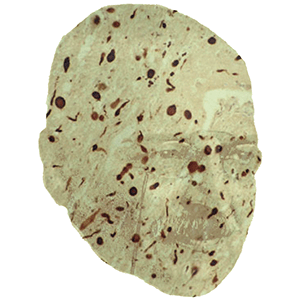
Stigler’s law of eponymy [uh-pon-uh-mee] is a process proposed by University of Chicago statistics professor Stephen Stigler in his 1980 publication of the same name. In its simplest and strongest form it says: ‘No scientific discovery is named after its original discoverer.’ Stigler named the sociologist Robert K. Merton as the discoverer of ‘Stigler’s law,’ consciously making ‘Stigler’s law’ exemplify Stigler’s law.
For example: Alzheimer’s disease, though named after Alois Alzheimer, had been previously described by at least half a dozen others before Alzheimer’s 1906 report which is often (wrongly) regarded as the first description of the disorder. Historical acclaim for discoveries is often allotted to persons of notoriety who bring attention to an idea that is not yet widely known, whether or not that person was its original inventor – theories may be named long after their discovery.
read more »
Posted in Humor, Language, Science |
1 Comment »
September 25, 2011
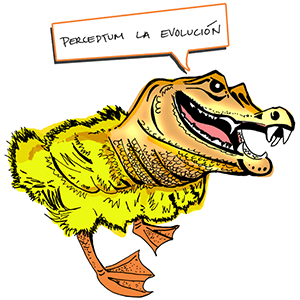
The term ‘crocoduck‘ was originally presented in a 2004 children’s story, ‘Guji Guji.’ The author and illustrator Chih-Yuan Chen produced the bestselling children’s story in 2004 as a modern day twist on The Ugly Duckling story in which a crocodile egg rolls into a duck’s nest and is raised in a brood of ducklings, growing up as a ‘crocoduck’ who thinks he is ‘not a bad crocodile,’ but ‘Of course, I’m not exactly a duck either.’ It was later used by creationists to claim that the absence of any half-crocodile, half-duck creature disproves evolution, an argument that quickly became a popular theme used to ridicule a common misrepresentation of the theory of evolution.
In 2007 creationists Kirk Cameron and Ray Comfort participated in a televised debate, parts of which were aired on ABC Nightline, on the existence of God. Comfort says they produced composite pictures of what ‘we imagined would be genuine species-to-species transitional forms. We called one a ‘crocoduck’ and another was called a ‘birddog.’ These pictures were used to show exactly what they thought evolutionists believe, but can’t back up through the fossil record.’ Their composite picture of the imaginary ‘crocoduck’ showed the head of a crocodile on a duck’s body. However, modern species share a common ancestor, but are neither descended from each other nor from some crude composite chimera, and ducks are not descended from crocodiles.
Posted in Humor, Philosophy, Science |
1 Comment »
September 24, 2011

Expletive infixation is a process by which an expletive or profanity is inserted into a word, usually for intensification. It is similar to tmesis, a word or phrase separated into two parts, e.g. ‘turn it off.’ The most commonly inserted English expletives are adjectival: either participles (fucking, mother-fucking, freaking, blooming, bleeding, damned) or adjectives (bloody). Although most speakers are not exposed to these formations until after childhood, they can form new examples readily once introduced to the process, and their judgments of which formations are acceptable are remarkably consistent. This suggests that the rules for the placement of the expletive are not arbitrary, but instead derive from fundamental aspects of English phonology.
A simple rule is that the insertion occurs at a syllable boundary, usually just before the primary stressed syllable. Thus, one hears abso-fuckin’-lutely rather than *ab-fuckin’-solutely. This rule is insufficient to describe examples such as un-fuckin’-believable, however, so modifications to this rule are proposed such as morpheme boundaries taking precedence over stress. Counterexamples to this exception do exist: unbe-fuckin’-lievable. A more fundamental theory due to John McCarthy is based on prosody, the rhythm, stress, and intonation of speech.
Posted in Humor, Language |
1 Comment »



