May 20, 2011

Wear Sunscreen is the common name of an essay titled ‘Advice, like youth, probably just wasted on the young’ written by Chicago Tribune columnist Mary Schmich, and published in 1997, but often erroneously attributed to a commencement speech by author Kurt Vonnegut.
Both its subject and tone are similar to the 1927 poem ‘Desiderata.’ The most popular and well-known form of the essay is the music single ‘Everybody’s Free (To Wear Sunscreen),’ released in 1998, by Baz Luhrmann.
Posted in Education, Humor, Philosophy |
Leave a Comment »
May 19, 2011

Malicious compliance is the behavior of a person who intentionally inflicts harm by strictly following the orders of management or following legal compulsions, knowing that compliance with the orders will cause a loss of some form resulting in damage to the manager’s business or reputation, or a loss to an employee or subordinate. In effect, it is a form of sabotage used to harm leadership or used by leadership to harm subordinates.
Work-to-rule is the expression of malicious compliance as an industrial action, in which rules are deliberately followed to the letter in an attempt to reduce employee productivity.
Posted in Humor, Language, Money |
Leave a Comment »
May 18, 2011

The chupacabra (literally ‘goat sucker’) is a legendary cryptid rumored to inhabit parts of the Americas. The name comes from the animal’s reported habit of attacking and drinking the blood of livestock, especially goats.
The most common description of chupacabras is a reptile-like being, appearing to have leathery or scaly greenish-gray skin and sharp spines or quills running down its back. Approximately 3 to 4 feet (1 to 1.2 m) high, it stands and hops in a similar fashion to a kangaroo.
Posted in Humor, Language, World |
Leave a Comment »
May 16, 2011
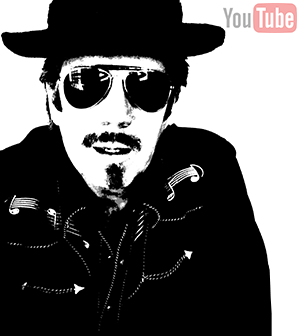
Dan Hicks (b. 1941) is an American singer-songwriter working at the intersection of cowboy folk, jazz, country, swing, bluegrass, pop, and gypsy music. His songs are frequently infused with humor, as evidenced by the title of his tune, ‘How Can I Miss You When You Won’t Go Away?’ Taking up the guitar in 1959, he became part of the San Francisco folk music scene, performing at local coffeehouses. Hicks joined the San Francisco band The Charlatans in 1965 as drummer.
In 1968, Hicks formed Dan Hicks and His Hot Licks, whose fourth album, 1973’s Last Train to Hicksville, gained the group critical and popular acclaim. Thus, it was a great surprise to many when he chose that moment to disband the Hot Licks. Asked why in 1974, he said, ‘I’m basically a loner… I like singing and stuff, but I didn’t necessarily want to be a bandleader. The thing had turned into a collective sort of thing — democracy, vote on this, do that. I conceived the thing. They wouldn’t be there if it wasn’t for me. My role as leader started diminishing, but it was my fault because I let it happen; I cared less as the thing went on.’
Posted in Art, Humor |
Leave a Comment »
May 9, 2011
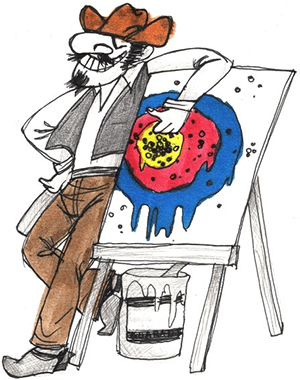
The Texas sharpshooter fallacy is a logical fallacy in which information that has no relationship is interpreted or manipulated until it appears to have meaning. The name comes from a joke about a Texan who fires some shots at the side of a barn, then paints a target centered on the biggest cluster of hits and claims to be a sharpshooter.
The fallacy does not apply if one had a prior expectation of the particular relationship in question before examining the data. It is related to the clustering illusion, which refers to the tendency in human cognition to interpret patterns in randomness where none actually exist.
read more »
Posted in Humor, Language, Science |
Leave a Comment »
May 9, 2011

The Firesign Theatre is an American comedy troupe consisting of Phil Austin, Peter Bergman, David Ossman and Philip Proctor. Their brand of surrealistic humor is best known through their record albums, which acquired a cult following in the late 1960s and early ’70s. The troupe began as live radio performers in LA; the name stems in part from astrology, because the membership encompasses all three ‘fire signs’: Aries, Leo, and Sagittarius. The name also refers to Fireside Theatre, an early television series that ran on NBC from 1949 to 1955, followed by ‘Jane Wyman Presents the Fireside Theatre’ (1955–58); it may also refer to the Fireside Chats radio broadcasts made by President Franklin Delano Roosevelt, a parody of which can be heard in one of the Theatre’s ‘Nick Danger’ adventures.
The Firesign Theatre employs a stream of consciousness style that includes direct references to movies, radio, TV, political figures, and other cultural sources, intermingled with sound effects and bits of music. The resulting stories — including the theft of a high school, a fair of clowns and holograms and aliens who use hemp smoking to turn people into crows — border on psychedelia, an effect intensified by the frequent appearance of mock ‘advertisements’ satirizing real products. The Firesign approach to comedy was strongly influenced by ‘The Goon Show,’ a British radio comedy program. While their style has the feel of improvisational comedy, most of the material is tightly scripted and memorized. The group’s writing method demands the consent of all four members before a line can be included. Much of their work has been copyrighted under the name ‘4 or 5 Crazee Guys.’
Posted in Art, Humor |
Leave a Comment »
May 8, 2011


Super Meat Boy is a platform game developed by Edmund McMillen and Tommy Refenes, and is the successor to ‘Meat Boy,’ originally released in 2008. Super Meat Boy was released in 2010. The game follows Meat Boy as he attempts to rescue his girlfriend Bandage Girl from the villainous Dr. Fetus through over 300 levels filled with deadly hazards. It has won acclaim for its extremely high difficulty.
Players must guide Meat Boy to the end of each level while avoiding buzzsaws, salt, and various other fatal obstacles. The player can jump and run, and can stick to walls in order to either jump off of them or to slide down them. The player has an unlimited number of attempts to complete each level; if Meat Boy is killed he immediately restarts the level, though the red blood left behind on surfaces that the player has touched remains.
Posted in Games, Humor |
Leave a Comment »
May 6, 2011

Chromotherapy, sometimes called color therapy, is an pseudoscientific alternative medicine practice. It is claimed that a therapist trained in chromotherapy can use color and light to balance ‘energy’ wherever a person’s body be lacking, be it physical, emotional, spiritual, or mental.
Color therapy is unrelated to light therapy, a valid and proven form of medical treatment for seasonal affective disorder and a small number of other conditions.
read more »
Posted in Health, Humor |
Leave a Comment »
May 4, 2011

‘(You Gotta) Fight for Your Right (to Party!)‘ was the first single released from the Beastie Boys’ breakthrough album, Licensed to Ill (1986). Ironically, the song, written by band friend Tom ‘Tommy Triphammer’ Cushman (who appears in the video), was intended as a parody of party and attitude songs, such as ‘Smokin’ In the Boys Room’ and ‘I Wanna Rock.’ However, the irony was lost on most listeners.
Mike D commented that, ‘The only thing that upsets me is that we might have reinforced certain values of some people in our audience when our own values were actually totally different. There were tons of guys singing along to ‘Fight for Your Right’ who were oblivious to the fact it was a total goof on them.’
read more »
Posted in Art, Humor |
Leave a Comment »
May 4, 2011
In 2011, Adam Yauch directed and wrote a surreal comedic short film entitled Fight For Your Right Revisited to commemorate the 25th anniversary of the original video release of their 1987 hit, ‘(You Gotta) Fight for Your Right (To Party!).’ ‘Revisited’ acts as a sequel to the events that took place in the original music video and stars Mike D, Ad-Rock and MCA (played by Seth Rogen, Elijah Wood & Danny McBride respectively) as they get into more drunken antics, before being challenged to a dance battle by the future Mike D, Ad-Rock and MCA (John C. Reilly, Will Ferrell and Jack Black, respectively).
The short also features several cameo appearances, including Stanley Tucci, Susan Sarandon, Steve Buscemi, Shannyn Sossamon, Kirsten Dunst, Ted Danson, Rashida Jones, Rainn Wilson, Amy Poehler, Mary Steenburgen, Will Arnett, Chloe Sevigny, Maya Rudolph, David Cross, Orlando Bloom, Martin Starr, and the actual Mike D, Ad-Rock & MCA.
Posted in Art, Humor |
Leave a Comment »
May 3, 2011

‘Happy Xmas (War Is Over)’ is a song written by John Lennon and Yoko Ono and released in 1971 as a single by John & Yoko/Plastic Ono Band with the Harlem Community Choir. Ostensibly a protest song about the Vietnam War, it has become a Christmas standard and has appeared on several Christmas albums. The lyric is based on a campaign in late 1969 by Lennon and Ono, who rented billboards and posters in eleven major cities around the world that read: ‘WAR IS OVER! (If You Want It) Happy Christmas from John and Yoko.’ In 1971, the US was deeply entrenched in the unpopular Vietnam War.
The melody and chord structure are from the folk standard ‘Stewball,’ about a race-horse. Lennon and Ono added modulation through several keys and the ‘War is over’ counter-melody. It was recorded at Record Plant Studios in New York City in late October 1971, with the help of producer Phil Spector. It features heavily echoed vocals and backing vocals from children from the Harlem Community Choir.
Posted in Art, Humor, War |
Leave a Comment »
May 3, 2011

The Yellow Kid emerged as the lead character in ‘Hogan’s Alley,’ a comic first drawn by Richard F. Outcault in 1894, which became one of the first Sunday supplement comic strips in an American newspaper. The Yellow Kid was a bald, snaggle-toothed boy who wore a yellow nightshirt and hung around in a ghetto alley filled with equally odd characters, mostly other children.
With a goofy grin, the Kid habitually spoke in a ragged, peculiar ghetto argot printed on his shirt, a device meant to lampoon advertising billboards. His head was drawn wholly shaved as if having been recently ridden of lice, a common sight among children in New York’s tenement ghettos at the time. His nightshirt, a hand-me-down from an older sister, was white or pale blue in the first color strips.
read more »
Posted in Art, Humor, Money |
Leave a Comment »




 The Daily Omnivore