May 3, 2011
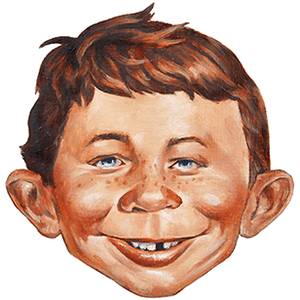
Alfred E. Neuman is the fictional mascot and iconic cover boy of Mad magazine. The face had drifted through American pictography for decades before being claimed and named by Mad editor Harvey Kurtzman. Since his debut in Mad, Neuman’s likeness, distinguished by jug ears, a missing front tooth, and one eye lower than the other has graced the cover of all but a handful of the magazine’s 500 issues. His face is rarely seen in profile; he has virtually always been shown in full frontal view, directly from behind, or in silhouette.
Harvey Kurtzman first spotted the image on a postcard pinned to the office bulletin board of Ballantine Books editor Bernard Shir-Cliff. ‘It was a face that didn’t have a care in the world, except mischief,’ recalled Kurtzman.
read more »
Posted in Art, Humor |
Leave a Comment »
May 3, 2011

The Stay Puft Marshmallow Man is a fictional mascot from the Ghostbusters franchise of media, which sometimes appears as a giant, lumbering paranormal monster.
It first appears in the 1984 film Ghostbusters as a picture logo on a prop package of marshmallows in Dana Barrett’s apartment when she places the groceries on her kitchen counter, on a graffiti advertisement on the building next to the Ghostbuster’s HQ when the ghosts are released from the containment grid after the power is shut down, then later in the climax of the film.
read more »
Posted in Art, Humor |
Leave a Comment »
May 2, 2011

‘Mission Accomplished‘ refers to a banner that was displayed during an address by President George W. Bush on May 1, 2003. Bush stated at the time that major combat operations in Iraq were completed. While his statement did coincide with an end to the conventional phase of the war, his assertion—and the sign itself—became controversial with the growing violence of the Iraqi insurgency. The vast majority of casualties, both military and civilian, occurred after the speech. White House staff members produced the banner. For critics of the war, the photo-op became a symbol of the Bush administration’s unrealistic goals and perceptions of the conflict. The banner came to symbolize the irony of Bush giving a victory speech only a few weeks after the beginning of a long war.
Bush became the first sitting President to make an arrested landing in a fixed-wing aircraft on an aircraft carrier when he arrived at the USS Abraham Lincoln in a Lockheed S-3 Viking, dubbed ‘Navy One,’ as the carrier returned from combat operations in the Persian Gulf. He posed for photographs with members of the ship’s crew while wearing a flight suit. Opponents criticized the event as a theatrical and expensive stunt. Bush was a passenger of the plane (unlike his father, who was a Navy pilot, he was never trained to land on a carrier). According to the Navy, the banner referred specifically to the Abraham Lincoln’s 10-month deployment (which was the longest deployment of a carrier since the Vietnam War) and not the war itself.
Posted in Humor, Politics, War |
Leave a Comment »
May 2, 2011

A Dagwood is a tall, multi-layered sandwich made with a variety of meats, cheeses and condiments. It was named after Dagwood Bumstead, a central character in the comic strip Blondie, who is frequently illustrated making enormous sandwiches. According to Blondie scripter Dean Young, his father, Chic Young, began drawing the huge sandwiches in the comic strip during 1936. Though the actual contents of Chic Young’s Dagwood sandwich remain obscure, it obviously contains large quantities and varieties of cold cuts, sliced cheese and vegetables, plus additional slices of bread. An olive pierced by a toothpick or wooden skewer usually crowns the edible superstructure.
In May 1999, a counter-service restaurant named Blondie’s opened at Universal Orlando’s Islands of Adventure, serving a traditional Dagwood-style sandwich. Blondie’s bills itself as ‘Home of the Dagwood Sandwich.’ A Blondie-themed restaurant chain, Dagwood’s Sandwich Shoppe, was founded in 2006. The Dagwood is sold as a 1.5-pound sandwich with three slices of deli bread, hard salami, pepperoni, cappicola, mortadella, deli ham, cotto salami, cheddar, Provolone, red onion, green leaf lettuce, tomato, fresh and roasted red bell peppers, mayo, mustard and a secret Italian olive salad oil.
Posted in Food, Humor |
Leave a Comment »
May 2, 2011
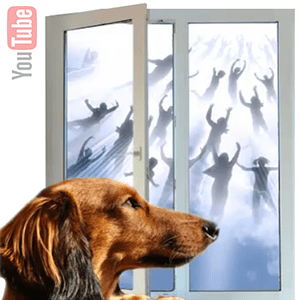
For a one-time charge of $10, After the Rapture Pet Care promises to look after Christian’s pets on Earth should the rapture occur. When Jesus returns, their non-Christian administrators will activate a rescue plan: animal caretakers will be alerted immediately by email and telephone that they have been activated.
Pets will be assigned to caretakers based upon location and other factors. Administrators will do whatever it takes to find and rescue pets covered by a policy.
Posted in Death, Humor, Philosophy |
Leave a Comment »
May 2, 2011

Alien abduction insurance is an insurance policy issued against alien abduction. Simon Burgess, former Managing Director of British Insurance, well known for being involved in the bizarre end of the business, said ‘Of course, the burden of proof lies with the claimant. Let’s face it – insurance is so tedious that if I can enlighten my dreary life with a bit of humor every now and again, I will.’ Policies typically cover injuries suffered during an alien examinations or death caused by aliens. The first company to offer UFO insurance was the St. Lawrence Agency in Florida. The company says that it has paid out at least two claims of $1 per year until their death or for 1 million years, whichever comes first. The insurance is normally purchased by the ‘feeble-minded,’ according to Burgess. Prominent policyholders have included Shirley MacLaine and a Harvard University professor who has written on aliens.
The Heaven’s Gate religious group purchased alien abduction insurance before their mass suicide. Their insurance company (London brokerage Goodfellow Rebecca Ingrams Pearson) stopped offering alien abduction insurance after the suicide – having sold the policy to about four thousand people (mostly in England and the United States). At a cost of roughly $155 a year the GRIP policy would pay about $160,000 to someone who could show that they had been abducted by a being who was not from Earth. The payment would double if the insured person was impregnated during the event. Men were also able to purchase the impregnation insurance for protection against the unknown capabilities of alien technology.
Posted in Humor, Money |
Leave a Comment »
April 29, 2011

Operation Nifty Package was a US Navy SEAL plan conducted in 1989 to apprehend or prevent the escape of Panamanian dictator Manuel Noriega.
Forty-eight SEALs (three SEAL Platoons) were tasked with destroying Noriega’s private jet on the ground in Panama City. This part of the mission put the SEALs into a skirmish with Panamanian military forces guarding the airport, and four SEALs were killed and eight wounded. Despite the casualties, a well-aimed AT4 rocket destroyed Noriega’s plane.
read more »
Posted in Humor, War, World |
Leave a Comment »
April 28, 2011

Eating your own dog food, also called dogfooding, is when a company (usually, a software company) uses the products that it makes. In 1988, Microsoft manager Paul Maritz wrote an email titled ‘Eating our own Dogfood,’ challenging his team to increase internal usage of the company’s product.
From there, the usage of the term spread through the company. The term is believed to have derived from a 1980s television advertisements for Alpo dog food, where TV actor, Lorne Greene pointed out that he fed Alpo to his own dogs.
read more »
Posted in Humor, Language, Money |
Leave a Comment »
April 28, 2011

Cluster ballooning is a form of ballooning where a harness attaches a balloonist to a cluster of helium-inflated rubber balloons. Unlike traditional hot-air balloons, where a single large balloon is equipped with vents enabling altitude control, cluster balloons are multiple, small, readily available and individually sealed balloons. To control flight, arrest a climb or initiate a descent, the pilot incrementally jettisons or deflates balloons.
In 1982, Californian truck driver Larry Walters, without any prior ballooning experience, attached 42 helium-filled weather balloons to a lawn chair and lifted off. He quickly rose to nearly 3 miles. He controlled his altitude by using a pellet gun to selectively pop some of the balloons. In his defense to charges filed against him by the FAA, he stated that he intended to rise just a few hundred feet, but underestimated helium’s lifting power causing his tethering strap to break prematurely.
Posted in Games, Humor |
Leave a Comment »
April 28, 2011

A leisure suit is a casual suit consisting of a shirt-like jacket and matching trousers, often associated with American-influenced fashion and fads of the 1970s.
Suits as casual wear became popular among members of Britain’s mod subculture in the 1960s, but only achieved widespread popularity in the United States when—with the creation and popularization of synthetic materials—unprecedented cheapness met with a culture that had come to hate formality.
read more »
Posted in Art, Humor, Money |
2 Comments »
April 28, 2011

Ultracrepidarianism [uhl-truh-krep-i-dair-ee-uhn-iz-uhm] is the habit of giving opinions and advice on matters outside of one’s knowledge. The term was first publicly recorded in 1819 by the essayist William Hazlitt in a letter to William Gifford, the editor of the ‘Quarterly Review,’ a London periodical. The term draws from a comment purportedly made by Apelles, a famous Greek artist to a shoemaker who presumed to criticise his painting. The Latin phrase, ‘Sutor, ne ultra crepidam’ meaning literally ‘Shoemaker, not above the sandal,’ used to warn people off passing judgement beyond their expertise.
As the story goes, the shoemaker (sutor) had approached the painter Apelles of Kos to point out a defect in the artist’s rendition of a sandal (crepida), which Apelles duly corrected. Encouraged by this, the shoemaker then began to enlarge on other defects he considered present in the painting, at which point Apelles silenced him with his famous ‘Sutor, ne ultra crepidam.’ The saying remains popular in several languages, and is translated directly into the common Dutch saying ‘schoenmaker, blijf bij je leest’ (shoemaker, stick to your last, a last being the wooden pattern used in shoemaking).
Posted in Humor, Language |
Leave a Comment »
April 28, 2011
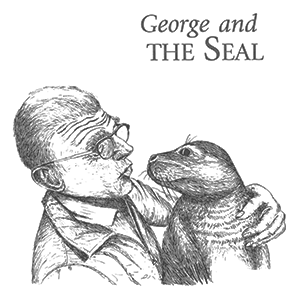
Hoover was a harbor seal who was able to imitate basic human speech. He was found as an orphan by George and Alice Swallow in Maine in 1971. At first the baby seal didn’t want to eat, but soon he ate at the pace of a vacuum cleaner (hence his name).
When Hoover outgrew the bathtub, he was transferred to the pond outside their house where he began to imitate people’s voices. Again he was moved, this time to the New England Aquarium, where he told visitors to ‘Get outta here!’ in a thick New England accent.
Posted in Humor, Language, Science |
Leave a Comment »




 The Daily Omnivore