May 2, 2011

Alien abduction insurance is an insurance policy issued against alien abduction. Simon Burgess, former Managing Director of British Insurance, well known for being involved in the bizarre end of the business, said ‘Of course, the burden of proof lies with the claimant. Let’s face it – insurance is so tedious that if I can enlighten my dreary life with a bit of humor every now and again, I will.’ Policies typically cover injuries suffered during an alien examinations or death caused by aliens. The first company to offer UFO insurance was the St. Lawrence Agency in Florida. The company says that it has paid out at least two claims of $1 per year until their death or for 1 million years, whichever comes first. The insurance is normally purchased by the ‘feeble-minded,’ according to Burgess. Prominent policyholders have included Shirley MacLaine and a Harvard University professor who has written on aliens.
The Heaven’s Gate religious group purchased alien abduction insurance before their mass suicide. Their insurance company (London brokerage Goodfellow Rebecca Ingrams Pearson) stopped offering alien abduction insurance after the suicide – having sold the policy to about four thousand people (mostly in England and the United States). At a cost of roughly $155 a year the GRIP policy would pay about $160,000 to someone who could show that they had been abducted by a being who was not from Earth. The payment would double if the insured person was impregnated during the event. Men were also able to purchase the impregnation insurance for protection against the unknown capabilities of alien technology.
Posted in Humor, Money |
Leave a Comment »
April 29, 2011

Operation Nifty Package was a US Navy SEAL plan conducted in 1989 to apprehend or prevent the escape of Panamanian dictator Manuel Noriega.
Forty-eight SEALs (three SEAL Platoons) were tasked with destroying Noriega’s private jet on the ground in Panama City. This part of the mission put the SEALs into a skirmish with Panamanian military forces guarding the airport, and four SEALs were killed and eight wounded. Despite the casualties, a well-aimed AT4 rocket destroyed Noriega’s plane.
read more »
Posted in Humor, War, World |
Leave a Comment »
April 28, 2011

Eating your own dog food, also called dogfooding, is when a company (usually, a software company) uses the products that it makes. In 1988, Microsoft manager Paul Maritz wrote an email titled ‘Eating our own Dogfood,’ challenging his team to increase internal usage of the company’s product.
From there, the usage of the term spread through the company. The term is believed to have derived from a 1980s television advertisements for Alpo dog food, where TV actor, Lorne Greene pointed out that he fed Alpo to his own dogs.
read more »
Posted in Humor, Language, Money |
Leave a Comment »
April 28, 2011

Cluster ballooning is a form of ballooning where a harness attaches a balloonist to a cluster of helium-inflated rubber balloons. Unlike traditional hot-air balloons, where a single large balloon is equipped with vents enabling altitude control, cluster balloons are multiple, small, readily available and individually sealed balloons. To control flight, arrest a climb or initiate a descent, the pilot incrementally jettisons or deflates balloons.
In 1982, Californian truck driver Larry Walters, without any prior ballooning experience, attached 42 helium-filled weather balloons to a lawn chair and lifted off. He quickly rose to nearly 3 miles. He controlled his altitude by using a pellet gun to selectively pop some of the balloons. In his defense to charges filed against him by the FAA, he stated that he intended to rise just a few hundred feet, but underestimated helium’s lifting power causing his tethering strap to break prematurely.
Posted in Games, Humor |
Leave a Comment »
April 28, 2011

A leisure suit is a casual suit consisting of a shirt-like jacket and matching trousers, often associated with American-influenced fashion and fads of the 1970s.
Suits as casual wear became popular among members of Britain’s mod subculture in the 1960s, but only achieved widespread popularity in the United States when—with the creation and popularization of synthetic materials—unprecedented cheapness met with a culture that had come to hate formality.
read more »
Posted in Art, Humor, Money |
2 Comments »
April 28, 2011

Ultracrepidarianism [uhl-truh-krep-i-dair-ee-uhn-iz-uhm] is the habit of giving opinions and advice on matters outside of one’s knowledge. The term was first publicly recorded in 1819 by the essayist William Hazlitt in a letter to William Gifford, the editor of the ‘Quarterly Review,’ a London periodical. The term draws from a comment purportedly made by Apelles, a famous Greek artist to a shoemaker who presumed to criticise his painting. The Latin phrase, ‘Sutor, ne ultra crepidam’ meaning literally ‘Shoemaker, not above the sandal,’ used to warn people off passing judgement beyond their expertise.
As the story goes, the shoemaker (sutor) had approached the painter Apelles of Kos to point out a defect in the artist’s rendition of a sandal (crepida), which Apelles duly corrected. Encouraged by this, the shoemaker then began to enlarge on other defects he considered present in the painting, at which point Apelles silenced him with his famous ‘Sutor, ne ultra crepidam.’ The saying remains popular in several languages, and is translated directly into the common Dutch saying ‘schoenmaker, blijf bij je leest’ (shoemaker, stick to your last, a last being the wooden pattern used in shoemaking).
Posted in Humor, Language |
Leave a Comment »
April 28, 2011
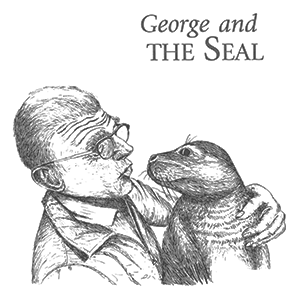
Hoover was a harbor seal who was able to imitate basic human speech. He was found as an orphan by George and Alice Swallow in Maine in 1971. At first the baby seal didn’t want to eat, but soon he ate at the pace of a vacuum cleaner (hence his name).
When Hoover outgrew the bathtub, he was transferred to the pond outside their house where he began to imitate people’s voices. Again he was moved, this time to the New England Aquarium, where he told visitors to ‘Get outta here!’ in a thick New England accent.
Posted in Humor, Language, Science |
Leave a Comment »
April 26, 2011

Vinegar valentines are greeting cards, or, rather, insult cards, that come in the form of an aspersion, decorated with a caricature and, below that, an insulting poem. Ostensibly given on Valentine’s Day, the caricature and poem is about the ‘type’ that the recipient belongs to–spinster, floozy, dude, scholar, etc.
They were later also produced in the form of postcards. They were usually sent anonymously. Postmasters sometimes confiscated these cards as unfit to be mailed.The cards were first produced in the late Victorian era and enjoyed their greatest popularity in that period and in the first quarter of the 20th century.
Posted in Humor |
Leave a Comment »
April 26, 2011

Minnesota nice is the stereotypical behavior of long-time Minnesota residents, to be courteous, reserved, and mild mannered. The cultural characteristics of Minnesota nice include a polite friendliness, an aversion to confrontation, a tendency toward understatement, a disinclination to make a fuss or stand out, emotional restraint, and self-deprecation.
It can also refer to traffic behavior, such as slowing down to allow another driver to enter a lane in front of the other person. The negative side of ‘Minnesota nice,’ occurs in the form of passive aggressiveness and resistance to change.
read more »
Posted in Humor, Language, Politics |
Leave a Comment »
April 26, 2011

A panty raid is a prank in which male students steal the panties (undergarments) of female students by intruding into their living quarters. The term dates to February, 1949.
It was the first college craze after World War II, following the 1930s crazes of goldfish swallowing or seeing how many could fit in a phone booth. By the 1970s, mixed dorms, less inhibited attitudes to intercourse on campus led to fading of panty raids.
read more »
Posted in Games, Humor, Sex |
Leave a Comment »
April 26, 2011

The Cardboard Tube Fighting League (CTFL) is a global organization that hosts cardboard tube based events in Seattle, Washington; San Francisco, California; and Sydney, Australia. The CTFL hosts tournaments and battles where cardboard tube fighters go head-to-head in an attempt to break their opponents tube without breaking their own.
The events also focus on cardboard costumes and theatrics. These events are often held at public parks throughout the summer, are open to everyone ages 5 and up, and emphasize fun over competition. Cardboard tubes are provided and all events are free for participants.
Posted in Games, Humor |
Leave a Comment »
April 26, 2011

Deadpan is a form of comic delivery in which humor is presented without a change in emotion or body language, usually speaking in a casual, monotone, solemn, blunt, disgusted or matter-of-fact voice and expressing an unflappably calm, archly insincere or artificially grave demeanor.
This delivery is also called dry wit when the intent, but not the presentation, is humorous, oblique, sarcastic, or apparently unintentional. The term ‘deadpan’ first emerged as an adjective or adverb in the 1920s, as a compound word (‘pan’ was a slang term for ‘face’).
read more »
Posted in Art, Humor, Language |
Leave a Comment »





