March 8, 2011
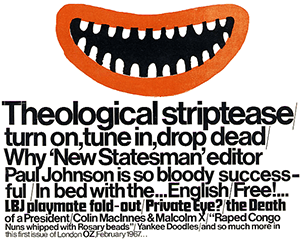

Oz was first published as a satirical humor magazine between 1963 and 1969 in Sydney, Australia and, in its second and better known incarnation, became a ‘psychedelic hippy’ magazine from 1967 to 1973 in London.
Strongly identified as part of the underground press, it was the subject of two celebrated obscenity trials, one in Australia in 1964 and the other in the UK in 1971. On both occasions the magazine’s editors were acquitted on appeal after initially being found guilty and sentenced to harsh jail terms. The central editor throughout the magazine’s life was Richard Neville.
Posted in Art, Drugs, Humor |
Leave a Comment »
March 4, 2011


In Internet slang, a troll is someone who posts inflammatory, extraneous, or off-topic messages in an online community, such as an online discussion forum, chat room, or blog, with the primary intent of provoking other users into a desired emotional response or of otherwise disrupting normal on-topic discussion. In addition to the offending poster, the noun troll can also refer to the provocative message itself.
read more »
Posted in Humor, Language, Technology |
Leave a Comment »
March 3, 2011
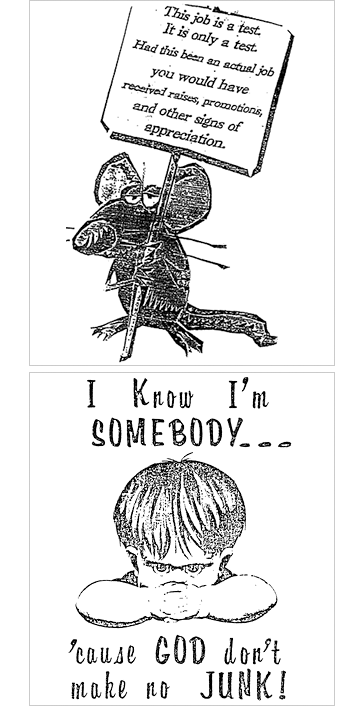
Faxlore refers to humorous texts, folk poetry, folk art, and urban legends that are circulated, not by word of mouth, but by fax machine. ‘Xeroxlore’ or ‘photocopylore’ is similar material circulated by photocopying. Cartoons and jokes often circulate as faxlore; the poor graphic quality becoming worse with each retransmission.
Because faxlore and xeroxlore is the (mis)appropriation of technology owned by the employer, it is often mildly subversive of the workplace and its values.
read more »
Posted in Humor, Language, Technology |
Leave a Comment »
March 3, 2011

The King of Kong: A Fistful of Quarters is a 2007 American documentary film that follows Steve Wiebe as he tries to take the world high score for the arcade game Donkey Kong from reigning champion Billy Mitchell. The film premiered at the 2007 Slamdance Film Festival.
A scripted film adaptation is already in the works. Director Seth Gordon has said that the movie might be a sequel instead of a remake, telling the story of how the documentary changed both men’s lives, as well as their continuing rivalry.
Posted in Art, Games, Humor |
Leave a Comment »
March 2, 2011

Superjail! is an American animated television series produced by Augenblick Studios. The series follows the events that take place in an unusual prison. The pilot episode aired on television in 2007. Superjail! is characterized by its psychedelic shifts in setting and plot and extreme graphic violence, which give the series a TV-MA rating. These elements are depicted through highly elaborate animated sequences, which have been described as ‘baroque and complicated and hard to take in at a single viewing.’
The majority of Superjail! is set inside the eponymous prison. Externally, Superjail is built inside a volcano which is itself located in a larger volcano. Internally, it seems to constitute its own reality, where the fabric of time and space is extremely fluid and changes at the whim of the Warden. Each episode begins with a linear story revolving around an irresponsible scheme concocted by the Warden to satisfy some whim. The episode builds up in both violence and surrealism until a climactic, psychedelic blood bath during which dozens of inmates are brutally murdered, either by one another or some external force.
Posted in Art, Humor |
Leave a Comment »
February 28, 2011


RTFM (‘read the fucking manual’) is a brusque way to remind others to try to help themselves in obvious ways before seeking assistance from others. Since the rise of the Web, pervasive internet connectivity, and ubiquitous search, a similar type of response has involved the idea that by asking questions that could easily be answered by even the most cursory, obvious search, the user embarrasses himself by showing that the very idea of searching before asking didn’t even occur to him.
The most common variants of this type are GIYF (‘Google is your friend’) and LMGTFY (‘let me google that for you’), both with a tone of patronizing helpfulness (with varying degrees of sarcasm).Often the responder will even insert a link into the reply that, when the user clicks it, will take them to a saved search query. The clear implication is that’you should know by now to do this yourself.’
Posted in Humor, Language, Technology |
Leave a Comment »
February 24, 2011

The Pacific Northwest Tree Octopus was an internet hoax created in 1998 by Lyle Zapato. This fictitious endangered species of cephalopod was given the Latin name ‘Octopus paxarbolis.’ It was purported to be able to live both on land and in water, and was said to live in the Olympic National Forest and nearby rivers, spawning in water where its eggs are laid. Its major predator was said to be the Sasquatch.
Posted in Humor |
1 Comment »
February 24, 2011

A placebo button, also called an idiot button, is a push-button with apparent functionality that actually has no effect when pressed, analogous to a placebo. In other cases, a control like a thermostat may not be connected. Although non-functional, the buttons can give the user an illusion of control. In some cases the button may have been functional, but may have failed or been disabled during installation or maintenance. Only in relatively rare cases will the button have been deliberately designed to do nothing. In many cases, a button may not appear to do something, but in fact cause behavior that is not immediately apparent; this can give the appearance of it being a placebo button.
Many walk buttons at pedestrian crossings were once functional in New York City, but now serve as placebo buttons. Some door-close buttons in elevators are placebo buttons, although some of them do in fact change the timing, and others are functional only when activated with a maintenance key. It has been reported that the temperature set point adjustment on thermostats in many office buildings are non-functional, installed to give tenants’ employees a similar illusion of control.
Posted in Humor, Technology |
Leave a Comment »
February 24, 2011
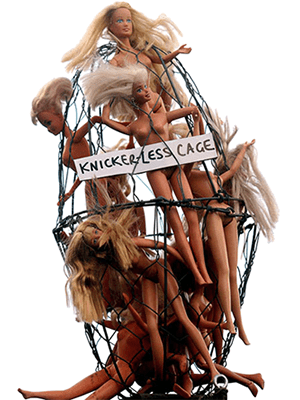
The Turnip Prize is a spoof UK award that satirises the Tate Gallery’s Turner Prize by rewarding deliberately bad modern art. It was started mainly as a joke in 1999, but has gained national media attention and inspired other similar prizes. Credit is given for entries that have bad puns as titles, display ‘lack of effort’ and pass the crucial test of ‘is it shit?’; conversely, entries which show ‘too much effort’ or are ‘not shit enough’ are disqualified. The first prize is a turnip nailed to a block of wood.
Posted in Art, Humor |
Leave a Comment »
February 24, 2011
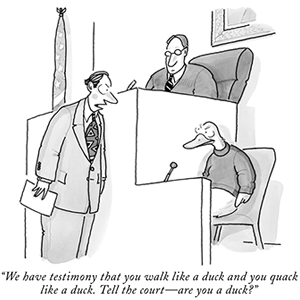
The duck test is a humorous term for a form of inductive reasoning. This is its usual expression: If it looks like a duck, swims like a duck, and quacks like a duck, then it probably is a duck. The test implies that a person can identify an unknown subject by observing that subject’s habitual characteristics. It is sometimes used to counter abstruse arguments that something is not what it appears to be.
Indiana poet James Whitcomb Riley (1849–1916) is sometimes credited with coining the phrase. The term was later popularized in the United States by Richard Cunningham Patterson Jr., United States ambassador to Guatemala during the Cold War in 1950, who used the phrase when he accused the Jacobo Arbenz Guzmán government of being Communist.
Posted in Humor, Language |
Leave a Comment »
February 24, 2011

The term elephant test refers to situations in which an idea or thing ‘is hard to describe, but instantly recognizable when spotted.’ The term is often used in legal cases when there is an issue which may be open to interpretation, such as in the case of Cadogan Estates Ltd v Morris, when Lord Justice Stuart-Smith referred to ‘the well known elephant test. It is difficult to describe, but you know it when you see it.’
Posted in Humor, Language, Politics |
2 Comments »
February 23, 2011


Laddism is a subculture commonly associated with Britpop music of the 1990s. The phenomenon was reflected in the magazine Loaded and its subsequent imitators.
Images of Laddishness are dominated by the male pastimes of drinking, watching football, and sex. The word ladette has been coined to describe young women who emulate laddish behavior, i.e. young women who behave in a boisterously assertive or crude manner and engage in heavy drinking sessions.
Posted in Humor, Language, Sex |
Leave a Comment »




 The Daily Omnivore