January 20, 2011

Archie Meets the Punisher or The Punisher Meets Archie was a one-shot comic book intercompany crossover published under two separate covers by Marvel Comics and Archie Comics in 1994. It featured the unlikely meeting of Marvel’s murderous vigilante, the Punisher, and Archie Comics’ all-American teenager, Archie Andrews. The book was written by Batton Lash, with artwork by John Buscema (drawing the Punisher characters) and Stan Goldberg (drawing the Archie characters).
Posted in Art, Humor, Money |
Leave a Comment »
January 19, 2011
Percussive maintenance, also known as percussion therapy or a technical tap, is a term used to describe the malediction of an ill-behaved device to make it work, that is to say, swear at it and hit it. The origins and practice of the term are unknown, although some suggest the act became commonplace with the introduction of vacuum tube electronics. The term is a play on ‘preventive maintenance.’
Posted in Humor, Language, Technology |
Leave a Comment »
January 19, 2011


Desert Bus a minigame found in the 1999 Sega CD title: ‘Penn & Teller’s Smoke and Mirrors.’ The objective of the game is to drive a bus from Tucson, Arizona to Las Vegas, Nevada in real time at a maximum speed of 45mph. The feat requires 8 hours of continuous play to complete, since the game cannot be paused. Penn Jillette commented in his radio show that the overly realistic nature of the game was in response to Janet Reno and the controversy surrounding violent video games at the time.
read more »
Posted in Games, Humor, Technology |
Leave a Comment »
January 18, 2011


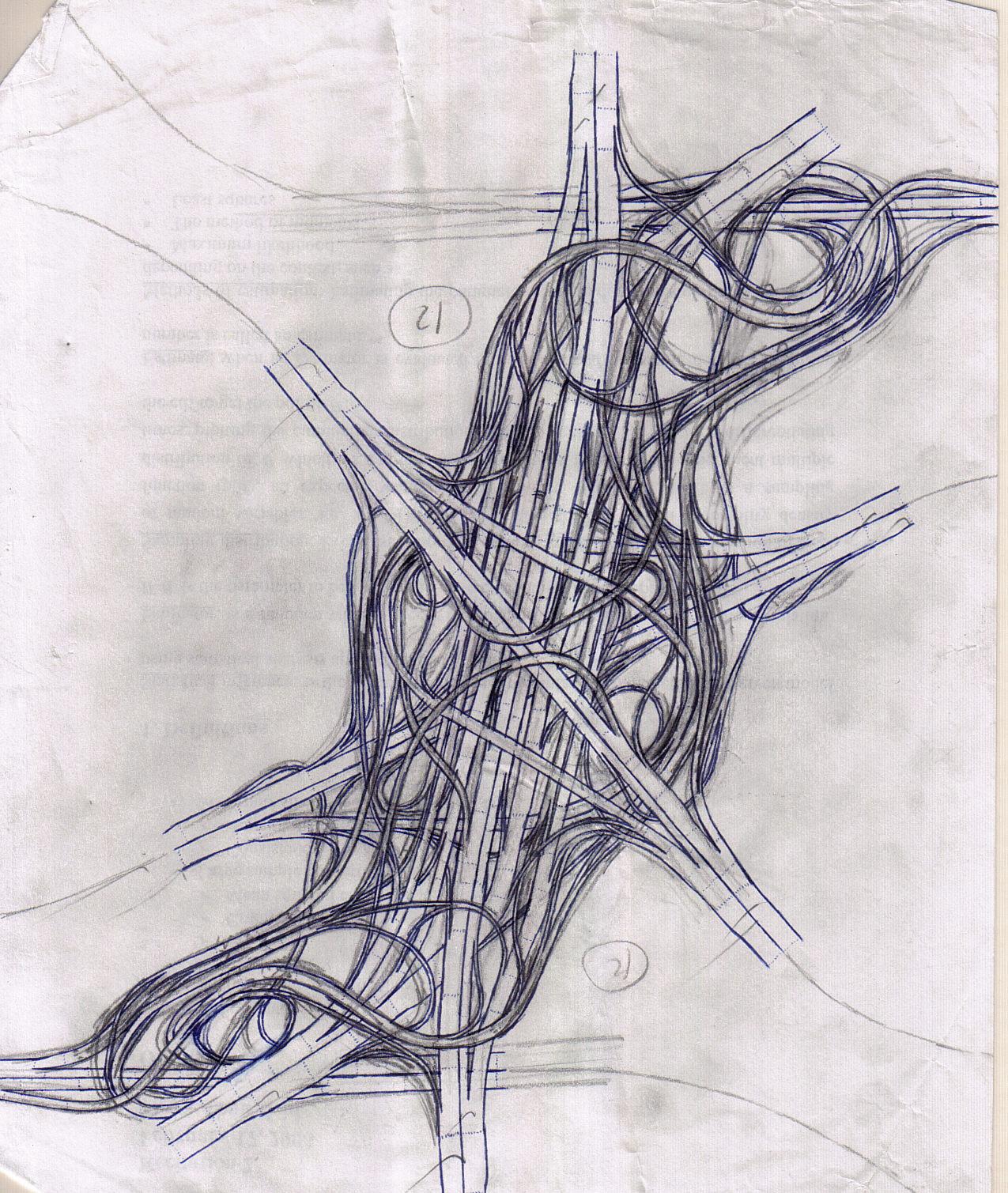
Spaghetti Junction is a nickname sometimes given to a complicated or massively intertwined road traffic interchange that resembles a plate of spaghetti. The term is believed to have been coined by a journalist at the Birmingham Evening Mail in the 1970s to refer to the Gravelly Hill Interchange on the M6 motorway in Birmingham, United Kingdom. Since then many complex interchanges around the world have acquired the nickname.
Posted in Humor, Language, Technology |
Leave a Comment »
January 17, 2011

Dead cat bounce is a Wall Street term that refers to a small, brief recovery in the price of a declining stock. The term is derived from the expression: ‘Even a dead cat will bounce if it falls from a great height.’ The earliest record of the phrase dates from a 1985 Financial Times article describing the Singaporean and Malaysian stock markets bounce after a hard fall during the recession of that year. A similar expression has an older history in Cantonese and this may be the origin of the term.
Posted in Humor, Language, Money |
Leave a Comment »
January 17, 2011

Parkinson’s Law of Triviality (also known by the expression ‘color of the bike shed’) is British author, C. Northcote Parkinson’s 1957 argument that organizations give disproportionate weight to trivial issues. Parkinson compares a committee’s deliberations on a nuclear power plant to deliberation on a bicycle shed:
A nuclear reactor is so vastly expensive and complicated that an average person cannot understand it, so they assume that those working on it understand it; even those with strong opinions often withhold them for fear of being shown to be insufficiently informed. On the other hand, everyone understands a bicycle shed (or thinks he or she does), so building one can result in endless discussions because everyone involved wants to add his or her touch and show that they have contributed.
Posted in Humor, Language, Money |
Leave a Comment »
January 11, 2011

A tin foil hat is a piece of headgear made from one or more sheets of aluminum foil or similar material or a conventional hat lined with foil worn to shield the brain from electromagnetic fields, or against mind control and/or mind reading; or attempt to limit the transmission of voices directly into the brain. The concept of wearing a tin foil hat for protection from such threats has become a popular stereotype and term of derision; the phrase serves as a byword for paranoia and persecutory delusions, and is associated with conspiracy theorists.
Posted in Humor |
Leave a Comment »
January 11, 2011

Bill Hicks (1961 – 1994) was an American stand-up comedian whose humor challenged mainstream beliefs, aiming to ‘enlighten people to think for themselves.’ Hicks used a ribald approach to express his material, describing himself as ‘Chomsky with dick jokes,’ while conceding that his humor was ‘caring.’ His material largely consisted of general discussions about society, religion, politics, philosophy, and personal issues. He was often controversial and his routine was steeped in dark comedy.
In both his stand-up performances and during interviews he criticized consumerism, superficiality, mediocrity, and banality within the media and popular culture, describing them as oppressive tools of the ruling class, meant to ‘keep people stupid and apathetic.’ Hicks died of pancreatic cancer in 1994 at the age of 32. In the years after his death, his work and legacy achieved the significant admiration and acclaim of numerous humorists.
read more »
Posted in Drugs, Humor, Politics |
Leave a Comment »
January 11, 2011

Snopes, officially the Urban Legends Reference Pages, is a web site discussing urban legends, Internet rumors, e-mail forwards, and other stories of uncertain or questionable origin.
It is the best-known resource for validating and debunking such stories in American popular culture, receiving 300,000 visits a day.
read more »
Posted in Education, Humor |
Leave a Comment »
January 10, 2011


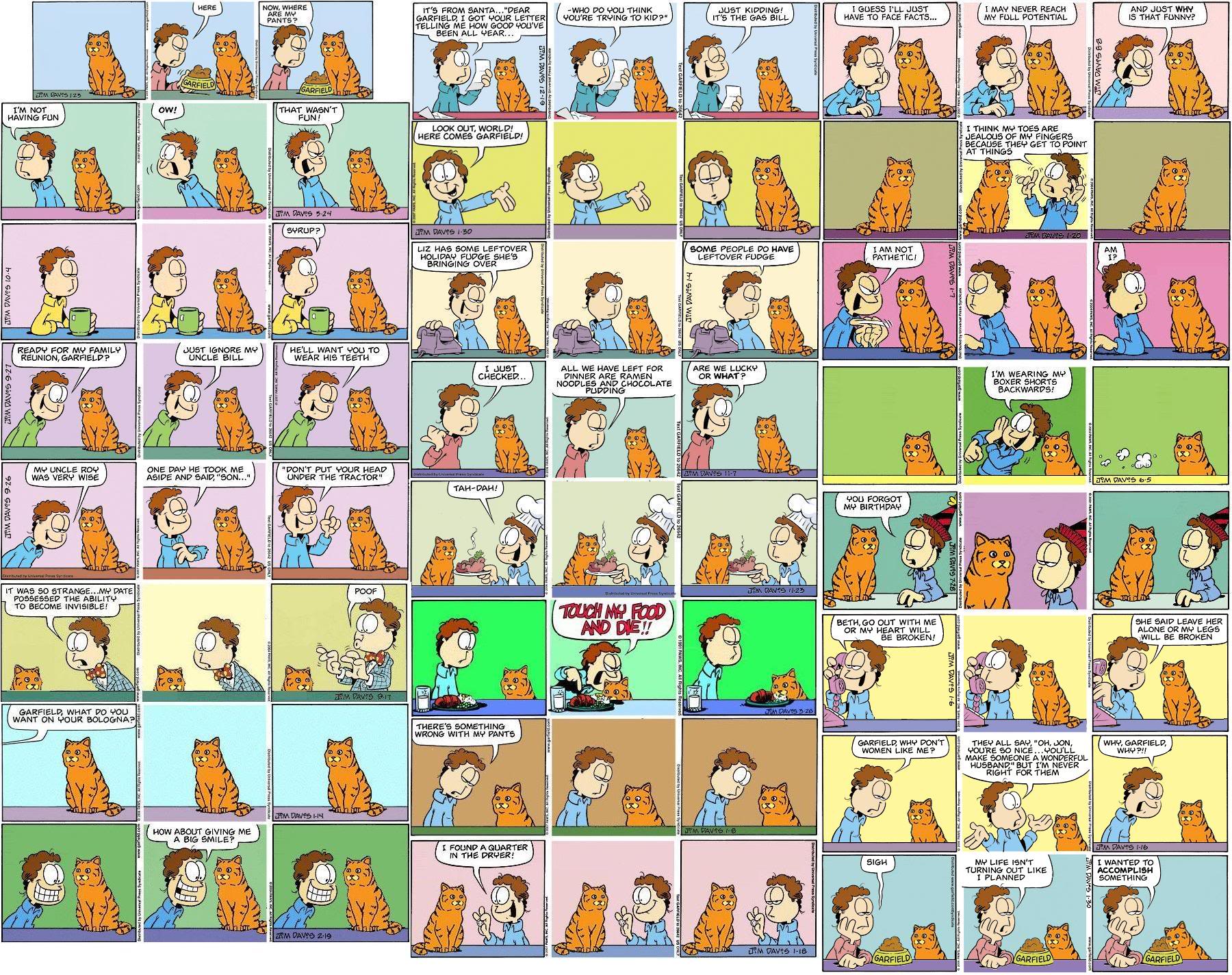
‘Silent Garfield‘ refers to the removal of Garfield’s thought balloons from his comic strips. A webcomic called Arbuckle does the above but also redraws the originals in a different art style. Garfield changes from being a comic about a sassy, corpulent feline, and becomes a compelling picture of a lonely, pathetic, delusional man who talks to his pets.
Another variation along the same lines, called ‘Realfield’ or ‘Realistic Garfield,’ is to redraw Garfield as a real cat as well as removing his thought balloons. Still another approach to editing the strips involves removing Garfield and other main characters from the originals completely, leaving Jon talking to himself, such as in ‘Garfield Minus Garfield’ by Dan Walsh.
Posted in Art, Humor |
Leave a Comment »
January 6, 2011

Místico (b. 1982) is a Mexican Luchador enmascarado, or masked professional wrestler currently working for the lucha libre promotion Consejo Mundial de Lucha Libre (CMLL). Since 2006 Místico has been the main tecnico (good guy) in CMLL and the biggest box office draw in all of Mexico. Místico is Spanish for ‘Mystic,’ a religious ring character who is the storyline protege of the wrestling priest Fray Tormenta.
Posted in Games, Humor |
Leave a Comment »
January 6, 2011

The tomacco is a hybrid of tomato and tobacco plants first described in a 1959 ‘Scientific American’ article. Both plants are members of the same family, Solanaceae or nightshade. The name ‘tomacco’ was given to the plant by Homer Simpson in a 1999 episode of ‘The Simpsons.’ Homer accidentally created it when he planted and fertilized his tomato and tobacco fields with plutonium. The result is a tomato that apparently has a dried, brown tobacco center, and, although being described as tasting terrible by many characters, is also immediately and powerfully addictive.
A Simpsons fan, Rob Baur of Lake Oswego, Oregon, was inspired by the episode. Remembering the article in a textbook, Baur cultivated real tomacco in 2003. The plant produced offspring that looked like a normal tomato, but Baur suspected that it contained a lethal amount of nicotine and thus would be inedible. The tomacco plant bore tomaccoes until it died after 18 months, spending one winter indoors. Baur was featured on audio commentary in the Simpsons Season 11 DVD box set discussing the plant and resulting fame.
Posted in Art, Humor, Science |
Leave a Comment »