January 5, 2011

Andre the Giant Has a Posse is a street art campaign based on a design by Shepard Fairey created in 1989 in Providence, Rhode Island. Distributed by the skater community, the Andre stickers began showing up in many cities across the U.S. Over time the artwork has been reused in a number of ways and spread worldwide, following in the footsteps of World War II icon ‘Kilroy Was Here.’
Threat of a lawsuit from Titan Sports, Inc. in 1994 spurred Fairey to stop using the trademarked name ‘André the Giant,’ and to create a more styled image of the wrestler’s face, now most often with the equally iconic branding OBEY.
read more »
Posted in Art, Humor |
Leave a Comment »
January 5, 2011

They Live is a 1988 film directed by John Carpenter, who also wrote the screenplay under the pseudonym Frank Armitage. The film is based on Ray Nelson’s 1963 short story ‘Eight O’Clock in the Morning.’ Part science fiction horror and part dark comedy, the film echoed contemporary fears of a declining economy, within a culture of greed and conspicuous consumption common among Americans in the 1980s.
In They Live, the ruling class within the moneyed elite are in fact aliens managing human social affairs through the use of a signal on top of the TV broadcast that is concealing their appearance and subliminal messages in mass media. The story revolves around a nameless man referred to as Nada (Roddy Piper), a quiet drifter who finds an unusual pair of sunglasses that allow him to see the aliens and their subliminal messages.
Posted in Art, Humor |
Leave a Comment »
January 3, 2011

A Nice Cup of Tea is an essay by George Orwell, first published in the Evening Standard newspaper in 1946. It is a straight-faced discussion about the craft of making a cup of tea, including his eleven ‘Golden’ rules. Orwell’s rules cover such matters as the best shape for a teacup, the advisability of using water that is still boiling, and his preference for very strong tea.
Posted in Food, Humor, Language |
Leave a Comment »
January 3, 2011

The Coffee Party USA is a grassroots political movement that was formed in January, 2010, as an alternative to the Tea Party movement, and has since grown into an increasingly diverse organization. Its mission states that it is based on the underlying principle that the government is ‘not the enemy of the people, but the expression of our collective will, and that we must participate in the democratic process in order to address the challenges we face as Americans’ Its goals include getting cooperation in government and removing corporate influence from politics.
Posted in Humor, Politics |
Leave a Comment »
January 3, 2011

Flexible glass is a legendary lost invention from the reign of Roman Emperor Tiberius Caesar (between 14 CE-37 CE). As recounted by Archbishop Isadore of Seville, the craftsman who invented the technique brought before Caesar a drinking bowl made of flexible glass, and Caesar threw it to the floor, whereupon the material dented, rather than shattering.
The inventor was able to simply repair the dent with a small hammer. After the inventor swore to the Emperor that he alone knew the technique of manufacture, Caesar had the man beheaded, fearing such material could undermine the value of gold and silver.
Posted in Humor, Technology |
Leave a Comment »
January 3, 2011

The Young Shuffle is a style of running named for Australian potato farmer and athlete, Cliff Young (1922 — 2003). Young won the 544 mile Melbourne Ultramarathon at age 61, running in overalls and gumboots. He grew up on a 2000 acre farm in Beech Forest in south-western Victoria with approximately 2,000 sheep that he roundup on foot. He arrived at the 1983 Melbourne to Sydney ultramarathon as an unknown. He ran at a slow loping pace and trailed the leaders for most of the course, but by denying himself sleep and running while the others slept he slowly gained on them and eventually won by a large margin.
Before running the race he told the press that he had previously run for two to three days straight rounding up sheep. He claimed afterwards that during the race he imagined that he was running after sheep and trying to outrun a storm. The run took him five days, 15 hours and four minutes, trimming almost two days off the record for any previous run between Sydney and Melbourne. All of the six competitors who finished the race broke the previous record, but Young beat them by running while they were sleeping, and by using an ungainly looking, but very energy efficient running style that his since been dubbed the Young Shuffle.
Posted in Games, Humor |
Leave a Comment »
December 23, 2010

TV-B-Gone is a type of simple universal remote control device for turning off a large majority of the current available brands of television sets. It was created to allow people in a public place to turn off nearby television sets, presumably because the broadcast was distracting them from other activities. Its inventor has referred to it as ‘an environmental management device.’
The device is part of a key-chain, and, like other remote devices, is battery-powered. Although it can require up to 69 seconds for the device to find the proper code for a particular television receiver, the most popular televisions turn off in the first few seconds. During the 2008 Consumer Electronics Show, some individuals from gadget blog, Gizmodo brought a TV-B-Gone remote control and shut off many display monitors at booths and during demos affecting several companies. These actions caused the individual from Gizmodo to be banned for life from future CES events.
Posted in Humor, Technology |
Leave a Comment »
December 19, 2010

The New Yorker cover (March 29, 1976) ‘View of the World from 9th Avenue,’ has come to represent Manhattan’s telescoped interpretation of the country beyond the Hudson River. The cartoon showed the supposedly limited mental geography of Manhattanites. The image shows Manhattan’s 9th Avenue, 10th Avenue, and the Hudson River (appropriately labeled), while the top half depicts the rest of the world. The rest of the United States is drawn as a square, with a thin brown strip along the Hudson representing New Jersey, the names of five cities (Los Angeles, Washington D.C., Las Vegas, Kansas City, and Chicago) and three states (Texas, Utah, and Nebraska) are scattered among a few rocks for the U.S. beyond New Jersey.
The Pacific Ocean, perhaps twice as wide again as the Hudson, separates the U.S. from three flattened land masses labeled China, Japan, and Russia. The illustration, depicting New Yorkers’ self-image, inspired many similar works, including the poster for the 1984 film Moscow on the Hudson; that movie poster led to a lawsuit, Steinberg v. Columbia Pictures Industries, Inc., 663 F. Supp. 706 (S.D.N.Y. 1987), which held that Columbia Pictures violated the copyright that Steinberg held on his work. Another homage was created for the cover of The Economist newspaper’s March 21–27, 2009 issue entitled ‘How China sees the world.’
Posted in Art, Humor, Politics |
Leave a Comment »
December 17, 2010
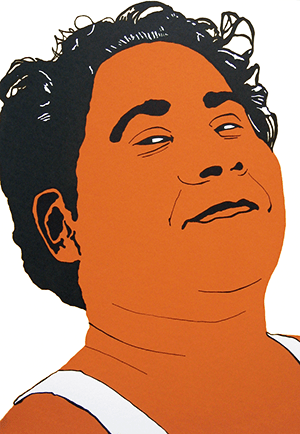
Oscar Zeta Acosta (1935 – disappeared 1974) was an American attorney, politician, and minor novelist, perhaps best known for his friendship with the American author Hunter S. Thompson, who characterized him as his Samoan Attorney, Dr. Gonzo, in his novel ‘Fear and Loathing in Las Vegas.’ In 1967, Acosta began working as an antipoverty attorney for the East Legal Aid Society in Oakland, California. In 1968 he moved to East Los Angeles and joined the Chicano Movement as an activist attorney. His controversial defense earned him the ire of the LAPD, who considered the ‘Brown Pride’ movement more dangerous than the Black Panthers.
In the summer of 1967 Acosta met Hunter S. Thompson, who would write an article on Acosta and the injustice in the barrios of East L.A. for ‘Rolling Stone’ in 1971 titled ‘Strange Rumblings in Aztlan.’ When working on the article, Thompson and Acosta visited Las Vegas (inspiring Hunter’s later novel on the city). In 1972, Acosta disappeared while traveling in Mexico. His son, Marco Acosta, believes that he was the last person to talk to his father. In May 1972, Acosta telephoned his son, telling him that he was ‘about to board a boat full of white snow.’ Marco is later quoted in reference to his father’s disappearance: ‘The body was never found, but we surmise that probably, knowing the people he was involved with, he ended up mouthing off, getting into a fight, and getting killed.’
Posted in Drugs, Humor, Politics |
Leave a Comment »
December 17, 2010
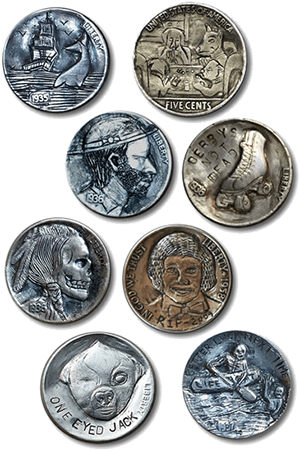
The hobo nickel is a sculptural art form involving the creative modification of small-denomination coins, essentially resulting in miniature bas reliefs. The nickel, because of its size, thickness, and relative softness, was a favored coin for this purpose. Due to its low cost and portability, this medium was particularly popular among hobos, hence the name. Common hobo nickels sell for $5 or $10, and rarer or more desirable coins sell for hundreds of dollars.
read more »
Posted in Art, Humor, Money |
Leave a Comment »
December 10, 2010

Transmetropolitan is a cyberpunk comic book series written by Warren Ellis with art by Darick Robertson and published by DC Comics. It chronicles the battles of Spider Jerusalem, infamous renegade gonzo journalist of the future, an homage to gonzo journalism founder Hunter S. Thompson. Jerusalem dedicates himself to fighting the corruption and abuse of power of two successive United States presidents; he strives to keep his world from turning more dystopian than it already is while dealing with the struggles of fame and power.
Posted in Art, Humor |
Leave a Comment »
December 10, 2010

Gonzo journalism is a style of journalism that is written subjectively, often including the reporter as part of the story via a first-person narrative. The word Gonzo was first used in 1970 to describe an article by Hunter S. Thompson, who later popularized the style. The term has since been applied to other subjective artistic endeavors.
Gonzo journalism tends to favor style over accuracy and often uses personal experiences and emotions to provide context for the topic or event being covered. It disregards the ‘polished’ edited product favored by newspaper media and strives for a more gritty approach. Use of quotations, sarcasm, humor, exaggeration, and profanity is common.
read more »
Posted in Humor, Language, Politics |
Leave a Comment »





