November 30, 2010

Anti-humor (also known as unjokes) are a kind of humor based on the surprise factor of absence of an expected joke or of a punch line in a narration which is set up as a joke. This kind of anticlimax is similar to that of the shaggy dog story. In anti-comedy the gist of the humor is in how poor the joke is or how poorly it was told. A popular kind of unjoke involves any seemingly humorous setup leading to the non-sequitur punchline of ‘No soap, radio’ or the joke ‘A man walks into a bar. He is an alcoholic and it’s destroying his family.’ Another form of anti-humor is poking fun at bad humor by the way of parody. An example is Jim’s Journal, a comic strip by Scott Dikkers, co-founder of The Onion, whose four-panel strips end without any sort of punchline.
Alternative comedy, among its other aspects, parodies the traditional idea of the joke as a form of humor. Andy Kaufman saw himself as a practitioner of anti-humor. Other comedians known for their anti-humor are Tim and Eric of Tim and Eric Awesome Show, Great Job!, Norm Macdonald, Ted Chippington, Neil Hamburger, Corey Mystyshyn, Jimmy Carr, and Bill Bailey.
Posted in Humor |
Leave a Comment »
November 30, 2010

Two elephants are sitting in the bathtub. One elephant says to the other, ‘Pass the soap.’
The elephant replies to the other elephant, ‘No soap, radio!‘
read more »
Posted in Humor, Science |
Leave a Comment »
November 18, 2010

Troma Entertainment is an American independent film production and distribution company founded by Lloyd Kaufman and Michael Herz in 1974. The company produces low-budget independent movies that play on 1950s horror with elements of farce. Many Troma films contain social commentary and have developed cult followings. Troma films are B-movies known for their surrealistic nature, along with their use of shocking imagery. They typically contain overt sexuality, graphic violence, gore and nudity, so much that the term ‘Troma Film’ has become synonymous with these characteristics.
Troma’s slogan is ‘Movies of the Future.’ Troma is also known for reusing the same props, actors, and scenes over and over again. Examples include a severed leg, a penis Monster, and the flipping/exploding car filmed for the movie ‘Sgt. Kabukiman, NYPD,’ which is used in place of any other car that needs to crash and explode. Troma produced or acquired many early films featuring several rising talents, such as Carmen Elektra (‘The Chosen One’), Billy Bob Thornton (‘Chopper Chicks in Zombietown’), Vanna White (‘Graduation Day’), Kevin Costner (‘Sizzle Beach, U.S.A.’), Samuel L. Jackson (‘Def by Temptation’), Marisa Tomei (‘The Toxic Avenger’), Vincent D’Onofrio (‘The First Turn-On!’), ‘Paul Sorvino’ (Cry Uncle), Trey Parker and Matt Stone (‘Cannibal! The Musical’), before they were discovered.
Posted in Art, Humor, Money |
Leave a Comment »
November 18, 2010
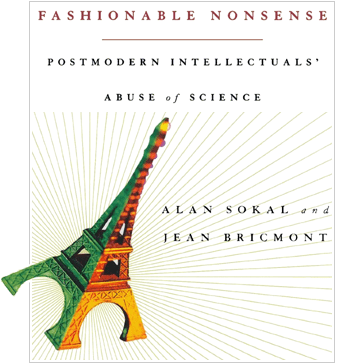
The Sokal affair was a publishing hoax perpetrated by Alan Sokal, a physics professor at New York University. In 1996, Sokal submitted an article to Social Text, an academic journal of postmodern cultural studies. The submission was an experiment to test the magazine’s intellectual rigor and, specifically, to learn if such a journal would ‘publish an article liberally salted with nonsense if it (a) sounded good and (b) flattered the editors’ ideological preconceptions.’
read more »
Posted in Humor, Language, Science |
Leave a Comment »
November 16, 2010

Principia Discordia is a Discordian religious text written by Greg Hill (Malaclypse The Younger) and Kerry Thornley (Omar Khayyam Ravenhurst). It was originally published under the title ‘Principia Discordia or How The West Was Lost’ in a limited edition of 5 copies in 1965. Discordianism is a religion centered on the idea that chaos is all that there is, and that disorder and order are both illusions that are imposed on chaos. There is some division as to whether it should be regarded as a parody religion, and if so to what degree.
It has been called ‘Zen for roundeyes,’ based on similarities with absurdist interpretations of the Rinzai school of Buddhism. Discordianism recognizes chaos, discord, and dissent as valid and desirable qualities, in contrast with most religions, which idealize harmony and order. While the Principia is full of literal contradictions and unusual humor, it contains several passages which propose that there is serious intent behind the work. Saints identified include Emperor Norton, Yossarian, Don Quixote, and Bokonon.
Posted in Humor, Language, Philosophy |
1 Comment »
November 16, 2010


Fnord is the typographic representation of disinformation or irrelevant information intending to misdirect, with the implication of a worldwide conspiracy. The word was coined as a nonsensical term with religious undertones in the Discordian religious text Principia Discordia (1965) by Kerry Thornley and Greg Hill, but was popularized by The Illuminatus! Trilogy (1975) of satirical conspiracy fiction novels by Robert Shea and Robert Anton Wilson.
read more »
Posted in Humor, Language, Philosophy |
Leave a Comment »
November 16, 2010

Kilgore Trout is a fictional character created by author Kurt Vonnegut. He was originally created as a fictionalized version of author Theodore Sturgeon (Vonnegut’s colleague in the genre of science fiction), although Trout’s consistent presence in Vonnegut’s works has also led critics to view him as the author’s own alter ego.
Trout, who has supposedly written over 117 novels and over 2000 short stories, is usually described as an unappreciated science fiction writer whose works are used only as filler material in pornographic magazines. However, he does have at least three fans: Eliot Rosewater and Billy Pilgrim—both Vonnegut characters—have a near-complete collection of Trout’s work or have read most of his work.
read more »
Posted in Art, Humor |
Leave a Comment »
November 15, 2010
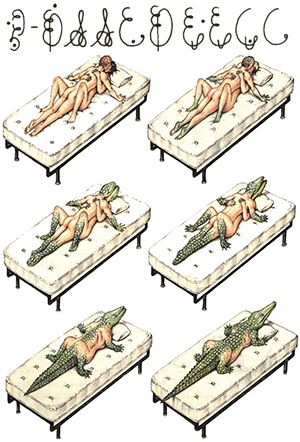

The Codex Seraphinianus is a book written and illustrated by the Italian artist, architect and industrial designer Luigi Serafini during thirty months, from 1976 to 1978. The book is a visual encyclopedia of an unknown world, written in one of its languages, a thus-far undeciphered alphabetic writing. The Codex is divided into eleven chapters, partitioned into two sections. The first section appears to describe the natural world, dealing with flora, fauna, and physics. The second deals with the humanities, the various aspects of human life: clothing, history, cuisine, architecture and so on. The illustrations are often surreal parodies of things in our world: bleeding fruit; a plant that grows into roughly the shape of a chair and is subsequently made into one; a lovemaking couple that metamorphoses into an alligator; etc.
The language of the codex has defied complete analysis by linguists for decades. The number system used for numbering the pages, however, has been discovered to be a variation of base 21. In a talk at the Oxford University Society of Bibliophiles held in 2009, Serafini stated that the script of the Codex is asemic, that his own experience in writing it was closely similar to automatic writing, and that what he wanted his alphabet to convey to the ‘reader’ is the sensation that children feel in front of books they cannot yet understand, although they see that their writing does make sense for grown-ups.
Posted in Art, Humor, Language |
2 Comments »
November 10, 2010

The term ‘Fucking New Guy‘ (FNG) is a derogatory term for new recruits, made popular by US troops in the Vietnam war. Every unit had an FNG, and the term was used across all unit types, from front line combat through to support and medical units. The term was not gender specific; female personnel could be FNGs as well.
FNGs were an important part of the group dynamic of US units in Vietnam and their treatment had at its core an overall sense of ‘us’ (those with experience of the war) and ‘them’ (those who were back in the United States). As one soldier said, FNGs were ‘still shitting stateside chow.’ It was in combat units that the FNG was truly ignored and hated by his colleagues. An FNG in a combat unit was ‘treated as a non-person, a pariah to be shunned and scorned, almost vilified, until he passed that magic, unseen line to respectability.’
read more »
Posted in Humor, Language, War |
Leave a Comment »
November 9, 2010

Jay Pinkerton (born June 15, 1977) is a nationally published humorist and a former editor of both CRACKED.com and Cracked magazine. Prior to joining Cracked, Pinkerton served as the managing editor of NationalLampoon.com. Since joining Cracked, Pinkerton has helped make CRACKED.com a leading comedy site, including by bringing in new contributors.
Jay Pinkerton initially registered his website, Jaypinkerton.com, to be a portfolio of his comedy and artwork. Afterwards, Pinkerton joined the forums of the Internet humor website ‘Pointless Waste of Time’ (PWOT), and took the attention of the site’s owner, David Wong, with whom Pinkerton worked with on a series of comedy articles. It was around this time that he first published his redone Spider-Man comics, spawning an Internet phenomenon. In addition to Cracked, Pinkerton’s work has also appeared on McSweeney’s Internet Tendency, Modern Humorist, CollegeHumor.com and numerous other sites. He has also been hired by Valve Software to write some of the sequel to Portal, Portal 2.
Posted in Art, Humor |
Leave a Comment »
November 9, 2010
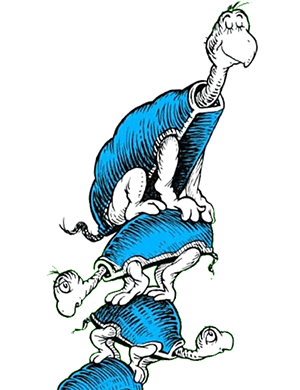
‘Turtles all the way down‘ is a jocular expression of the infinite regress problem in cosmology. The joke goes as follows: An Eastern guru affirms that the earth is supported on the back of a tiger. When asked what supports the tiger, he says it stands upon an elephant; and when asked what supports the elephant he says it is a giant turtle. When asked, finally, what supports the giant turtle, he is briefly taken aback, but quickly replies ‘Ah, after that it is turtles all the way down.’
The phrase was popularized by Stephen Hawking in 1988. The ‘turtle’ metaphor in the anecdote represents a popular notion of a primitive cosmological myth, viz. the flat earth supported on the back of a World Turtle.
Posted in Humor, Philosophy |
Leave a Comment »
November 9, 2010

Easter eggs are hidden messages, in-jokes or features in things like video games, web sites, DVDs and other media. For example, the HP 54622D, a professional oscilloscope, has an ‘Asteroids’ clone called ‘Rocks’ that can be accessed by entering a secret sequence of buttons. Google Maps contains an easter egg whereby a user asking for directions from Japan to China would be directed to jetski across the Pacific Ocean.
read more »
Posted in Games, Humor, Technology |
Leave a Comment »




 The Daily Omnivore