February 27, 2011

Sehnsucht is a German noun translated as ‘longing,’ ‘yearning’ and ‘craving,’ or in a wider sense a type of ‘intensely missing.’ The word is almost impossible to translate adequately and describes a deep emotional state. Its meaning is somewhat similar to the Portuguese word, ‘saudade.’ The stage director and author Georg Tabori called Sehnsucht one of those quasi-mystical terms in German for which there is no satisfactory corresponding term in another language.
The term is a compound word, originating from an ardent longing or yearning (‘das Sehnen’) and addiction (‘die Sucht’). However, these words do not adequately encapsulate the full meaning of their resulting compound, even when considered together.
read more »
Posted in Language, Philosophy, World |
Leave a Comment »
February 27, 2011

A third-culture kid (TCK) is someone who, as a child, has spent a significant period of time in one or more culture(s) other than his or her own, thus integrating elements of those cultures and their own birth culture, into a third culture. TCKs tend to have more in common with one another, regardless of nationality, than they do with non-TCKs from their passport country. TCKs are often multilingual and highly accepting of other cultures. Although moving between countries may become an easy thing for some TCKs, after a childhood spent in other cultures, adjusting to their passport country often takes years.
Before World War II, 66% of TCKs came from missionary families, and 16% came from business families. After World War II, with the increase of international business and the rise of two international superpowers, the composition of international families changed. Sponsors are generally broken down into five categories: missionary (17%), business (16%), government (23%), military (30%), and “other” (14%). Some TCK families migrate for work independently of any organization based in their country of origin.
Posted in Language, Politics, World |
Leave a Comment »
February 27, 2011
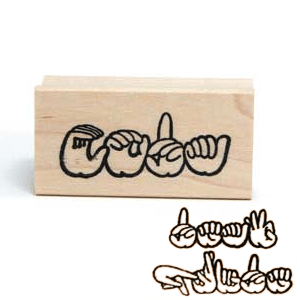
A child of a deaf adult, often known by the acronym CODA, is a person who was raised by a deaf parent or guardian. Many CODAs identify with both deaf and hearing cultures. The organization CODA (Children of Deaf Adults) was established in 1983 for hearing children of deaf adults in the United States. CODA began hosting annual conferences in 1986, in Fremont, California. The conferences have grown, taking on an international status with attendees hailing from worldwide.
Posted in Health, Language, Politics |
Leave a Comment »
February 27, 2011

In business, economics or investment, market liquidity is an asset’s ability to be sold without causing a significant movement in the price and with minimum loss of value. Money, or cash in hand, is the most liquid asset, and can be used immediately to perform economic actions like buying, selling, or paying debt, meeting immediate wants and needs. An act of exchange of a less liquid asset with a more liquid asset is called liquidation. Liquidity also refers both to a business’s ability to meet its payment obligations, in terms of possessing sufficient liquid assets, and to such assets themselves.
Posted in Language, Money |
Leave a Comment »
February 24, 2011

Gadsby: A Story of Over 50,000 Words Without Using the Letter ‘E’ is a 1939 novel by Ernest Vincent Wright. The plot revolves around the dying fictional city of Branton Hills, which is revitalized thanks to the efforts of protagonist John Gadsby and a youth group he organizes. The novel is written as a lipogram: a constrained writing or word game consisting of writing paragraphs or longer works in which a particular letter or group of letters is avoided. Though self-published and little-noticed in its time, the book is a favorite of fans of constrained writing and is a sought-after rarity among some book collectors.
Posted in Art, Language |
Leave a Comment »
February 24, 2011

Retroactive continuity (often shortened to retcon) refers to the alteration of previously established facts in a literary work. Retcons may be carried out for a variety of reasons, such as to accommodate sequels or further derivative works in the same series, to reintroduce popular characters, to resolve chronological issues, to reboot a familiar series for modern audiences, or to simplify an excessively complex continuity structure.
Retcons are common in pulp fiction, especially comic books published by long-established houses such as DC, Marvel and leading manga publishers. The long history of popular titles and the plurality of writers who contribute stories can often create situations that demand clarification or revision of exposition. Retcons appear as well in soap operas, serial drama, movie sequels, professional wrestling, video games, radio series, and other kinds of serial fiction.
Posted in Art, Language |
Leave a Comment »
February 24, 2011

Vertebral [vur-tuh-bruhl] subluxation [suhb-luhk-sey-shuhn] is a controversial term that is commonly used by chiropractors to describe signs and symptoms of the spinal column. The chiropractic vertebral subluxation complex has been a source of controversy since its inception in 1895 due to its metaphysical origins and claims of far reaching effects on health and disease. Although some in the chiropractic profession reject the concept of subluxation and shun the use of this term as a diagnosis, its current and officially accepted status by the profession has been repeatedly confirmed.
In 2010 the General Chiropractic Council, the statutory regulatory body for chiropractors in the United Kingdom, issued guidance for chiropractors stating that the chiropractic vertebral subluxation complex ‘is not supported by any clinical research evidence that would allow claims to be made that it is the cause of disease or health concerns.’ A similar stance is taken by the National Health Service: ‘There is also no scientific evidence to support the idea that most illness is caused by misalignment of the spine.’
Posted in Health, Language, Science |
Leave a Comment »
February 24, 2011
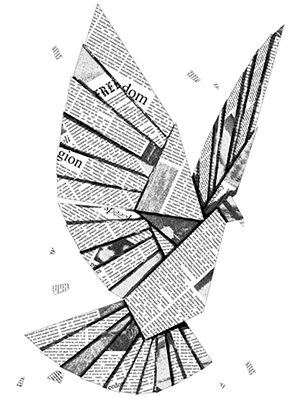
The concept of the Fourth Estate is a societal or political force or institution whose influence is not consistently or officially recognized. It now most commonly refers to the news media; especially print journalism. Thomas Carlyle attributed the origin of the term to Edmund Burke, who used it in a parliamentary debate in 1787 on the opening up of press reporting of the House of Commons of the United Kingdom. Earlier writers have applied the term to lawyers, to the queen of England (acting as a free agent, independent of the king), and to the proletariat.
Posted in Language, Politics |
Leave a Comment »
February 24, 2011
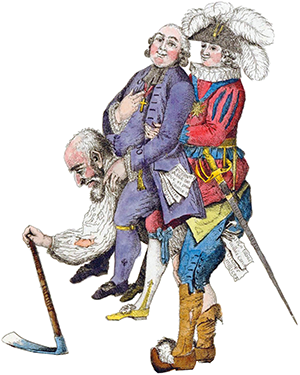
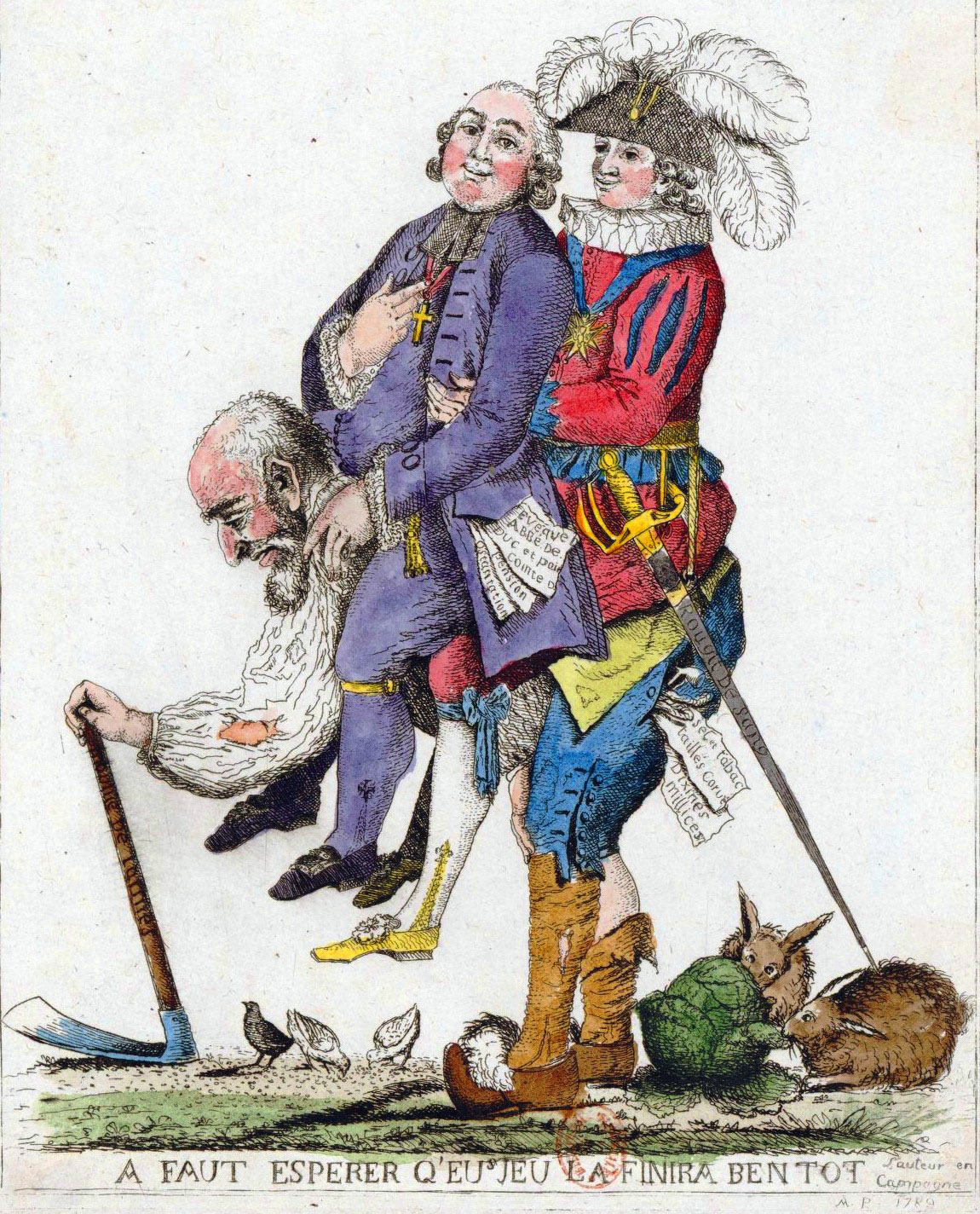
Estates of the realm were the broad divisions of a hierarchically conceived society in the Middle Ages and in Early Modern Europe. The first estate was typically the clergy, the second estate was the nobility, and the third estate was the commoners. While various realms inverted the order of the first two, commoners were universally tertiary, and often further divided into burghers (also known as bourgeoisie) and peasants; in some regions, there also was a population outside the estates.
An estate was usually inherited and based on occupation, similar to a caste. Legislative bodies or advisory bodies to a monarch were traditionally grouped along lines of these estates, with the monarch above all three estates. Meetings of the estates of the realm became early legislative and judicial parliaments. Monarchs often sought to legitimize their power by requiring oaths of fealty from the estates.
Posted in Language, Money, Politics |
Leave a Comment »
February 24, 2011
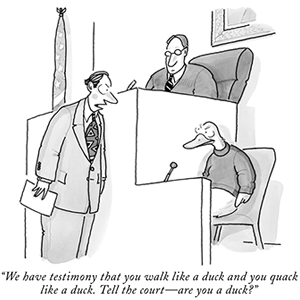
The duck test is a humorous term for a form of inductive reasoning. This is its usual expression: If it looks like a duck, swims like a duck, and quacks like a duck, then it probably is a duck. The test implies that a person can identify an unknown subject by observing that subject’s habitual characteristics. It is sometimes used to counter abstruse arguments that something is not what it appears to be.
Indiana poet James Whitcomb Riley (1849–1916) is sometimes credited with coining the phrase. The term was later popularized in the United States by Richard Cunningham Patterson Jr., United States ambassador to Guatemala during the Cold War in 1950, who used the phrase when he accused the Jacobo Arbenz Guzmán government of being Communist.
Posted in Humor, Language |
Leave a Comment »
February 24, 2011
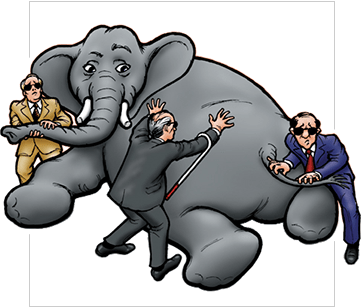
The term elephant test refers to situations in which an idea or thing ‘is hard to describe, but instantly recognizable when spotted.’ The term is often used in legal cases when there is an issue which may be open to interpretation, such as in the case of Cadogan Estates Ltd v Morris, when Lord Justice Stuart-Smith referred to ‘the well known elephant test. It is difficult to describe, but you know it when you see it.’
Posted in Humor, Language, Politics |
2 Comments »
February 24, 2011
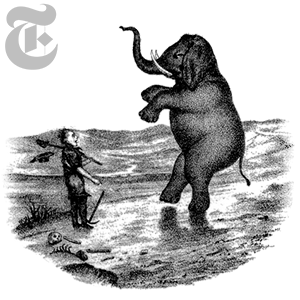
The phrase ‘seeing the elephant‘ is an Americanism of the mid to late 19th century. Those planning to travel west announced they were ‘going to see the elephant.’ Those turning back claimed they had seen the ‘elephant’s tracks’ or the ‘elephant’s tail,’ and confessed they’d seen more than enough of the animal. The expression is said to arise from a tale current when circus parades first featured elephants. A farmer, so the story went, hearing that a circus was in town, loaded his wagon with vegetables for the market there. He had never seen an elephant and very much wished to. On the way to town he encountered the circus parade, led by an elephant. The farmer was thrilled. His horses, however, were terrified.
Bolting, they overturned the wagon and ruined the vegetables. ‘I don’t give a hang,’ the farmer said, ‘for I have seen the elephant.’ The elephant symbolized both the high cost of their endeavor — the myriad possibilities for misfortune on the journey or in California — and, like the farmer’s circus elephant, an exotic sight, and unequaled experience, the adventure of a lifetime. As early as the 1590s, the English used the idiom to ‘see the lions.’ This referred to the Tower of London which is thought to have been one of the world’s oldest zoos. Travelers and visitors were hopeful for a glimpse of the animals, especially the lion which was the living emblem of the king.
Posted in Language, World |
Leave a Comment »



 The Daily Omnivore