February 21, 2011


A platonic [pluh-ton-ik] solid is a three dimensional shape where each face is built from the same type of polygons, and there are the same number of polygons meeting at every corner of the shape. There are only five Platonic Solids: Tetrahedron, Cube, Hexahedron, Octahedron, Dodecahedron, and Isosahedron. The shapes are often used to make dice, because dice of these shapes can be made fair. 6-sided dice are very common, but the other numbers are commonly used in role-playing games. Such dice are commonly referred to as D followed by the number of faces (d8, d20 etc.).
The tetrahedron (4 sided), cube (6 sided), and octahedron (8 sided), are found naturally in crystal structures. In meteorology and climatology, global numerical models of atmospheric flow are of increasing interest which use grids that are based on an icosahedron (20 sides,refined by triangulation) instead of the more commonly used longitude/latitude grid. This has the advantage of better spatial resolution without singularities (i.e. the poles) at the expense of somewhat greater numerical difficulty.
Posted in Art, Language, Science |
Leave a Comment »
February 21, 2011

Lucy Temerlin (1964–1987) was a chimpanzee owned by the Institute for Primate Studies in Oklahoma, and raised by Maurice K. Temerlin, Ph.D., a psychotherapist and professor at the University of Oklahoma and his wife, Jane W. Temerlin.
read more »
Posted in Language, Science, Sex |
1 Comment »
February 21, 2011

A slush or a slushie is a flavored frozen drink. Frozen carbonated beverages, typified by the Slurpee or ICEE, are made by freezing a carbonated drink. These machines are complicated and expensive, and notably require a carbon dioxide supply. They make a very fine and ‘dry’ slush. Frozen uncarbonated beverages are made by freezing a non-carbonated juice or liquid. These machines do not require a pressure chamber, and so are much cheaper and easier to maintain. They make a slightly wetter slush. They are notable in the wide variety of drinks they create, including coffee-flavored ices and alcoholic drinks like margaritas and daiquiris.
Conventional slush drinks, typified by the Slush Puppie, use a single slurry made by freezing a sweetened base, similar to apple juice. This slurry is mixed at serving time with a flavoring syrup. These drinks are notable in that the flavored syrup can be drawn out of the drink, leaving a relatively-unflavoured base ice behind. ‘Instant’ slush drinks (beverages that turn to slush upon opening) are formed via supercooling (e.g. Slush-It!, the Chill Chamber which allows businesses to store beverages at below freezing temperatures, and supercooled Sprite from Coca-Cola which required special vending machines).
Posted in Food, Language, Money |
Leave a Comment »
February 21, 2011

Canard [kuh-nahrd] is the French word for duck. The word also can mean an unfounded or false, deliberately misleading fabrication, a false report, rumor or hoax. That usage derives from the phrase ‘vendre un canard à moitié’ (‘to half-sell a duck’), thus, from some long-forgotten joke, ‘to cheat.’ The Canard Digérateur, or Digesting Duck, was an automaton in the form of a duck, created in 1739 by Jacques de Vaucanson (the French inventor credited with creating the world’s first true robots, as well as the first automated loom).
The mechanical duck appeared to have the ability to eat kernels of grain, and to metabolize and defecate them. While the duck did not actually have the ability to do this – the food was collected in one inner container, and the pre-stored feces was ‘produced’ from a second, so that no actual digestion took place – Vaucanson hoped that a truly digesting automaton could one day be designed.
Posted in Art, Language, Technology |
Leave a Comment »
February 20, 2011

Small Is Beautiful: Economics As If People Mattered is a collection of essays by British economist E. F. Schumacher. It is often used to champion small, appropriate technologies that are believed to empower people more, in contrast with phrases such as ‘bigger is better.’ First published in 1973, ‘Small Is Beautiful’ brought Schumacher’s critiques of Western economics to a wider audience during the 1973 energy crisis and emergence of globalization.
Schumacher argues that the modern economy is unsustainable. Natural resources (like fossil fuels), are treated as expendable income, when in fact they should be treated as capital, since they are not renewable, and thus subject to eventual depletion. He further argues that nature’s resistance to pollution is limited as well. He concludes that government effort must be concentrated on sustainable development.
Posted in Language, Money, Politics |
Leave a Comment »
February 20, 2011

‘Wicked problem‘ is a phrase originally used in social planning to describe a problem that is difficult or impossible to solve because of incomplete, contradictory, and changing requirements that are often difficult to recognize. Moreover, because of complex interdependencies, the effort to solve one aspect of a wicked problem may reveal or create other problems.
A problem whose solution requires a great number of people to change their mindsets and behavior is likely to be a wicked problem. Therefore, many standard examples of wicked problems come from the areas of public planning and policy. These include global climate change, natural hazards, healthcare, the AIDS epidemic, pandemic influenza, international drug trafficking, homeland security, nuclear weapons, and nuclear energy and waste.
Posted in Language, Money, Politics |
Leave a Comment »
February 20, 2011

‘Bread and Circuses‘ (Latin: panem et circenses) is a metaphor for a superficial means of appeasement. In the case of politics, the phrase is used to describe the creation of public approval, not through exemplary or excellent public service or public policy, but through the mere satisfaction of the immediate, shallow requirements of a populace. The phrase also implies the erosion or ignorance of civic duty amongst the concerns of the common man (l’homme moyen sensuel).
In modern usage, the phrase has become an adjective to deride a populace that no longer values civic virtues and the public life. To many across the political spectrum, left and right, it connotes the triviality and frivolity that in popular culture is supposed to have characterized the Roman Empire prior to its decline.
Posted in Language, Money, Politics |
Leave a Comment »
February 17, 2011
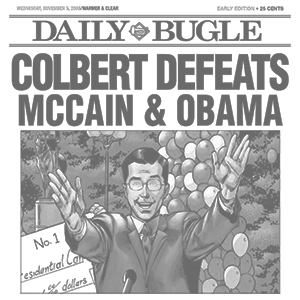
Satire is a literary genre where vices, follies, abuses, and shortcomings are held up to ridicule, ideally with the intent of shaming individuals, and society itself, into improvement. Although satire is usually meant to be funny, its greater purpose is often constructive social criticism, using wit as a weapon.
A common feature of satire is strong irony or sarcasm, but parody, burlesque, exaggeration, juxtaposition, comparison, analogy, and double entendre are all frequently used in satirical speech and writing as well. Satire is not possible under dictatorships. It was not allowed, for example, in the Soviet Union. Anyone trying to make fun of Stalin would have been put to death immediately.
Posted in Humor, Language, Politics |
Leave a Comment »
February 17, 2011
The Droste [dro-st] effect is a specific kind of recursive picture, one that in heraldry is termed ‘mise en abyme’ (French for ‘placing into infinity’). An image exhibiting the Droste effect depicts a smaller version of itself in a place where a similar picture would realistically be expected to appear. This smaller version then depicts an even smaller version of itself in the same place, and so on. Only in theory could this go on forever; practically, it continues only as long as the resolution of the picture allows, which is relatively short, since each iteration geometrically reduces the picture’s size.
The effect is named after the image on the tins and boxes of Droste cocoa powder, one of the main Dutch brands, which displayed a nurse carrying a serving tray with a cup of hot chocolate and a box with the same image. This image, introduced in 1904 and maintained for decades with slight variations, became a household notion.
Posted in Art, Language, Science |
Leave a Comment »
February 17, 2011

Dualism is the idea or theory that something (an object, an idea or the whole world) is split into two parts. These parts are separate from each other and the thing cannot be divided up into any other way. The idea or theory that something cannot be split into any parts is called monism. The idea that something can be split into many parts is called pluralism.
read more »
Posted in Language, Philosophy |
Leave a Comment »
February 16, 2011


Stuckism is an international art movement that was founded in 1999 by Billy Childish and Charles Thomson to promote figurative painting in opposition to conceptual art. The charter group of thirteen British artists has since expanded, as of January 2011, to 209 groups in 48 countries. Although painting is the dominant artistic form of Stuckism, artists using other media such as photography, sculpture, film and collage have also joined, and share the Stuckist opposition to conceptualism.
The name ‘Stuckism’ was coined in January 1999 by Charles Thomson in response to a poem recited to him several times by Billy Childish, who records in it that his former girlfriend, Tracey Emin had said he was “stuck! stuck! stuck!” with his art, poetry and music. Later that month, Thomson approached Childish with a view to co-founding an art group called Stuckism.
Posted in Art, Language |
Leave a Comment »
February 16, 2011

A wildcat strike is a strike action taken by workers without the authorization of their trade union officials. This is sometimes termed unofficial industrial action. Wildcat strikes were the key fighting strategy during the events of May 1968 in France, during which the country saw its largest general strike, resulting in the economy coming to a virtual standstill.
The strike involved eleven million workers for a continuous two weeks, and its impact was such that it almost caused the collapse of President Charles de Gaulle’s government. Groups revolted against modern consumer and technical society and embraced left-wing positions that were critical of authoritarianism and Western capitalism.
Posted in Language, Money, Politics |
Leave a Comment »



