January 29, 2011

The Valknut (Old Norse for ‘slain warriors knot’) is a symbol consisting of three interlocked triangles, and appears on various Germanic objects. A number of theories have been proposed for its significance. The name is an unattested modern invention used to describe the symbol, and was not used contemporaneously when the symbol was used. The Valknut has been compared to the three-horned symbol found on the 9th century Snoldelev runestone and may be related to it.
The symbol plays a role in modern Germanic Neopagan faiths, where numerous explanations and interpretations of the symbol are given. The Swedish paper manufacturer Svenska Cellulosa Aktiebolaget uses a triquetra Valknut as their logo. The symbol has also been used by a number of neo-Nazi groups. It is also represented in the Deutscher Fußball-Bund logo for the Germany national football team.
Posted in Art, Language, Philosophy |
Leave a Comment »
January 29, 2011

Islamism is a set of ideologies holding that Islam is not only a religion but also a political system; that modern Muslims must return to the roots of their religion, and unite politically. It is a controversial term and definitions sometimes vary. Leading Islamist thinkers emphasized the enforcement of sharia (Islamic law) on Muslims; of pan-Islamic political unity; and of the elimination of non-Muslim, particularly western military, economic, political, social, or cultural influences in the Muslim world, which they believe to be incompatible with Islam.
Some observers suggest Islamism’s tenets are less strict and can be defined as a form of identity politics or support for Muslim authenticity, broader regionalism, and revivalism. Still others define it as an Islamic militant, anti-democratic movement, bearing a holistic vision of Islam whose final aim is the restoration of the ‘caliphate.’ Many described as ‘Islamists’ disfavor the term, and claim their political beliefs and goals are simply an expression of Islamic religious belief. Similarly, some scholars favor the term activist ‘Political Islam’ instead.
Posted in Language, Philosophy, Politics |
Leave a Comment »
January 28, 2011

A Mickey Finn (or simply Mickey) is a slang term for a drink laced with a drug (especially chloral hydrate) given to someone without their knowledge in order to incapacitate them. Serving someone a Mickey Finn is most commonly referred to as ‘slipping a mickey.’ The practice is most likely named for the bartender of a Chicago establishment, the Lone Star Saloon and Palm Garden Restaurant.
In December 1903, several newspapers document that a Michael ‘Mickey’ Finn managed the Lone Star Saloon and was accused of using knockout drops to incapacitate and rob some of his customers. Moreover, the first known written example (according to the Oxford English Dictionary) of the use of the term Mickey Finn is in 1915, twelve years after his trial, lending credence to this theory of the origination of the phrase.
Posted in Drugs, Health, Language |
Leave a Comment »
January 28, 2011

To grok is to share the same reality or line of thinking with another physical or conceptual entity. Author Robert A. Heinlein coined the term in his best-selling 1961 book ‘Stranger in a Strange Land.’ Grokking is the intermingling of intelligence that necessarily affects both the observer and the observed. According to the novel: ‘Grok means to understand so thoroughly that the observer becomes a part of the observed—to merge, blend, intermarry, lose identity in group experience. It means almost everything that we mean by religion, philosophy, and science—and it means as little to us (because of our Earthly assumptions) as color means to a blind man.’
To grok something is both to comprehend (relate intellectually) and to apprehend (relate emotionally and spiritually) its quiddity, its essence, its being. In an ideological context, a grokked concept becomes part of the person who contributes to its evolution by improving the doctrine, perpetuating the myth, espousing the belief, adding detail to the social plan, refining the idea or proving the theory.
Posted in Education, Language, Philosophy |
Leave a Comment »
January 26, 2011

In computer terminology, a honeypot is a trap set to detect, deflect, or in some manner counteract attempts at unauthorized use of information systems. Generally it consists of a computer, data, or a network site that appears to be part of a network, but is actually isolated and monitored, and which seems to contain information or a resource of value to attackers.
A honeypot is valuable as a surveillance and early-warning tool. They should have no production value, and hence should not see any legitimate traffic or activity. Whatever they capture is therefore malicious or unauthorized. One practical application of this is a honeypot that thwarts spam by masquerading as a type of system abused by spammers. Honeypots can carry risks to a network, and must be handled with care. If they are not properly walled off, an attacker can use them to break into a system.
Posted in Language, Money, Technology |
Leave a Comment »
January 26, 2011


Henry Charles Bukowski (1920 – 1994) was a German-American poet, novelist and short story writer.
His writing was influenced by the social, cultural and economic ambience of his home city of Los Angeles. It is marked by an emphasis on the ordinary lives of poor Americans, the act of writing, alcohol, relationships with women and the drudgery of work. Bukowski wrote thousands of poems, hundreds of short stories and six novels, eventually having over 60 books in print. In 1986 Time called Bukowski a ‘laureate of American lowlife.’
read more »
Posted in Art, Drugs, Language |
1 Comment »
January 26, 2011

Henry Charles ‘Hank’ Chinaski is a semi-autobiographical protagonist of several works by the American writer Charles Bukowski. He appears in five of Bukowski’s novels, a number of his short stories and poems, the 1987 film ‘Barfly’ (played by Mickey Rourke and featuring a script written by Bukowski), and the 2005 film ‘Factotum’ (portrayed by Matt Dillon).
The works featuring him are ‘Confessions of a Man Insane Enough to Live With the Beasts’ (1965), ‘Post Office’ (1971), ‘South of No North’ (1973), ‘Factotum’ (1975), ‘Women’ (1978), ‘Ham on Rye’ (1982), ‘Hot Water Music’ (1983), ‘Hollywood’ (1989), and ‘Septuagenarian Stew’ (1990). He is also mentioned briefly in the beginning of Bukowski’s last novel, ‘Pulp.’
Posted in Art, Drugs, Language |
Leave a Comment »
January 26, 2011
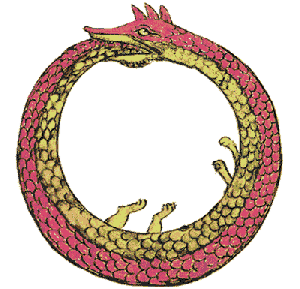

The Ouroboros [or-oh-bohr-ohs] is an ancient symbol depicting a serpent or dragon eating its own tail, which often represents self-reflexivity or cyclicality, especially in the sense of something constantly re-creating itself, the eternal return, and other things perceived as cycles that begin anew as soon as they end (compare with phoenix). It can also represent the idea of primordial unity related to something existing in or persisting before any beginning with such force or qualities it cannot be extinguished.
The ouroboros has been important in religious and mythological symbolism, but has also been frequently used in alchemical illustrations, where it symbolizes the circular nature of the alchemist’s opus. It is also often associated with Gnosticism, and Hermeticism. The earliest known representation of the Ouroboros is contained in the Egyptian Book of the Netherworld. The self-begetting sun god Atum is said to have ascended from chaos-waters with the appearance of a snake, the animal renewing itself every morning, and the deceased wishes to turn into the shape of the snake Sato (‘son of the earth’), the embodiment of Atum.
Posted in Art, Language, Philosophy |
1 Comment »
January 26, 2011

Thundersnow is a rare kind of thunderstorm with snow falling as the primary precipitation instead of rain. It typically falls in regions of strong upward motion within the cold sector of an extratropical cyclone, where the precipitation consists of ice pellets rather than snow. One unique aspect of thundersnow is that the snowfall acts as an acoustic suppressor of the thunder.
The thunder from a typical thunderstorm can be heard many miles away, while the thunder from thundersnow can usually only be heard within a two to three mile radius from the lightning. In the United States, March is their peak month of formation, and on average, only 6.3 events are reported per year.
Posted in Language, Science |
Leave a Comment »
January 25, 2011


Prole drift, short for proletarian drift, is a trend in which products, styles or other aspects of culture previously considered to be upscale or upper class become popular among working class people. Prole drift can also go the other way, as when things that were once the purview of the working class become fashionable in the middle or upper classes. The term was coined by, American literary historian, Paul Fussell in 1983 to describe the phenomenon of most aspects of high culture eventually joining the lowest common denominator.
Examples include sales of premium coffee, Burberry clothing or Coach Inc. handbags to working class people. Examples of reverse prole drift include Mockney, the skinhead and punk subcultures, hip hop, rockabilly, dressing down, slumming it (e.g. going to a working class bar) and NASCAR. BMW cars (particularly the 3 series) have also suffered from this phenomenon, in some instances the 3 series outselling more mainstream cars such as the Ford Mondeo and Vauxhall Vectra.
Posted in Language, Money, Politics |
Leave a Comment »
January 25, 2011

A chav is a stereotype of certain people in the United Kingdom. Also known as a charver in Yorkshire and North East England, ‘chavs’ are said to be aggressive teenagers, of white working class background, who repeatedly engage in antisocial behaviour such as street drinking, drug abuse and rowdiness, or other forms of juvenile delinquency. The derivative Chavette has been used to refer to females.
Chav probably has its origins in the Romani word ‘chavi,’ meaning ‘child’ (or ‘chavo,’ meaning ‘boy,’ or ‘chavvy,’, meaning ‘youth’). This word may have entered the English language through the Geordie dialect word charva, meaning a rough child. This is similar to the colloquial Spanish word chaval, meaning ‘kid’ or ‘guy.’ In Italy, chavs are termed as coatto, which basically means ‘working class’ and vulgar.
read more »
Posted in Language, Money, World |
Leave a Comment »
January 25, 2011

In the context of the World Wide Web, content farms are companies (or their divisions) that employ large numbers of (often freelance) writers to generate large amounts of textual content. The articles in content farms are written by human beings but may not be written by a specialist in the area. In one of Google’s own promotional videos the majority of the links available were actually produced at content farms.
Content farms contain huge number of articles. For instance, Demand Media will soon be publishing 1 million items a month, the equivalent of four English-language Wikipedias a year. Big content farms are expensive resources, sold for many millions.
read more »
Posted in Language, Money, Technology |
Leave a Comment »




 The Daily Omnivore