December 3, 2010

In 1938 American engineer, Buckminster Fuller coined the term ephemeralization to describe the increasing tendency of physical machinery to be replaced by what is now called software. It describes the ability of technological advancement to do ‘more and more with less and less until eventually you can do everything with nothing.’ Fuller’s vision was that ephemeralization will result in ever-increasing standards of living for an ever-growing population despite finite resources. The concept is a counterargument to Malthusian philosophy, where that the dangers of population growth (famine, disease, etc.) would preclude endless progress towards a utopian society.
Fuller uses Henry Ford’s assembly line as an example of how ephemeralization can continuously lead to better products at lower cost with no upper bound on productivity. Another example is found in length measurement technologies: ruler > rod > rope > telescope > radio. The technological progression is a continuing increase in length-measuring ability per pound of instrument, with no apparent upper limit according to Fuller. However, increasing system complexity and information overload make it difficult and stressful for the people who must control the ephemeralized systems. This can negate the advantages of ephemeralization.
Posted in Language, Technology |
Leave a Comment »
December 1, 2010
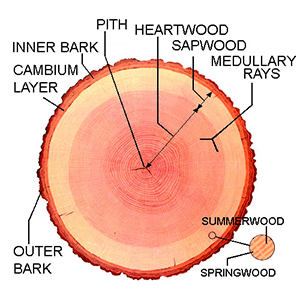
Pith is a substance that is found in vascular plants. It consists of soft, spongy cells, and is located either in the center of the stem or the center of the roots in flowering plants. It is encircled by a ring of xylem (woody tissue), and outside that, a ring of phloem (bark tissue). In some plants the pith is solid, but for most it is soft. A few plants, such as walnuts, have distinctive chambered pith with numerous short cavities.
The word comes from the Old English word piþa, meaning substance, akin to Middle Dutch pit, meaning the pit of a fruit. The modern word pithy (concise and forcefully expressive) derives from it. The inner rind of citrus fruits and other hesperidium is also called pith. The pith and the peel are where about three quarters of the nutrients of an orange are. The pith itself is bitter and is usually added to marmalade or otherwise prepared to be eaten.
Posted in Language, Science |
Leave a Comment »
December 1, 2010


Teetotalism [tee-toht-l-iz-uhm] refers to either the practice of or the promotion of complete abstinence from alcoholic beverages. A person who practices or advocates teetotalism is called a teetotaler (plural teetotalers or teetotalli). The teetotalism movement was first started in Preston, England in the early 19th century. Some common reasons for choosing teetotalism are religious, health, family, philosophical, or social reasons, and, sometimes, as simply a matter of taste or preference.
Contemporary and colloquial usage has somewhat expanded teetotalism to include strict abstinence from most recreational intoxicants (legal and illegal). Most teetotaler organizations also demand from their members that they do not promote or produce alcoholic intoxicants.
read more »
Posted in Drugs, Language, Politics |
Leave a Comment »
November 30, 2010

Hedcut is a term referring to a style of drawing, associated with ‘The Wall Street Journal’ half-column portrait illustrations. They use the stipple method of many small dots and the hatching method of small lines to create an image, and are designed to emulate the look of woodcuts from old-style newspapers, and engravings on certificates and currency. The phonetic spelling of ‘hed’ may be based on newspapers’ use of the term ‘hed’ for ‘headline.’ The ‘Wall Street Journal’ adopted the current form of this portraiture in 1979 when freelance artist Kevin Sprouls approached the paper with some ink dot illustrations he’d created. The front page editor felt that the drawings complemented the paper’s classical feeling and gave it a sense of stability. Additionally, they are generally more legible than photographs of the same size would be.
Sprouls was subsequently hired as a staff illustrator and remained there until 1987. Today, there are six hedcut artists on staff. Each drawing takes between three and five hours to produce. First, a high quality photograph must be secured. This photograph is scanned, converted to grayscale, and the contrast is adjusted. The photograph is then printed and placed on a light table, and overlaid with tracing vellum. The illustrators then trace directly over this image with ink pens, recreating the source photo using specific dot and line patterns. Women are sometimes more difficult to depict than men as they tend to have more complicated haircuts, which are often cropped for simplicity.
Posted in Art, Language |
Leave a Comment »
November 22, 2010

At sufficiently high doses of the drug ketamine (half a gram or more), it is common to experience a ‘K-hole.’ This is a slang term for a state of dissociation from the body which may mimic the phenomenology of schizophrenia. Experience of the K-hole may include distortions in bodily awareness, such as the feeling that one’s body is being tugged, or is gliding on silk, flying, or has grown very large or distended. Users have reported the sensation of their soul leaving their human body.
read more »
Posted in Drugs, Language, Science |
Leave a Comment »
November 22, 2010
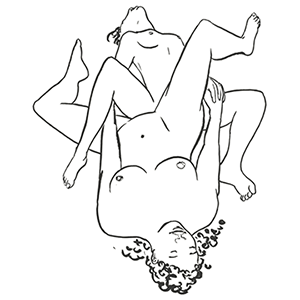
Tribadism [trib-uh-diz-uhm] (also known as tribbing or scissoring) is a form of non-penetrative sex in which a woman rubs her vulva against her partner’s body for sexual stimulation. This may involve female-to-female genital contact or a female rubbing her vulva against her partner’s thigh, arm, palm or stomach, and does not always reflect a scissoring motion (a missionary position may also be acted upon); the term can also refer to a masturbation technique in which a woman rubs her vulva against an inanimate object such as a bolster, in an effort to achieve orgasm.
In the sexuality of the ancient Romans, a tribas (a Greek loan-word) was a woman or hermaphrodite who actively penetrated another woman. Until the 20th century, the term was used to refer to lesbian sexual practices in general. Therefore, lesbians were occasionally called tribades. This position is not exclusive to humans. Female bonobo monkeys, found in the Democratic Republic of the Congo, also engage in female-female genital sex, usually known as GG rubbing (genito-genital).
Posted in Language, Sex |
Leave a Comment »
November 18, 2010

Cisgender [sis-jen-der] is a neologism that refers to individuals who are comfortable in the gender they were assigned at birth. It contrasts ‘transgender’ on the gender spectrum. A more popular term is ‘gender normative.’ The word has its origin in the Latin-derived prefix cis, meaning ‘on the same side’. In this case, ‘cis’ refers to the alignment of gender identity with assigned gender.
The word was coined in 1995 by Carl Buijs, a transsexual man from the Netherlands. Buijs said in a usenet posting, ‘As for the origin, I just made it up. I just kept running into the problem of what to call non-trans people in various discussions, and one day it just hit me: non-trans equals cis. Therefore, cisgendered.’
Posted in Language, Politics, Sex |
Leave a Comment »
November 18, 2010


The Virtuality Continuum is a phrase used to describe a concept that there is a continuous scale ranging between the completely virtual, a Virtual Reality (VR), and the completely real: Reality. The reality-virtuality continuum therefore encompasses all possible variations and compositions of real and virtual objects. It has been somewhat incorrectly described as a concept in new media and computer science, when in fact it could belong closer to anthropology.
The concept was first introduced by industrial engineer Paul Milgram of the University of Toronto. The area between the two extremes, where both the real and the virtual are mixed, is the so-called Mixed reality. This in turn is said to consist of both Augmented Reality (AR), where the virtual augments the real, and Augmented virtuality, where the real augments the virtual.
Posted in Language, Technology |
Leave a Comment »
November 18, 2010

The Sokal affair was a publishing hoax perpetrated by Alan Sokal, a physics professor at New York University. In 1996, Sokal submitted an article to Social Text, an academic journal of postmodern cultural studies. The submission was an experiment to test the magazine’s intellectual rigor and, specifically, to learn if such a journal would ‘publish an article liberally salted with nonsense if it (a) sounded good and (b) flattered the editors’ ideological preconceptions.’
read more »
Posted in Humor, Language, Science |
Leave a Comment »
November 16, 2010

Catullus 16 is a poem by Gaius Valerius Catullus (ca. 84 BC – ca. 54 BC). The poem, written in a hendecasyllabic (11-syllable) meter, was considered so explicit that a full English translation was not openly published until the late twentieth century:
read more »
Posted in Art, Language, Sex |
Leave a Comment »
November 16, 2010

Principia Discordia is a Discordian religious text written by Greg Hill (Malaclypse The Younger) and Kerry Thornley (Omar Khayyam Ravenhurst). It was originally published under the title ‘Principia Discordia or How The West Was Lost’ in a limited edition of 5 copies in 1965. Discordianism is a religion centered on the idea that chaos is all that there is, and that disorder and order are both illusions that are imposed on chaos. There is some division as to whether it should be regarded as a parody religion, and if so to what degree.
It has been called ‘Zen for roundeyes,’ based on similarities with absurdist interpretations of the Rinzai school of Buddhism. Discordianism recognizes chaos, discord, and dissent as valid and desirable qualities, in contrast with most religions, which idealize harmony and order. While the Principia is full of literal contradictions and unusual humor, it contains several passages which propose that there is serious intent behind the work. Saints identified include Emperor Norton, Yossarian, Don Quixote, and Bokonon.
Posted in Humor, Language, Philosophy |
1 Comment »
November 16, 2010


Fnord is the typographic representation of disinformation or irrelevant information intending to misdirect, with the implication of a worldwide conspiracy. The word was coined as a nonsensical term with religious undertones in the Discordian religious text Principia Discordia (1965) by Kerry Thornley and Greg Hill, but was popularized by The Illuminatus! Trilogy (1975) of satirical conspiracy fiction novels by Robert Shea and Robert Anton Wilson.
read more »
Posted in Humor, Language, Philosophy |
Leave a Comment »




 The Daily Omnivore