November 18, 2010

Cisgender [sis-jen-der] is a neologism that refers to individuals who are comfortable in the gender they were assigned at birth. It contrasts ‘transgender’ on the gender spectrum. A more popular term is ‘gender normative.’ The word has its origin in the Latin-derived prefix cis, meaning ‘on the same side’. In this case, ‘cis’ refers to the alignment of gender identity with assigned gender.
The word was coined in 1995 by Carl Buijs, a transsexual man from the Netherlands. Buijs said in a usenet posting, ‘As for the origin, I just made it up. I just kept running into the problem of what to call non-trans people in various discussions, and one day it just hit me: non-trans equals cis. Therefore, cisgendered.’
Posted in Language, Politics, Sex |
Leave a Comment »
November 18, 2010


The Virtuality Continuum is a phrase used to describe a concept that there is a continuous scale ranging between the completely virtual, a Virtual Reality (VR), and the completely real: Reality. The reality-virtuality continuum therefore encompasses all possible variations and compositions of real and virtual objects. It has been somewhat incorrectly described as a concept in new media and computer science, when in fact it could belong closer to anthropology.
The concept was first introduced by industrial engineer Paul Milgram of the University of Toronto. The area between the two extremes, where both the real and the virtual are mixed, is the so-called Mixed reality. This in turn is said to consist of both Augmented Reality (AR), where the virtual augments the real, and Augmented virtuality, where the real augments the virtual.
Posted in Language, Technology |
Leave a Comment »
November 18, 2010

The Sokal affair was a publishing hoax perpetrated by Alan Sokal, a physics professor at New York University. In 1996, Sokal submitted an article to Social Text, an academic journal of postmodern cultural studies. The submission was an experiment to test the magazine’s intellectual rigor and, specifically, to learn if such a journal would ‘publish an article liberally salted with nonsense if it (a) sounded good and (b) flattered the editors’ ideological preconceptions.’
read more »
Posted in Humor, Language, Science |
Leave a Comment »
November 16, 2010

Catullus 16 is a poem by Gaius Valerius Catullus (ca. 84 BC – ca. 54 BC). The poem, written in a hendecasyllabic (11-syllable) meter, was considered so explicit that a full English translation was not openly published until the late twentieth century:
read more »
Posted in Art, Language, Sex |
Leave a Comment »
November 16, 2010

Principia Discordia is a Discordian religious text written by Greg Hill (Malaclypse The Younger) and Kerry Thornley (Omar Khayyam Ravenhurst). It was originally published under the title ‘Principia Discordia or How The West Was Lost’ in a limited edition of 5 copies in 1965. Discordianism is a religion centered on the idea that chaos is all that there is, and that disorder and order are both illusions that are imposed on chaos. There is some division as to whether it should be regarded as a parody religion, and if so to what degree.
It has been called ‘Zen for roundeyes,’ based on similarities with absurdist interpretations of the Rinzai school of Buddhism. Discordianism recognizes chaos, discord, and dissent as valid and desirable qualities, in contrast with most religions, which idealize harmony and order. While the Principia is full of literal contradictions and unusual humor, it contains several passages which propose that there is serious intent behind the work. Saints identified include Emperor Norton, Yossarian, Don Quixote, and Bokonon.
Posted in Humor, Language, Philosophy |
1 Comment »
November 16, 2010


Fnord is the typographic representation of disinformation or irrelevant information intending to misdirect, with the implication of a worldwide conspiracy. The word was coined as a nonsensical term with religious undertones in the Discordian religious text Principia Discordia (1965) by Kerry Thornley and Greg Hill, but was popularized by The Illuminatus! Trilogy (1975) of satirical conspiracy fiction novels by Robert Shea and Robert Anton Wilson.
read more »
Posted in Humor, Language, Philosophy |
Leave a Comment »
November 15, 2010

A kytoon [kahy-toon] (kite + balloon) is a kite with a significant amount of aerostatic lift from a lighter than air gas carried within. The primary advantage of a kytoon is that it remains up and at a reasonably stable position above the tether point, irrespective of the wind. Kytoons have been used in peace and war, been employed for raising rescue signals, antennae, and turbines for generating electricity.
Kytoons may be flown in earth or other planetary atmospheres. Any gas may be used to inflate the bladder parts of a kytoon. Hydrogen, methane, air, helium, etc. may be used to inflate the balloon aspect of a kytoon.
Posted in Language, Technology |
Leave a Comment »
November 15, 2010
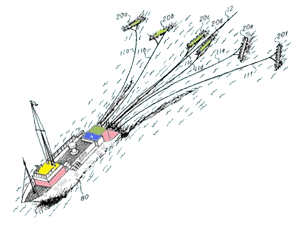

A paravane [par-uh-veyn], also called a water kite, is a towed winged (hydrofoiled) underwater object. Paravanes have applications in sport or commercial fishing, marine exploration, and defense. Navies equip paravanes with cable cutters to sever moored mines, and explosive paravanes are essentially towable mines. Commercial fishers use paravanes to tow bait and lead fish into trolling nets. Paravanes are also used for sampling water chemistry, taking seismic readings, and mapping marine geography.
Human-on-board paravanes are used to transport explorers, scuba divers, and spear-fishers. Foilboards used for recreation are also a type of water kite. Early work in coupling water kites was done by the late J.C. Hagedoorn, a geophysics professor at Delft University. His system coupled manned parafoils with water kites he named ‘hapas.’ Later experimenters also used the terminology ‘chien de mer’ (French for ‘sea dog’).
Posted in Language, Technology |
Leave a Comment »
November 15, 2010

The Voynich manuscript is a handwritten book thought to have been written between 1404 and 1438, composed of 240 vellum (mammal skin) pages, most with illustrations. Despite centuries of research, the author, script, and language remain unknown. Some think the manuscript is an elaborate hoax, others believe it was meant to serve as a pharmacopoeia or to address topics in medieval or early modern medicine.
Generally presumed to be some kind of ciphertext (an encrypted document), the Voynich manuscript has been studied by many professional and amateur cryptographers, including American and British codebreakers from both World War I and World War II. Yet it has defied all decipherment attempts, becoming a historical cryptology cause célèbre. The book is named after the Polish-Lithuanian-American book dealer Wilfrid M. Voynich, who acquired it in 1912. Currently the Voynich manuscript is owned by the Beinecke Rare Book and Manuscript Library of Yale University.
Posted in Art, Language |
Leave a Comment »
November 15, 2010
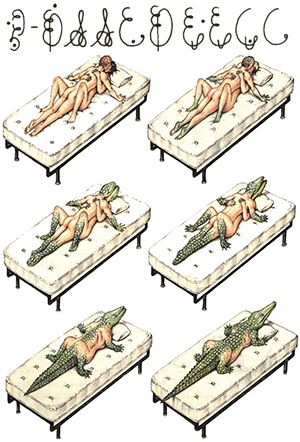

The Codex Seraphinianus is a book written and illustrated by the Italian artist, architect and industrial designer Luigi Serafini during thirty months, from 1976 to 1978. The book is a visual encyclopedia of an unknown world, written in one of its languages, a thus-far undeciphered alphabetic writing. The Codex is divided into eleven chapters, partitioned into two sections. The first section appears to describe the natural world, dealing with flora, fauna, and physics. The second deals with the humanities, the various aspects of human life: clothing, history, cuisine, architecture and so on. The illustrations are often surreal parodies of things in our world: bleeding fruit; a plant that grows into roughly the shape of a chair and is subsequently made into one; a lovemaking couple that metamorphoses into an alligator; etc.
The language of the codex has defied complete analysis by linguists for decades. The number system used for numbering the pages, however, has been discovered to be a variation of base 21. In a talk at the Oxford University Society of Bibliophiles held in 2009, Serafini stated that the script of the Codex is asemic, that his own experience in writing it was closely similar to automatic writing, and that what he wanted his alphabet to convey to the ‘reader’ is the sensation that children feel in front of books they cannot yet understand, although they see that their writing does make sense for grown-ups.
Posted in Art, Humor, Language |
2 Comments »
November 15, 2010

A bug-out bag is a portable kit that contains the items one would require to survive for seventy two hours when evacuating from a disaster. It is also known as a 72-hour kit, a grab bag, or a battle box. The focus is on evacuation, rather than long-term survival, distinguishing it from a survival kit, boating or aviation emergency kit, or a fixed-site disaster supplies kit. Bug-out bags are popular in the survivalist community. The term is related to, and possibly derived from, the ‘bail-out bag’ emergency kit many military aviators carry.
Typical contents include: 1 Gallon H2O per person, per day; Non-perishable food, Water purification supplies, Cooking supplies (camp stove, sterno, utensils), First aid kit, Fire starting tool (matches, ferrocerium rod, lighter), Disaster plan (location of emergency centers, rallying points, possible evacuation routes), Emergency reference literature,Maps, Clothing (rain poncho, hat, gloves), Bedding (bedroll, blankets), Medicine, Medical records, Radio, Lighting (flashlight, glow sticks), Firearm, Cash, Identification cards, Knife, Duct Tape, Rope, Plastic tarps, and Wire.
Posted in Health, Language |
1 Comment »
November 11, 2010

The Lamborghini Countach was a mid-engined sports car produced by Italian automaker Lamborghini from 1974 to 1990. A total of 2,042 cars were built during the Countach’s sixteen year lifetime: Its design both pioneered and popularized the wedge-shaped, sharply angled look popular in many high performance sports cars. The ‘cabin-forward’ design concept, which pushes the passenger compartment forward in order to accommodate a larger engine, was also popularized by the Countach.
The word ‘countach’ is an exclamation of astonishment in the local Piedmontese language — generally used by men on seeing an extremely beautiful woman. The Countach name stuck when Nuccio Bertone first saw ‘Project 112’ in his studio. The prototype was introduced to the world at the 1971 Geneva Motor Show. Most previous and subsequent Lamborghini car names were associated with bulls and bullfighting.
Posted in Language, Technology, World |
Leave a Comment »





