November 2, 2010

Pantheism [pan-thee-iz-uhm] is the view that the Universe (Nature) and God are identical. Pantheists thus do not believe in a personal, anthropomorphic or creator god. Although there are divergences within Pantheism, the central ideas found in almost all versions are the Cosmos as an all-encompassing unity and the sacredness of Nature.
The term ‘pantheist’ — from which the word ‘Pantheism’ was derived — was purportedly first used in English by Irish writer John Toland in his 1705 work, ‘Socinianism Truly Stated, by a pantheist.’ However, many earlier writers, schools of philosophy, and religious movements expressed pantheistic ideas such as Heraclitus and Anaximander, and the early Taoism of Laozi and Zhuangzi is also pantheistic.
Posted in Language, Philosophy |
Leave a Comment »
October 27, 2010

The clean and jerk is one of two olympic weightlifting events (the other being the snatch). It is a highly technical lift that is known as ‘the king of lifts’ because more weight can be lifted above one’s head as compared to any other known weightlifting technique. The clean portion of the lift refers to the lifter explosively pulling the weight from the floor to a racked position across deltoids and clavicles.
In early twentieth century weightlifting competitions, a variant movement called the ‘Continental’ (because it was practiced by Germans rather than the British) allowed the lifter to pull the barbell up to his belt, where it could rest. Then with several successive flips, the bar would be moved up the torso until it reached the position for the overhead jerk. The Continental gained a reputation as clumsy, slow, and nonathletic compared to the swift coordinated movement required to lift the bar ‘clean.’ Hence, the clean movement was adopted by the early weightlifting federations as the official movement.
Posted in Games, Health, Language |
Leave a Comment »
October 25, 2010


Astroturfing denotes political, advertising, or public relations campaigns that are formally planned by an organization, but are disguised as spontaneous, popular ‘grassroots’ behavior. The term refers to AstroTurf, a brand of synthetic carpeting designed to look like natural grass. The goal of such campaigns is to disguise the efforts of a political or commercial entity as an independent public reaction to some political entity—a politician, political group, product, service or event. The term is said to have been used first in this context by former US Senator Lloyd Bentsen of Texas in 1985.
Astroturfers attempt to orchestrate the actions of apparently diverse and geographically distributed individuals, by both overt (outreach, awareness, etc.) and covert (disinformation) means. Astroturfing may be undertaken by an individual promoting a personal agenda, or highly organized professional groups with money from large corporations, unions, non-profits, or activist organizations. Very often, the efforts are conducted by political consultants who also specialize in opposition research.
Posted in Language, Politics |
Leave a Comment »
October 19, 2010

Sangfroid [sahn-frwa] is a noun meaning self-possession or imperturbability especially under strain. The word derives from French, c. 1712 and translates literally as, ‘cool blood.’
‘Keep Calm and Carry On’ was a poster produced by the British government in 1939 during the beginning of World War II, to raise the morale of the British public in the case of invasion. It was little known and never used. The poster was rediscovered in 2000 and has been re-issued by a number of private sector companies, and used as the decorative theme for a range of other products.
Posted in Language, World |
Leave a Comment »
October 19, 2010

A saccade [suh-kahd] is a fast movement of an eye, head or other part of an animal’s body or device. It can also be a fast shift in frequency of an emitted signal or other quick change. Saccades are quick, simultaneous movements of both eyes in the same direction. Saccades serve as a mechanism for fixation and rapid eye movement. The word appears to have been coined in the 1880s by French ophthalmologist Émile Javal, who used a mirror on one side of a page to observe eye movement in silent reading, and found that it involves a succession of discontinuous individual movements.
Humans and many other animals do not look at a scene in fixed steadiness (as opposed to e.g., most birds); instead, the eyes move around, locating interesting parts of the scene and building up a mental, three-dimensional ‘map’ corresponding to the scene (as opposed to the graphical map of avians, that often relies upon detection of angular movement on the retina). One reason for the saccadic movement of the human eye is that the central part of the retina—known as the fovea—plays a critical role in resolving objects. By moving the eye so that small parts of a scene can be sensed with greater resolution, body resources can be used more efficiently. Saccades are the fastest movements produced by the human body
Posted in Health, Language |
Leave a Comment »
October 19, 2010

Isabella ‘Issy’ Blow (1958 – 2007) was an English magazine editor and international style icon. The muse of hat designer Philip Treacy, she is credited with discovering the models Stella Tennant and Sophie Dahl as well as the fashion designer Alexander McQueen. Blow battled with depression and bipolar disorder most of her adult life.
In 2006, Blow attempted suicide with an overdose of sleeping pills. Later that year, she again attempted suicide by jumping from the Hammersmith Flyover, which resulted in her breaking both ankles. In 2007, Blow made several more suicide attempts by driving her car into the rear of a truck, by attempting to obtain horse tranquilizers, by drowning in a lake and by overdosing while on a beach in India. She died in May of 2007 after ingesting a weedkiller, in what was later ruled a suicide.
Posted in Art, Language |
Leave a Comment »
October 18, 2010

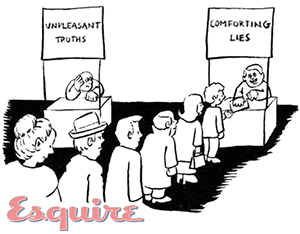
Radical Honesty is a technique and self-improvement program developed by Dr. Brad Blanton. The program asserts that lying is the primary source of modern human stress, and that practitioners will become happier by being more honest, even about painful or taboo subjects. Blanton claims this form of honesty can help all human relationships since it ‘creates an intimacy not possible if you are hiding something for the sake of someone’s feelings.’ The Radical Honesty technique includes having practitioners state their feelings bluntly, directly and in ways typically considered impolite.
People who practice Radical Honesty employ a collection of techniques to shift them out of acceptable norms of ‘white lying’ for the purpose of having a more truthful relationship with themselves and others. The material employed to communicate and teach Radical Honesty through books and workshops is drawn from an eclectic collection of sources including Sufism, clinical psychology, Gestalt therapy and the comic spiritual belief (developed by Blanton) called Futilitarianism. Futilitarianism claims it is futile to have any belief whatsoever.
Posted in Humor, Language, Philosophy |
Leave a Comment »
October 16, 2010

When used in reference to consumer electronics, ‘brick’ describes a device that cannot function in any capacity (such as a device with damaged firmware). This usage derives from the fact that some electronic devices (and their detachable power supplies) are vaguely brick-shaped, and so those which do not function are useful only as actual bricks. The term can also be used as a verb. For example, I bricked my MP3 player when I tried to modify its firmware.’ Some devices which are ‘bricked’ because the contents of their nonvolatile memory are incorrect can be ‘unbricked‘ using separate hardware (a debug board) that accesses this memory directly.
Bricking a device is usually an unwanted consequence of an attempt to update the device. Many devices have an update procedure which must not be interrupted; if interrupted by a power failure, user intervention, or any other reason the existing firmware may be partially overwritten and unusable. Installing incorrect firmware can also brick a device, e.g., installing firmware for a different revision of the hardware, or installing firmware incompetently patched by third parties to get around restrictions imposed by official firmware, such as DVD firmware which only plays DVDs sold in a particular region. Devices can also be bricked by malware (malicious software), and sometimes by running software not intentionally harmful but with errors which cause damage.
Posted in Language, Technology |
Leave a Comment »
October 13, 2010

A sizable number of Indian immigrants to the United States came in the 1960s and 1970s, when the motel and hotel industry was booming. Many of them bought up undervalued and dilapidated properties and turned them into businesses, including motels and hotels. It was estimated in 2007 that 60% of the mid-sized motels and hotels in the United States were owned by Indians. Nearly one-third of those Indians were called Patel (and came from Gujarat), with the result that, apparently, many people believe Patel is an Indian word meaning ‘hotel.’
Patel, originally meaning ‘headman’ or ‘village chief” derives from Patlikh, the record keeper named by princely rulers in Gujarat to keep track of the crops, pat being a parcel of land. Traditionally, the Patels or Patils assist the Talati or Kulkarni in collection or revenue in rural areas. Patels in northern Gujarat were very prominent farmers as well. Within the United Kingdom, it is the twenty-fourth most common surname nationally, and the third most common in the Greater London region. In the US, the surname ‘Patel’ ranks 174 among the top 500 list of most common last names.
Posted in Language, Money, World |
Leave a Comment »
October 13, 2010

A meme [meem] is a unit of cultural ideas, symbols or practices, which can be transmitted from one mind to another through writing, speech, gestures, rituals or other imitable phenomena. Supporters of the concept regard memes as cultural analogues to genes, in that they self-replicate and respond to selective pressures. The British scientist Richard Dawkins coined the word in ‘The Selfish Gene’ (1976) as a concept for discussion of evolutionary principles in explaining the spread of ideas and cultural phenomena.
Examples of memes given in the book included melodies, catch-phrases, beliefs (notably religious beliefs), clothing fashion, and the technology of building arches. Meme-theorists contend that memes evolve by natural selection (in a manner analogous to that of biological evolution) through the processes of variation, mutation, competition, and inheritance influencing an individual meme’s reproductive success. Memes spread through the behaviors that they generate in their hosts. Memes that propagate less prolifically may become extinct, while others may survive, spread, and (for better or for worse) mutate.
Posted in Humor, Language, Philosophy |
Leave a Comment »
October 13, 2010
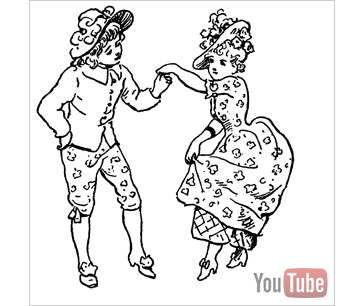
A minuet [min-yoo-et] is a social dance of French origin for two people, usually in 3/4 time. The word was adapted from Italian minuetto and French menuet, meaning small, pretty, delicate, a diminutive of menu, from the Latin minutus. At the period when it was most fashionable it was slow, soft, ceremonious, and graceful. The name is also given to a musical composition written in the same time and rhythm, but when not accompanying an actual dance the pace was quicker. As the other dances that made up a Baroque suite dropped out of use, the minuet retained its popularity.
Posted in Art, Language, World |
Leave a Comment »
October 11, 2010

On many computer operating systems, the superuser, or root, is a special user account used for system administration. Separation of administrative privileges from normal user privileges makes an operating system more resistant to viruses and other malware. Additionally, in organizations, administrative privileges are often reserved for authorized individuals in order to control abuse, misuse, or other undesired activities by end-users.
Posted in Language, Technology |
Leave a Comment »


 The Daily Omnivore