July 11, 2010

The word spoof was coined by English comedian Arthur Roberts and popularized by a card game that he invented called Spoof, which involved trickery and nonsense. The first recorded reference to the game is in 1884. Soon the word took on the general meaning of ‘nonsense, trickery,’ first recorded in 1889. The verb spoof is first recorded in 1889 as well, in the sense ‘to deceive.’ These senses are now less widely used than the noun meaning of ‘a light parody or satirical imitation,’ first recorded in 1958, and the verb sense ‘to satirize gently,’ first recorded in 1927.
In the context of network security, a spoofing attack is a situation in which one person or program successfully masquerades as another by falsifying data and thereby gaining an illegitimate advantage. Another kind of spoofing is ‘webpage spoofing,’ also known as phishing. In this attack, a legitimate web page such as a bank’s site is reproduced in ‘look and feel’ on another server under control of the attacker. The main intent is to fool the users into thinking that they are connected to a trusted site, for instance to harvest user names and passwords. Spoof is also the name for an object used to mask the odor of marijuana or tobacco smoke. It is most commonly made of a paper towel roll tube stuffed with dryer sheets through which the smoke is blown.
Posted in Drugs, Humor, Language |
Leave a Comment »
June 30, 2010
A shibboleth [shib-uh-lith] is any distinguishing practice that is indicative of one’s social or regional origin. It usually refers to features of language, and particularly to a word whose pronunciation identifies its speaker as being a member or not a member of a particular group. But, shibboleths can also be customs or practices, such as male circumcision.
Shibboleths have been used by different subcultures throughout the world at different times. For example, during the Battle of the Bulge, American soldiers used knowledge of baseball to determine if others were fellow Americans or if they were German infiltrators in American uniform. Some US soldiers in the Pacific theater used the word ‘lollapalooza’ as a shibboleth to verbally test people who were hiding and unidentified, on the premise that Japanese people often pronounce the letter L as R.
Posted in Language, World |
Leave a Comment »
June 30, 2010

Simple English Wikipedia is an English edition of the online encyclopedia Wikipedia, primarily written in Basic English (an 850-word auxiliary language created by Charles Kay Ogden in the 1920s for learning English as a second language) and Special English (avoids idioms; created in 1959 and still presented daily by the Voice of America broadcast). Launched in 2003, the site has the stated aim of providing an encyclopedia for ‘people with different needs, such as students, children, adults with learning difficulties and people who are trying to learn English.’
Articles on the Simple English Wikipedia are usually shorter than their English Wikipedia counterparts, typically presenting only basic information: Tim Dowling of ‘the Guardian’ newspaper explained that ‘the Simple English version tends to stick to commonly accepted facts.’ The interface is also more simply labeled; for instance, the ‘Random article’ link on the English Wikipedia is replaced with a ‘Show Any Page’ link; users are invited to ‘change’ rather than ‘edit’ pages; clicking on a red link shows a ‘not yet started’ message rather than the usual ‘page does not exist.’
Posted in Education, Language, Technology |
Leave a Comment »
June 29, 2010

A paradox is a true statement that leads to a contradiction or a situation which defies intuition.
Posted in Language, Philosophy |
Leave a Comment »
June 29, 2010

Balkanization [bawl-kuhn-uh-zey-shuhn] is a geopolitical term originally used to describe the process of fragmentation or division of a region or state into smaller regions or states that are often hostile or non-cooperative with each other. The term arose from conflicts in the 20th century Balkans. While what is now termed Balkanization has occurred throughout history, the term originally described the creation of smaller, ethnically diverse states following the breakup of the Ottoman Empire after World War I.
The term is also used to describe other forms of disintegration, including, for instance, the subdivision of the Internet into separate enclaves, the division of subfields and the creation of new fields from sociology, and the breakdown of cooperative arrangements due to the rise of independent competitive entities.
Posted in Language, Politics, War |
Leave a Comment »
June 29, 2010
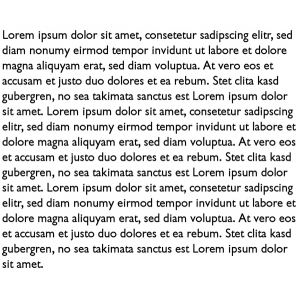
In publishing and graphic design, lorem ipsum is the name given to commonly used placeholder text (filler text) to demonstrate the graphic elements of a document or visual presentation, such as font, typography, and layout. The lorem ipsum text, which is typically a nonsensical list of semi-Latin words, is an edited version of a Latin text by Cicero, with words/letters omitted and others inserted, but not proper Latin
Even though using ‘lorem ipsum’ often arouses curiosity because of its resemblance to classical Latin, it is not intended to have meaning. Where text is visible in a document, people tend to focus on the textual content rather than upon overall presentation, so publishers use lorem ipsum when displaying a typeface or design elements and page layout in order to direct the focus to the publication style and not the meaning of the text.
Posted in Language, Money |
Leave a Comment »
June 29, 2010

Baader-Meinhof is the phenomenon where one happens upon some obscure piece of information– often an unfamiliar word or name– and soon afterwards encounters the same subject again, often repeatedly. The phenomenon bears some similarity to synchronicity, which is the experience of having a highly meaningful coincidence… such as having someone telephone you while you are thinking about them. How the phenomenon came to be known as ‘Baader-Meinhof’ is uncertain. It seems likely that some individual learned of the existence of the historic German urban guerrilla group which went by that name, and then heard the name again soon afterwards.
Posted in Language, Science |
Leave a Comment »
June 28, 2010

Wolf ticket (or woof ticket) is a slang term meaning a verbal threat, criticism, or insult used to intimidate an opponent. The term originates from ‘woofing,’ meaning aimless talk, an onomatopoeic reference to the sound of dogs barking. The term is usually used as a part of the phrase ‘to sell wolf tickets,’ meaning to bluff or threaten someone in a boastful way, or ‘to buy wolf tickets,’ meaning to call the bluff or accept the implied challenge.
Professor Emeritus Herbert L. Foster noted in the first edition of his book ‘Ribbin’, Jivin’, and Playin’ the Dozens: The Unrecognized Dilemma of Inner City Schools’ that his students, in New York City Public School 613, about 1964, started using the expression ‘woof’ or ‘wolf’ ticket interchangeably. Since he was teaching graphic arts, his students, at first, printed wolf tickets. As Foster became more astute about his students’ street culture, he created the woof ticket that was used on the street and discussed further in his book.
read more »
Posted in Language |
Leave a Comment »
June 28, 2010

Slash fiction, or slashfic, is a genre of fan fiction that focuses on the depiction of romantic or sexual relationships between fictional characters. While the term was originally restricted to stories in which male media characters were involved in an explicit adult relationship as a primary plot element, it is now often used to refer to any fan story containing a pairing between same-sex characters, although many fans distinguish the female-focused variety as a separate genre commonly referred to as ‘femslash.’
Posted in Language, Love, Sex |
Leave a Comment »
June 24, 2010

The English language makes a distinction between blue and green, but some languages do not. Of these, quite a number do not distinguish blue from black either. In languages that do not have separate terms for blue and green, one word applies to both (when the issue is discussed in linguistics, this cover term is sometimes called grue or bleen in English).
Posted in Language, World |
Leave a Comment »
June 24, 2010

In disc golf or other disc-related sports, a hyzer [hahy-zer] is a throw which curves in the direction opposite of the arm used to throw. For a normal straight shot, you release the disc flat. To throw a hyzer, simply tilt the edge of the disc opposite your grip toward the ground. The more you tilt this edge toward the ground at release, the faster the disc will curve off in the hyzer direction. For an anhyzer, the edge is tilted up, and the disc curves in the same direction as the arm used to throw.
The terms are similar to hook and slice in golf. Hook shots curve in the direction opposite of the player’s handedness (i.e. right-handed players hook left), and slices do the opposite (i.e. right handed players slice right).
Posted in Games, Language |
Leave a Comment »


 The Daily Omnivore