August 25, 2010
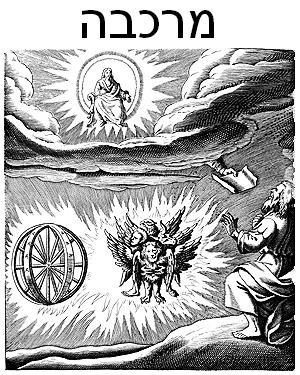
The Hebrew word Merkabah is used in Ezekiel (1:4-26) to refer to the throne-chariot of God, the four-wheeled vehicle driven by four ‘chayot’ (‘living creatures’), each of which has four rings and the four faces of a man, lion, ox, and eagle. Due to the concern of some Torah scholars that misunderstanding these passages as literal descriptions of God’s image might lead to blasphemy and/or idolatry, there was great opposition to studying this topic.
Jewish biblical commentaries emphasize that the imagery of the Merkaba is not meant to be taken literally; rather the chariot and its accompanying angels are analogies for the various ways that God reveals Himself in this world. Hasidic philosophy and Kabbalah discuss at length what each aspect of this vision represents in this world, and how the vision does not imply that God is made up of these forms. Jews customarily read the Biblical passages concerning the Merkaba in their synagogues every year on the holiday of Shavuot, which commemorates the receiving of the Ten Commandments.
Posted in Language, Philosophy |
1 Comment »
August 24, 2010

In video gaming a nerf is a change to a game that reduces the effectiveness of a particular game element. The term is also used as a verb for the act of making such a change. The opposite of nerfing is buffing. The term originated with ‘Ultima Online,’ and refers to the Nerf brand of toys which designed to prevent serious injury.
Game developers nerf aspects of a game in order to maintain game balance. Occasionally a new feature (such as an item, class, or skill) may be made too powerful, unfair, or too easily obtained to the extent that it unbalances the game system. This is sometimes due to an unforeseen bug or method of using or acquiring the object that was not considered by the developers.
Posted in Games, Language |
Leave a Comment »
August 24, 2010

Sprezzatura is an Italian word originating from Castiglione’s ‘The Book of the Courtier,’ where it is defined by the author as ‘a certain nonchalance, so as to conceal all art and make whatever one does or says appear to be without effort and almost without any thought about it.’
It is the ability of a courtier to display an easy facility in accomplishing difficult actions which hides the conscious effort that went into them. Sprezzatura has also been described as a form of defensive irony: the ability to disguise what one really desires, feels, thinks, and means or intends behind a mask of apparent reticence and nonchalance.
Posted in Language, World |
Leave a Comment »
August 17, 2010
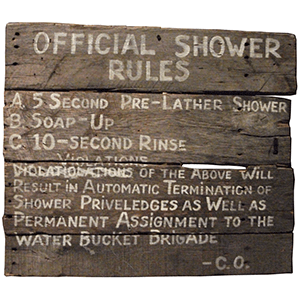
A navy shower (or ‘sea shower’) is a method of showering that allows for significant conservation of water and energy. The total time for the water being on is typically under two minutes. Navy showers originated on naval ships, where supplies of fresh water were often scarce. Using this method, crew members were able to stay clean, while conserving their limited water supply.
The idea has been adopted by many people who wish to conserve water and the energy needed to heat the water, for both environmental and economic reasons. Maritime cruisers often take navy showers when they are not in a port with easy access to fresh water. A ten-minute shower takes as much as 60 gallons of water, while a navy shower usually takes as little as three gallons; one person can save 15,000 gallons per year. The United States Navy refers to long lavish showers without limits on water usage as ‘Hollywood showers.’
Posted in Language, War |
Leave a Comment »
August 16, 2010

Mamihlapinatapai is a word from the Yaghan language of Tierra del Fuego, listed in The Guinness Book of World Records as the ‘most succinct word,’ and is considered one of the hardest words to translate. It describes ‘a look shared by two people with each wishing that the other will initiate something that they both desire but which neither one wants to start.’
Posted in Language, World |
Leave a Comment »
August 12, 2010

Formosa [fawr-moh-suh] is the name given to Taiwan (Ilha Formosa, ‘Beautiful Isle’) by passing Portuguese mariners in 1544. It is now also the name of a province of Argentina, a city in Brazil, a small island off the northwest coast of Africa, and the language of Taiwanese aborigines.
Posted in Language, World |
Leave a Comment »
August 10, 2010


In economics, a monopsony [muh-nop-suh-nee] is a market form in which only one buyer faces many sellers. It is an example of imperfect competition, similar to a monopoly, in which only one seller faces many buyers. As the only purchaser of a good or service, the ‘monopsonist’ may dictate terms to its suppliers in the same manner that a monopolist controls the market for its buyers.
The term was first introduced by Joan Robinson in her influential book, ‘The Economics of Imperfect Competition.’ Robinson credits classics scholar Bertrand Hallward of Peterhouse College, Cambridge with coining the term. A single-payer universal health care system, in which the government is the only ‘buyer’ of health care services, is an example of a monopsony. It has also been argued that Wal-Mart, in the United States, functions as a monopsony in certain market segments, as its buying power for a given item may dwarf the remaining market. The Canadian Wheat Board, established by the Parliament of Canada in 1935 as a producer marketing system, is a monopsonistic buyer of wheat and barley.
Posted in Language, Money, Politics |
Leave a Comment »
August 9, 2010
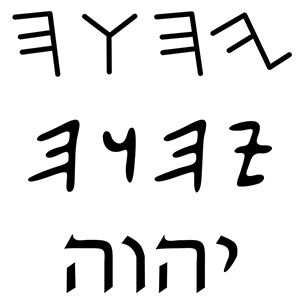
Ineffability [in-ef-fuh-bil-uh-tee] is concerned with ideas that cannot or should not be expressed in spoken words (or language in general), often being in the form of a taboo or incomprehensible term. Illogical statements, principles, reasons, and arguments are intrinsically ineffable along with impossibilities, contradictions, and paradoxes.
Terminology describing the nature of experience cannot be properly conveyed in symbolic language; it is believed that this knowledge is only held by the individual from which it originates. Obscene profanity and vulgarisms, however, can easily (and clearly) be stated – but they simply should not be and so are still considered ineffable.
Posted in Language, Philosophy |
Leave a Comment »
August 9, 2010
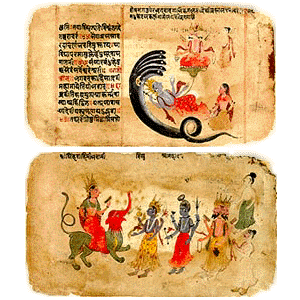
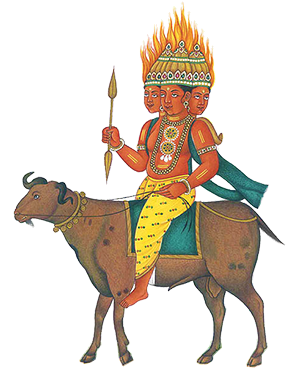
The Vedas [vey-duhs] (Sanskrit for ‘knowledge’) are a large body of texts originating in ancient India, which constitute the oldest Sanskrit literature (1500–1000 BCE) and the oldest scriptures of Hinduism. The texts are aggregated around the four canonical Vedas:.Rig Veda, Sama Veda, Yajur Veda, and Atharva Veda. Together they make up a sacred collection of hymns, incantations, and liturgical rites. The Atharva Veda is less predominant than other Vedas and is little used in solemn ritual. According to Hindu tradition, the Vedas are, ‘not of human agency.’ The individual verses contained in these compilations are known as mantras. Some selected Vedic mantras are still recited at prayers, religious functions and other auspicious occasions in contemporary Hinduism.
The various Indian philosophies and sects have taken differing positions on the Vedas. Schools of Indian philosophy which cite them as their scriptural authority are classified as orthodox. Other traditions, notably Buddhism, Sikhism, and Jainism, which did not regard the Vedas as authorities are referred to by traditional Hindu texts as heterodox schools.
Posted in Language, Philosophy, World |
Leave a Comment »
August 4, 2010
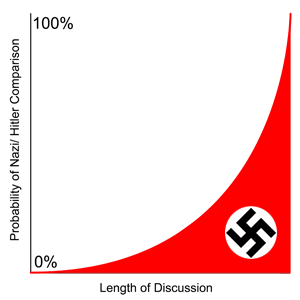
Godwin’s law is a humorous observation made by Mike Godwin in 1990 which has become an Internet adage. It states: ‘As an online discussion grows longer, the probability of a comparison involving Nazis or Hitler approaches 1.’ In other words, given enough time, all discussions —regardless of topic or scope —inevitably wind up being about Hitler and the Nazis. Also the poster who mentioned Nazis loses all debates/discussions they had in said topic, and their insults are nullified. Godwin’s law is often cited in online discussions as a deterrent against the use of arguments in the widespread reductio ad Hitlerum form.
The rule does not make any statement about whether any particular reference or comparison to Adolf Hitler or the Nazis might be appropriate, but only asserts that the likelihood of such a reference or comparison arising increases as the discussion progresses. It is precisely because such a comparison or reference may sometimes be appropriate, Godwin has argued that overuse of Nazi and Hitler comparisons should be avoided, because it robs the valid comparisons of their impact. Although in one of its early forms Godwin’s law referred specifically to Usenet newsgroup discussions, the law is now applied to any threaded online discussion: electronic mailing lists, message boards, chat rooms, and more recently blog comment threads, wiki talk pages, and social networking sites.
Posted in Humor, Language, War |
Leave a Comment »
August 2, 2010

Omphaloskepsis [om-fuh-loh-skep-sis] is the contemplation of one’s navel as an aid to meditation. It can also be used as a pejorative referring to excessive introspection, self-absorption, or concentration on a single issue. This criticism is also often leveled at professions which are interested in themselves (e.g. movies about Hollywood or television shows about television writers). The word has several other forms, such as omphalism used to describe the spiritual practice; omphaloskeptic or omphaloskeptical, for someone who engages in navel-gazing; and omphalocentric meaning to be in a self-absorbed state.
Posted in Language, Philosophy |
Leave a Comment »
August 1, 2010

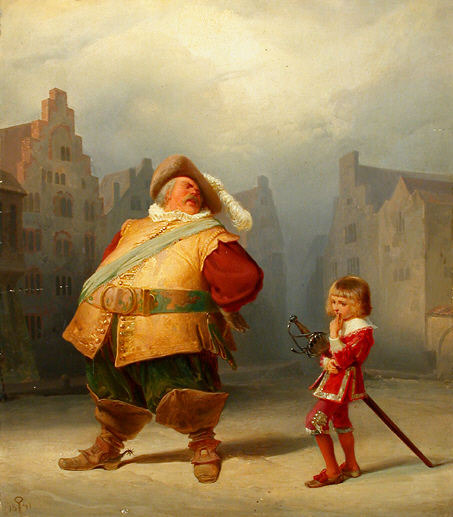
Sir John Falstaff is a fictional character who appears in three plays by William Shakespeare as a companion to Prince Hal, the future King Henry V. A fat, vainglorious, and cowardly knight, Falstaff leads the apparently wayward Prince Hal into trouble, and is ultimately repudiated after Hal becomes king. To describe someone as falstaffian is to say they are characterized by joviality and conviviality.
Posted in Art, Humor, Language |
Leave a Comment »