July 20, 2010

Dada [dah-dah] or Dadaism is a movement in art and literature based on deliberate irrationality and negation of traditional artistic values. It began in Zürich, Switzerland, during World War I and peaked from 1916 to 1922. The movement primarily involved visual arts, literature—poetry, art manifestoes, art theory—theatre, and graphic design, and concentrated its anti-war politics through a rejection of the prevailing standards in art through anti-art cultural works.
Its purpose was to ridicule what its participants considered to be the meaninglessness of the modern world. In addition to being anti-war, dada was also anti-bourgeois and anarchistic in nature. The movement influenced later styles like the avant-garde and downtown music movements, and groups including surrealism, Nouveau réalisme, pop art, Fluxus and punk rock.
Posted in Art, Language |
Leave a Comment »
July 17, 2010

A kōan [koh-ahn] is a fundamental part of the history and lore of Zen Buddhism. It consists of a story, dialogue, question, or statement, the meaning of which cannot be understood by rational thinking but may be accessible through intuition. One widely known kōan is ‘what is the sound of one hand clapping.’ The word kōan, the name by which practice is known to the West, comes from the Japanese pronunciation of the Chinese characters.
Posted in Language, Philosophy, World |
Leave a Comment »
July 17, 2010

Ylem is a term coined in the late 1940s by cosmologist Ralph Alpher for a hypothetical original substance or condensed state of matter, which became subatomic particles and elements as we understand them today.
Posted in Language, Science |
Leave a Comment »
July 17, 2010

The rod of Asclepius [uh-sklee-pee-uhs] is an ancient symbol associated with astrology, the Greek god Asclepius, and with medicine and healing. It consists of a serpent entwined around a staff. The name of the symbol derives from its early and widespread association with Asclepius, the son of Apollo, who was a practitioner of medicine in ancient Greek mythology. Hippocrates himself was a worshipper of Asclepius.
Posted in Health, Language |
Leave a Comment »
July 17, 2010

The caduceus [kuh-doo-see-uhs] is a herald’s staff, a symbolic object representing Hermes (or the Roman Mercury), and by extension trades, occupations or undertakings associated with the god. It is today typically depicted as a short staff entwined by two serpents in the form of a double helix, and is sometimes surmounted by wings. The caduceus is sometimes used as a symbol of medicine and/or medical practice, especially in North America, due to widespread confusion with the traditional medical symbol, the rod of Asclepius, which has only a single snake and no wings.
Posted in Health, Language |
Leave a Comment »
July 12, 2010

Cryptozoology [krip-toh-zoh-ol-uh-jee] refers to the pseudo-scientific investigation of animals which are considered to be legendary or otherwise nonexistent by mainstream biology.
This includes looking for living examples of animals which are extinct, such as dinosaurs; animals whose existence lacks physical support but which appear in myths, legends, or are reported, such as Bigfoot and Chupacabra; and wild animals dramatically outside of their normal geographic ranges, such as so-called phantom cats. The animals they study are often referred to as cryptids.
Posted in Humor, Language, Science |
Leave a Comment »
July 11, 2010

The word spoof was coined by English comedian Arthur Roberts and popularized by a card game that he invented called Spoof, which involved trickery and nonsense. The first recorded reference to the game is in 1884. Soon the word took on the general meaning of ‘nonsense, trickery,’ first recorded in 1889. The verb spoof is first recorded in 1889 as well, in the sense ‘to deceive.’ These senses are now less widely used than the noun meaning of ‘a light parody or satirical imitation,’ first recorded in 1958, and the verb sense ‘to satirize gently,’ first recorded in 1927.
In the context of network security, a spoofing attack is a situation in which one person or program successfully masquerades as another by falsifying data and thereby gaining an illegitimate advantage. Another kind of spoofing is ‘webpage spoofing,’ also known as phishing. In this attack, a legitimate web page such as a bank’s site is reproduced in ‘look and feel’ on another server under control of the attacker. The main intent is to fool the users into thinking that they are connected to a trusted site, for instance to harvest user names and passwords. Spoof is also the name for an object used to mask the odor of marijuana or tobacco smoke. It is most commonly made of a paper towel roll tube stuffed with dryer sheets through which the smoke is blown.
Posted in Drugs, Humor, Language |
Leave a Comment »
June 30, 2010
A shibboleth [shib-uh-lith] is any distinguishing practice that is indicative of one’s social or regional origin. It usually refers to features of language, and particularly to a word whose pronunciation identifies its speaker as being a member or not a member of a particular group. But, shibboleths can also be customs or practices, such as male circumcision.
Shibboleths have been used by different subcultures throughout the world at different times. For example, during the Battle of the Bulge, American soldiers used knowledge of baseball to determine if others were fellow Americans or if they were German infiltrators in American uniform. Some US soldiers in the Pacific theater used the word ‘lollapalooza’ as a shibboleth to verbally test people who were hiding and unidentified, on the premise that Japanese people often pronounce the letter L as R.
Posted in Language, World |
Leave a Comment »
June 30, 2010

Simple English Wikipedia is an English edition of the online encyclopedia Wikipedia, primarily written in Basic English (an 850-word auxiliary language created by Charles Kay Ogden in the 1920s for learning English as a second language) and Special English (avoids idioms; created in 1959 and still presented daily by the Voice of America broadcast). Launched in 2003, the site has the stated aim of providing an encyclopedia for ‘people with different needs, such as students, children, adults with learning difficulties and people who are trying to learn English.’
Articles on the Simple English Wikipedia are usually shorter than their English Wikipedia counterparts, typically presenting only basic information: Tim Dowling of ‘the Guardian’ newspaper explained that ‘the Simple English version tends to stick to commonly accepted facts.’ The interface is also more simply labeled; for instance, the ‘Random article’ link on the English Wikipedia is replaced with a ‘Show Any Page’ link; users are invited to ‘change’ rather than ‘edit’ pages; clicking on a red link shows a ‘not yet started’ message rather than the usual ‘page does not exist.’
Posted in Education, Language, Technology |
Leave a Comment »
June 29, 2010

A paradox is a true statement that leads to a contradiction or a situation which defies intuition.
Posted in Language, Philosophy |
Leave a Comment »
June 29, 2010

Balkanization [bawl-kuhn-uh-zey-shuhn] is a geopolitical term originally used to describe the process of fragmentation or division of a region or state into smaller regions or states that are often hostile or non-cooperative with each other. The term arose from conflicts in the 20th century Balkans. While what is now termed Balkanization has occurred throughout history, the term originally described the creation of smaller, ethnically diverse states following the breakup of the Ottoman Empire after World War I.
The term is also used to describe other forms of disintegration, including, for instance, the subdivision of the Internet into separate enclaves, the division of subfields and the creation of new fields from sociology, and the breakdown of cooperative arrangements due to the rise of independent competitive entities.
Posted in Language, Politics, War |
Leave a Comment »
June 29, 2010
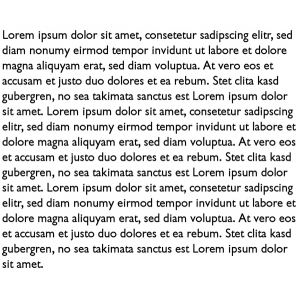
In publishing and graphic design, lorem ipsum is the name given to commonly used placeholder text (filler text) to demonstrate the graphic elements of a document or visual presentation, such as font, typography, and layout. The lorem ipsum text, which is typically a nonsensical list of semi-Latin words, is an edited version of a Latin text by Cicero, with words/letters omitted and others inserted, but not proper Latin
Even though using ‘lorem ipsum’ often arouses curiosity because of its resemblance to classical Latin, it is not intended to have meaning. Where text is visible in a document, people tend to focus on the textual content rather than upon overall presentation, so publishers use lorem ipsum when displaying a typeface or design elements and page layout in order to direct the focus to the publication style and not the meaning of the text.
Posted in Language, Money |
Leave a Comment »



