November 5, 2014


Cover your ass (CYA) describes activity, usually in a work-related or bureaucratic context, done by an individual to protect himself or herself from possible subsequent legal penalties or criticism. According to lexicographer William Safire, it describes the bureaucratic technique of ‘deflecting responsibility in advance,’ that is, diffusing responsibility for one’s actions as a form of insurance against possible negative repercussions. It can denote a type of institutional risk-averse mentality which works against accountability and responsibility, often characterized by excessive paperwork and documentation (red tape), which can be harmful to the institution’s overall effectiveness.
The activity, sometimes seen as instinctive, is generally unnecessary towards accomplishing the goals of the organization, but helpful to protect a particular individual’s career within it, and it can be seen as a type of institutional corruption working against individual initiative. In a slightly different sense, it can be used to describe rightful steps to protect oneself properly while in a difficult situation, such as what steps to take to protect oneself after being fired (due diligence).
read more »
Posted in Humor, Language, Politics |
Leave a Comment »
November 4, 2014

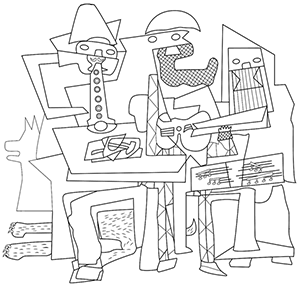
Commedia [kuh-mey-dee-uh] dell’arte [del-ahr-tee] is a form of improvisational theater that began in Italy in the 16th century. The actors often wore masks and the stories were often about the cunning pursuit of love, money, or simply food. The genre developed several stock characters that represent fixed social types, such as foolish old men, devious servants, or military officers full of false bravado including Harlequin (comic servant), Pantalone (rich old miser), Colombina (tricky slave wife), Pulcinella (disfigured trickster), Pierrot (unrequited clown), and Scaramuccia (roguish clown).
Stock characters can be divided into three groups, ‘Innamorati’ (‘The Lovers,’ who are never masked nor well developed as characters), ‘Vecchi’ (‘The Old People,’ often the Lovers’ parents, who get in the way of their romance), and ‘Zanni’ (‘The Servants/ Commoners,’ always hungry, and often responsible for the Lovers finding their way to the altar). Characters such as Pantalone, the Venetian merchant; Dottore Gratiano, the pedant from Bologna; or Arlecchino, the mischievous servant from Bergamo, began as satires on Italian ‘types’ and became the archetypes of many of the favorite characters of 17th- and 18th-century European theater.
read more »
Posted in Art, Humor, Language |
1 Comment »
October 31, 2014
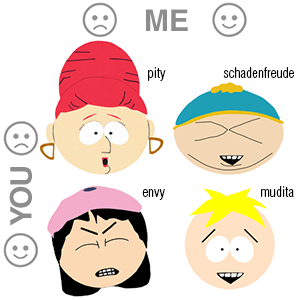
Muditā [moo-dee-tah] means ‘joy’ in sanskrit, especially sympathetic or vicarious joy. it is the pleasure that comes from delighting in other people’s well-being rather than begrudging it. The traditional paradigmatic example of this mind-state is the attitude of a parent observing a growing child’s successes, but it is not to be confounded with pride as the person feeling mudita must not have any interest or direct income from the accomplishments of the other. Its antonym is the German word ‘schadenfreude’ (‘pleasure derived from the misfortunes of others’).
Many Buddhist teachers interpret joy more broadly as an inner spring of infinite joy that is available to everyone at all times, regardless of circumstances. The more deeply one drinks of this spring, the more secure one becomes in one’s own abundant happiness, and the easier it then becomes to relish the joy of other people as well. Joy is also traditionally regarded as the most difficult to cultivate of the four immeasurables (the ‘four sublime attitudes’). To show joy is to celebrate happiness and achievement in others even when we are facing tragedy ourselves.
Posted in Language, Philosophy, World |
Leave a Comment »
October 28, 2014

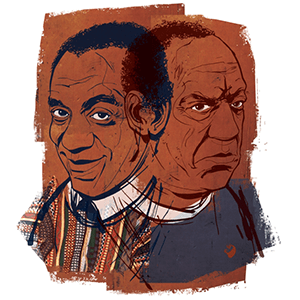
The ‘Pound Cake speech‘ was an address given by comedian Bill Cosby in May 2004 during an NAACP awards ceremony in Washington, D.C., to commemorate the 50th anniversary of the ‘Brown v. Board of Education Supreme Court’ decision which desegregated US schools. In it, Cosby was highly critical of members of subsets of the black community. He criticized the use of ebonics (African American Vernacular English), the prevalence of single-parent families, the emphasis on frivolous and conspicuous consumption at the expense of necessities, lack of responsibility, and other behaviors.
Cosby accused the African American community of treating people who had robbed convenience stores like political activists: ‘But these people, the ones up here in the balcony fought so hard. Looking at the incarcerated, these are not political criminals. These are people going around stealing Coca-Cola. People getting shot in the back of the head over a piece of pound cake! And then we all run out and are outraged, ‘The cops shouldn’t have shot him.’ What the hell was he doing with the pound cake in his hand? I wanted a piece of pound cake just as bad as anybody else, and I looked at it and I had no money. And something called parenting said, ‘If you get caught with it you’re going to embarrass your mother.’ Not ‘You’re going to get your butt kicked.’ No. ‘You’re going to embarrass your family.”
read more »
Posted in Language, Politics |
1 Comment »
October 23, 2014
‘There ain’t no such thing as a free lunch’ (TANSTAAFL) is a popular adage communicating the idea that it is impossible to get something for nothing. The phrase dates to the 1930s and 1940s, but its first appearance is unknown. The ‘free lunch’ in the saying refers to the nineteenth-century practice in American bars of offering a ‘free lunch’ in order to entice drinking customers.
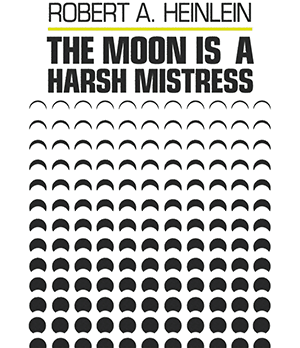
The phrase and the acronym are central to Robert Heinlein’s 1966 science-fiction novel ‘The Moon Is a Harsh Mistress,’ about the revolt of a lunar colony and the installation of a libertarian regime. Free-market economist Milton Friedman used it as the title of a 1975 book, and it is often mentioned in economics literature to describe opportunity cost (the value of the next best thing you give up whenever you make a decision). Macroeconomist Campbell McConnell writes that the idea is ‘at the core of economics.’
read more »
Posted in Language, Money, Science |
Leave a Comment »
October 21, 2014
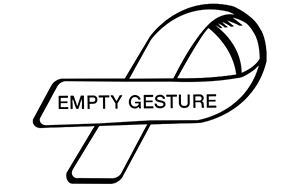

Handwaving is a pejorative label applied to the action of displaying the appearance of doing something, when actually doing little, or nothing. It is often used in working situations where results are expected, but no work is actually accomplished. Handwaving can be an idiomatic term, and it can also be a literal descriptive term for the use of excessive body language gestures that may be perceived as lacking productivity in communication or other effort. If the opponent in a debate uses the term, it is meant as a shorthand way to accuse the proponent of having committed an informal fallacy. In this sense, it is also as if a participant is waving their hands as to discourage an insect that is flying around their head, so are they waving away questions. The superlative expressions for the term, such as ‘vigorous handwaving’ or ‘furious handwaving,’ are used to imply that the handwaver lacks confidence in the information being conveyed, and cannot actually convey the essence or core of his argument.
Handwaving arguments often include order-of-magnitude estimates and dimensional analysis. Competent well-intentioned researchers and professors rely on handwaving when, given a limited time, a large result must be shown and minor technical details cannot be given much attention. ‘Back-of-the-envelope’ calculations are approximate ways to get an answer by over-simplification and are compatible with handwaving. By extension, handwaving is used in speculative fiction criticism to refer to a plot device (e.g., a scientific discovery, a political development, or rules governing the behavior of a fictional creature) that is left unexplained or sloppily explained because it is convenient to the story, with the implication that the writer is aware of the logical weakness but hopes the reader will not notice or will suspend disbelief. The fictional material ‘handwavium’ is sometimes referred to in situations where the solution requires access to a substance that is physically impossible to create as it defies physics but is convenient to solving a problem in the story.
Posted in Language, Politics |
Leave a Comment »
October 16, 2014
In fiction, a foil is a character who contrasts with another character (usually the protagonist) in order to highlight particular qualities in their counterpart (the term derives from the practice of backing gems with foil to increase their brilliance). In some cases, a subplot can be used as a foil to the main plot, particularly in metafiction (‘breaking the fourth wall’) and the ‘story within a story’ motif. A foil often differs drastically from the lead character, but can also be extremely similar, with only a key difference setting them apart. Foils generally serve one or more of three broad functions: contrast (‘this is different than X’), exclusion (‘this is not X’), or blame (‘X did this’).
In ‘Frankenstein,’ by Mary Shelley, the two main characters of Dr. Frankenstein and his ‘Adam of your Labors,’ his ‘creature,’ his ‘wretch,’ are both together literary foils. Both are hungry for knowledge, but whereas the doctor is selfish and arrogant, the monster is compassionate and gentle. In ‘Pride and Prejudice,’ Mary’s absorption in her studies places her as a foil to her sister Lydia Bennet’s lively and distracted nature. Similarly, in Shakespeare’s ‘Julius Caesar,’ the naive Brutus has foils in Cassius and Mark Antony, who are ambitious and experienced politicians.
Posted in Art, Language |
Leave a Comment »
October 6, 2014
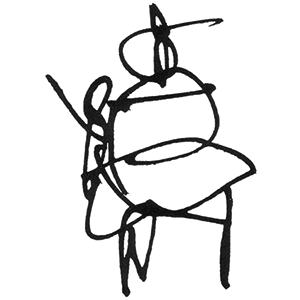
A sidekick is a close companion who is generally regarded as subordinate to the one he accompanies. Some well-known fictional sidekicks include Don Quixote’s Sancho Panza, Sherlock Holmes’ Doctor Watson, The Lone Ranger’s Tonto, and Batman’s Robin.
The origin of the term is unknown. It was originally ‘side kicker’ (as seen in the short stories of American writer O Henry), having grown from the 1850s term ‘side partner.’ Contrary to popular folk etymology, it is unrelated to the early-20th century British pickpocket slang ‘kick,’ referring to a trouser pocket. One of the earliest recorded sidekicks may be Enkidu, who adopted a sidekick role to Gilgamesh after they became allies in the ‘Epic of Gilgamesh’ (an epic poem from Mesopotamia). Other early examples include Achilles’ Patroclus from the ‘Iliad,’ and Moses’ Aaron from the Bible.
read more »
Posted in Art, Language |
Leave a Comment »
September 29, 2014

‘Under the Banner of Heaven: A Story of Violent Faith’ is a 2003 investigative nonfiction book by Jon Krakauer. It is a juxtaposition of two stories: the origin and evolution of The Church of Jesus Christ of Latter-day Saints (LDS Church), and a modern double murder committed in the name of God by brothers Ron and Dan Lafferty, who subscribed to a fundamentalist version of Mormonism.
The title is drawn from an 1880 address by John Taylor, the third president of the LDS Church, defending the practice of plural marriage: ‘God is greater than the United States, and when the Government conflicts with heaven, we will be ranged under the banner of heaven against the Government. The United States says we cannot marry more than one wife. God says different…’
read more »
Posted in Language, Philosophy, Politics |
Leave a Comment »
September 5, 2014
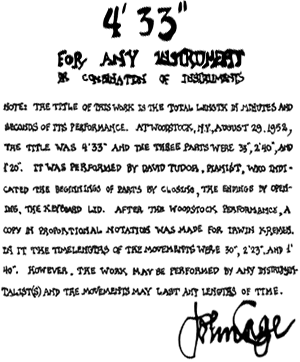
Silence is the lack of audible sound or presence of sounds of very low intensity. By analogy, the term also refers to an absence of communication, including in media other than speech. Silence is also used as ‘total communication,’ in reference to nonverbal communication and spiritual connection. It is an important factor in many cultural spectacles, as in rituals, both positive and negative. For example, in a Christian Methodist faith organization quiet reflection during a sermon might mean indicate assent, while in a Southern Baptist church, silence might mean disagreement with what is being said, or perhaps disconnectedness from the congregated community. A common way to remember a tragic incident is a commemorative moment of silence.
In discourse analysis, speakers use brief absences of speech to mark the boundaries of prosodic units (segments of speech that occurs with a single pitch and rhythm contour). Silence in speech can be hesitation, stutters, self-correction—or deliberate slowing of speech to clarify or aid processing of ideas. These are short silences; longer pauses in language occur in interactive roles, turn-taking, or reactive tokens (short utterance that indicate a listener is following a conversation).
read more »
Posted in Language, Philosophy, Science |
Leave a Comment »
September 4, 2014
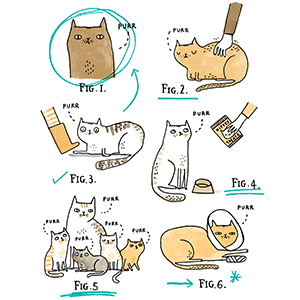
A purr is a continuous, soft, vibrating sound made in the throat by most species of felines. Domestic cat kittens can purr as early as two days of age. This tonal rumbling can characterize different personalities in domestic cats and is often believed to indicate a positive emotional state, however, felines sometimes purr when they are ill, tense, or experiencing traumatic or painful moments. Purring varies between cats (for example by loudness and tone), and from species to species, but can be characterized as a tonal buzzing.
The term ‘purring’ has been used liberally in literature, and it has been claimed that many non-cats including viverrids (civet, mongoose, genet), bears, badgers, and hyaenas purr. Others are reported to purr only at specific times, for example rabbits, squirrels, guinea pigs, tapirs, ring-tailed lemurs, elephants, raccoons and gorillas are claimed to purr while eating. However, using a strict definition of purring that continuous sound production must alternate between pulmonic egressive and ingressive airstream (breathing in and out) and usually go on for minutes, a 2002 study reached the conclusion that until then only ‘purring cats’ (Felidae) and two species of genets, Genetta tigrina, and most likely also Genetta genetta, had been documented to purr.
read more »
Posted in Health, Language, Science |
1 Comment »
August 29, 2014

The True Believer: Thoughts On The Nature Of Mass Movements is a 1951 social psychology book by American moral philosopher Eric Hoffer that discusses the psychological causes of fanaticism. The book analyzes and attempts to explain the motives of the various types of personalities that give rise to mass movements; why and how mass movements start, progress and end; and the similarities between them, whether religious, political, radical or reactionary.
Hoffer argues that even when their stated goals or values differ mass movements are interchangeable, that adherents will often flip from one movement to another, and that the motivations for mass movements are interchangeable. Thus, religious, nationalist, and social movements, whether radical or reactionary, tend to attract the same type of followers, behave in the same way and use the same tactics and rhetorical tools. As examples, the book often refers to Communism, Fascism, National Socialism, Christianity, Protestantism, and Islam.
read more »
Posted in Health, Language, Politics |
Leave a Comment »


 The Daily Omnivore