December 17, 2014

Louchébem [loo-shuh-behm] is Parisian and Lyonnaise butchers’ (French boucher) slang, similar to Pig Latin and Verlan. It originated in the mid-19th century and was in common use until the 1950s. Each word is transformed by moving the first consonant to the end; and suffixes such as -ème, -ji, -oc, -muche are added at the end; the letter ‘L’ is placed at the beginning of the new word. Note that spelling often becomes phoneticized.
Even today, Louchébem is still well-known and used among those working at point-of-sale in the meat retail industry. Some words have even leaked into common, everyday use by the masses; an example is the word ‘loufoque,’ meaning unsound of mind. In 1937, English novelist E.C. Bentley used the language as a plot point in his short story, ‘The Old-Fashioned Apache.’
Posted in Games, Language, World |
Leave a Comment »
December 16, 2014

Jargon [jahr-guhn], or term of art, is ‘the technical terminology or characteristic idiom of a special activity or group.’ The word ‘jargon’ is French and is believed to have been derived from the Latin ‘gaggire,’ meaning ‘to chatter,’ which was used to describe something in which the speaker did not understand.
An ‘industry term’ is jargon that is associated with one particular industry. Jargon is similar to slang, both are non-standard definitions often created by and for subcultures. It is also common for each generation to create their own jargon. Whether this is because they want to identify with each other and thus create a language of their own, or conversely, if they deliberately do not want to be understood by anybody else (e.g. texting slang used by teens to communicate messages their parents won’t be able to translate).
read more »
Posted in Language, Money, Technology |
Leave a Comment »
December 15, 2014

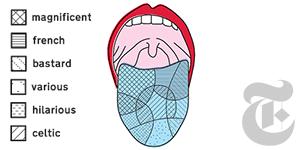
Creolization [kree-uh-lahy-zey-shuhn] is the process of two or more cultures mixing, as happened in in the Americas between people of indigenous, African, and European descent. Creolization is traditionally used to refer to the Caribbean but can be extended to represent other diasporas. The mixing of populations creates a cultural melting pot which ultimately leads to the formation of new identities. Creolization also is the mixing of the ‘old’ and ‘traditional,’ with the ‘new’ and ‘modern.’
Furthermore, creolization occurs when participants actively select cultural elements that may become part of or inherited culture. Social scientist Robin Cohen states that Creolization is a condition in which ‘the formation of new identities and inherited culture evolve to become different from those they possessed in the original cultures,’ and then creatively merge these to create new varieties that supersede the prior forms.
read more »
Posted in Language, Politics, World |
1 Comment »
December 12, 2014
Knocking on wood, or to touch wood, refers to the apotropaic tradition (a ritual intended to ward off evil) of literally touching, tapping, or knocking on wood, or merely stating that you are doing or intend same, in order to avoid ‘tempting fate’ after making a favorable observation, a boast, or declaration concerning one’s own death or other situation beyond one’s control. The origin of this may be in Germanic folklore, wherein dryads (forest spirits) are thought to live in trees, and can be invoked for protection.
In Italy, ‘tocca ferro’ (‘touch iron’) is used, especially after seeing an undertaker or something related to death. In Iran, ‘bezan be takhteh’ (‘knock on the wood’) is said. The ‘evil eye,’ and being jinxed are common phobias and superstitions in Iranian culture. In old English folklore, ‘knocking on wood’ also referred to when people spoke of secrets – they went into the isolated woods to talk privately and ‘knocked’ on the trees when they were talking to hide their communication from evil spirits who would be unable to hear when they knocked. Another version holds that the act of knocking was to perk up the spirits to make them work in the requester’s favor. Yet another version holds that a sect of Monks who wore large wooden crosses around their necks would tap or ‘knock’ on them to ward away evil.
Posted in Language, Philosophy, World |
Leave a Comment »
December 10, 2014
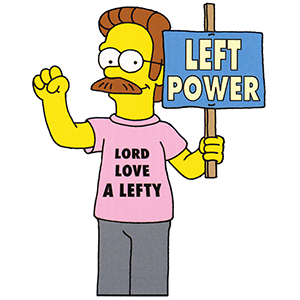
Handedness [han-did-nis] is a better (faster or more precise) performance or individual preference for use of a hand. It is not a discrete variable (right or left), but a continuous one that can be expressed at levels between strong left and strong right. While in an ordinary disclosure the terms left and right are used to define handedness, there are actually four types: left-handedness, right-handedness, mixed-handedness (favoring one hand for some tasks and the other hand for others), and ambidexterity (equally adept with both hands). Left-handedness is somewhat more common among men.
Global studies indicate that 10% of people are left-handed, 30% are mixed-handed, and the remainder are right-handed. Ambidexterity is exceptionally rare, although it can be learned. However, a truly ambidextrous person is able to do any task equally well with either hand, whereas those who learn it still tend to favor their originally dominant hand. Ambilevous or ambisinister people demonstrate awkwardness with both hands. Parkinson’s disease in particular is associated with a loss of dexterity.
read more »
Posted in Health, Language, Science |
Leave a Comment »
December 9, 2014

Lumpers and splitters are opposing factions in any discipline which has to place individual examples into rigorously defined categories. The lumper-splitter problem occurs when there is the need to create classifications and assign examples to them, for example schools of literature, biological taxa and so on. ‘Lumpers’ take a gestalt view (looking at the whole rather than the parts) and assign examples broadly, assuming that differences are not as important as signature similarities. ‘Splitters’ prefer precise definitions, and create new categories to classify things that don’t fit perfectly within an existing group.
The earliest use of these terms was by Charles Darwin, in a letter to botanist J. D. Hooker in 1857: ‘Those who make many species are the ‘splitters,’ and those who make few are the ‘lumpers.’ They were introduced more widely by paleontologist George G. Simpson in his 1945 work ‘The Principles of Classification and a Classification of Mammals.’ As he put it, ‘splitters make very small units – their critics say that if they can tell two animals apart, they place them in different genera … and if they cannot tell them apart, they place them in different species. … Lumpers make large units – their critics say that if a carnivore is neither a dog nor a bear, they call it a cat.’
read more »
Posted in Language, Philosophy, Science |
Leave a Comment »
December 4, 2014
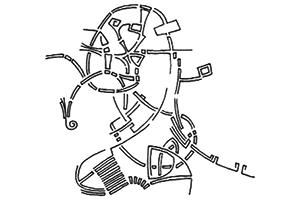
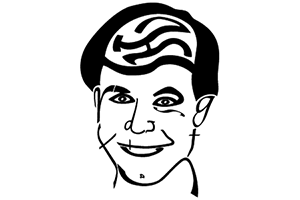
Metamagical [met-uh-maj-i-kuhl] Themas [thee-muhs] is an eclectic collection of articles that cognitive scientist Douglas Hofstadter wrote for ‘Scientific American’ during the early 1980s. The title is an anagram of Martin Gardner’s ‘Mathematical Games,’ the column that preceded Hofstadter’s. The anthology was published in 1985. Major themes include: self-reference in memes (ideas that spread within cultures), language, art and logic; discussions of philosophical issues important in cognitive science/AI; analogies and what makes something similar to something else (specifically what makes, for example, an uppercase letter ‘A’ recognizable as such); and lengthy discussions of the work of political scientist Robert Axelrod on the prisoner’s dilemma (a game theory problem).
There are three articles centered on the Lisp programming language, where Hofstadter first details the language itself, and then shows how it relates to Gödel’s incompleteness theorem. Two articles are devoted to Rubik’s Cube and other such puzzles. Many other topics are also mentioned, all in Hofstadter’s usual easy, approachable style. Many chapters open with an illustration of an extremely abstract alphabet, yet one which is still recognizable as such. The game of ‘Nomic’ (in which the rules of the game include mechanisms for the players to change those rules) was first introduced to the public in this column, in June 1982.
Posted in Language, Philosophy, Science |
1 Comment »
December 2, 2014
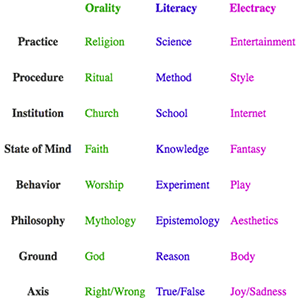

Electracy [ee-lek-truh-see] is a theory by Gregory Ulmer, a professor of English and electronic languages, that describes the skills necessary to access and utilize electronic media such as multimedia (audio, visual, and text), hypermedia (linked material), social networks, and virtual worlds. According to Ulmer, electracy ‘is to digital media what literacy is to print.’ However, ‘If literacy focused on universally valid methodologies of knowledge (sciences), electracy focuses on the individual state of mind within which knowing takes place (arts).’ It is his attempt to describe the transition from a culture of print literacy to a culture saturated with electronic media.
Ulmer sees this shift as a positive step, writing, ‘The near absence of art in contemporary schools is the electrate equivalent of the near absence of science in medieval schools for literacy. The suppression of empirical inquiry by religious dogmatism during the era sometimes called the ‘dark ages’ (reflecting the hostility of the oral apparatus to literacy), is paralleled today by the suppression of aesthetic play by empirical utilitarianism (reflecting the hostility of the literate apparatus to electracy). The ambivalent relation of the institutions of school and entertainment today echoes the ambivalence informing church-science relations throughout the era of literacy.’ He concludes that the sociological changes will be profound: ‘What literacy is to the analytical mind, electracy is to the affective body: a prosthesis that enhances and augments a natural or organic human potential. Alphabetic writing is an artificial memory that supports long complex chains of reasoning impossible to sustain within the organic mind. Digital imaging similarly supports extensive complexes of mood atmospheres beyond organic capacity.’
Posted in Language, Philosophy, Technology |
Leave a Comment »
November 23, 2014
To have ‘skin in the game’ is to have incurred monetary risk by being invested in achieving a goal. In the phrase, ‘skin’ is a synecdoche (a part that represents the whole) for the person involved, and ‘game’ is the metaphor for the actions on whatever field of play is at reference. The aphorism is common in finance, gambling, and politics. The origin of the phrase is unknown. It has been attributed to Warren Buffett since in Buffett’s first fund he raised $105,000 from 11 doctors, himself placing a token sum of $100.00 as his ‘skin in the game’ (though New York Times columnist William Safire dispelled the Buffett origin). Another possible explanation is that the phrase is derived from William Shakespeare’s ‘The Merchant of Venice’; in which a money lender demands a pound of actual flesh from a borrower should they default.
The term is used to ask or convey a principals undefined but significant equity stake in an investment vehicle where outside investors are solicited to invest. The theory is that principal’s equity contribution is directly related to the stability of the investment and confidence that management has in the venture and is also (falsely) strongly correlated to the expected yield of the investment. Research has shown that there tends to be a negative correlation between excess ‘skin’ and negative returns. The main issues is the principal–agent problem whereby transparency and fiduciary obligations are disregarded by principals who have capital or excess capital (skin) tied into an entity. Many banks and other financial institutions bar employees from having any ‘skin’ where client capital is managed, principally to address the issue of commingled funds. Hedge funds, private equity, Trusts, and Mutual funds are legally limited to a minority investment positions.
Posted in Language, Money |
Leave a Comment »
November 20, 2014
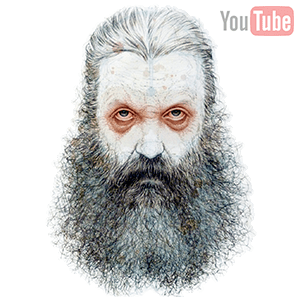
Alan Moore (b. 1953) is an English writer primarily known for his work in comic books including ‘Watchmen,’ ‘V for Vendetta,’ and ‘From Hell.’ Frequently described as the best graphic novel writer in history (though he prefers the term ‘comic’ to ‘graphic novel’), he has been called ‘one of the most important British writers of the last fifty years.’ He has occasionally used such pseudonyms as Curt Vile, Jill de Ray, and Translucia Baboon.
Moore is an occultist, ceremonial magician, and anarchist, and features such themes in his fiction, as well as performing avant-garde spoken word occult ‘workings’ with ‘The Moon and Serpent Grand Egyptian Theatre of Marvels,’ some of which have been released on CD. Despite his own personal objections, his books have provided the basis for a number of Hollywood films. He has stated that much of his work is designed to be ‘unfilmable’ to expose difference in the two mediums.
read more »
Posted in Art, Language |
1 Comment »
November 17, 2014
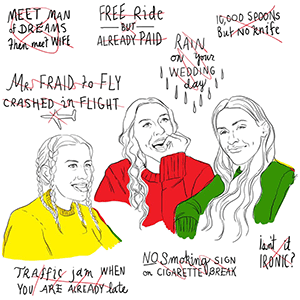
Irony is when something happens that is opposite from what is expected. In literature, it is sometimes used for comedic effect, but it is also used in tragedies. There are many types of irony, such as ‘dramatic irony’ (when the audience knows something is going to happen on stage that the characters on stage do not), ‘Socratic irony’ (when a teacher feigns ignorance to his students), ‘cosmic irony’ (when something that everyone thinks will happen actually happens very differently — as opposed to ‘situational irony’ that only affects a small group or individual), ‘verbal irony’ (an absence of expression and intention or the use of sarcasm), and ‘ironic fate’ (misfortune as the result of fate or chance).
The word ‘irony’ comes from Ancient Greek (‘eironeia’: ‘dissimulation, feigned ignorance’), in specific terms it is a rhetorical device, literary technique, or event characterized by an incongruity, or contrast, between what the expectations of a situation are and what is really the case, with a third element, that defines that what is really the case is ironic because of the situation that led to it. Verbal, dramatic, and situational irony are often used to underscore the assertion of a truth. The ironic form of simile, used in sarcasm, and some forms of litotes (understatement used to emphasize a point by denying the opposite) can highlight one’s meaning by the deliberate use of language which states the opposite of the truth, denies the contrary of the truth, or drastically and obviously understates a factual connection.
read more »
Posted in Art, Humor, Language |
1 Comment »
November 14, 2014


The curse of knowledge is a cognitive bias that leads better-informed parties to find it extremely difficult to think about problems from the perspective of lesser-informed parties. It is related to public policy engineer Baruch Fischhoff’s work on the hindsight bias (the knew-it-all-along effect). In economics the bias is studied to understand why the assumption that better informed agents can accurately anticipate the judgments of lesser informed agents is not inherently true, as well as to support the finding that sales agents who are better informed about their products may, in fact, be at a disadvantage against other, less-informed agents. It is believed that better informed agents fail to ignore the privileged knowledge that they possess, thus ‘cursed’ and unable to sell their products at a value that more naïve agents would deem acceptable.
In one experiment, one group of subjects ‘tapped’ a well-known song on a table while another listened and tried to identify the song. Some ‘tappers’ described a rich sensory experience in their minds as they tapped out the melody. Tappers on average estimated that 50% of listeners would identify the specific tune; in reality only 2.5% of listeners could. Related to this finding is the phenomenon experienced by players of charades: The actor may find it frustratingly hard to believe that his or her teammates keep failing to guess the secret phrase, known only to the actor, conveyed by pantomime.
Posted in Education, Language, Money |
Leave a Comment »



